Are you gearing up for an interview for a Insulation Board Back Tender position? Whether you’re a seasoned professional or just stepping into the role, understanding what’s expected can make all the difference. In this blog, we dive deep into the essential interview questions for Insulation Board Back Tender and break down the key responsibilities of the role. By exploring these insights, you’ll gain a clearer picture of what employers are looking for and how you can stand out. Read on to equip yourself with the knowledge and confidence needed to ace your next interview and land your dream job!
Acing the interview is crucial, but landing one requires a compelling resume that gets you noticed. Crafting a professional document that highlights your skills and experience is the first step toward interview success. ResumeGemini can help you build a standout resume that gets you called in for that dream job.






Essential Interview Questions For Insulation Board Back Tender
1. What are the key responsibilities of an Insulation Board Back Tender?
As an Insulation Board Back Tender, I am responsible for the following tasks:
- Assisting with the preparation and setup of insulation boards for installation
- Measuring and cutting insulation boards to the required dimensions
- Applying adhesive to insulation boards and adhering them to the back of drywall or other surfaces
- Ensuring that insulation boards are installed securely and in accordance with specifications
- Cleaning up the work area and disposing of waste materials safely
2. What safety precautions should be taken when working with insulation boards?
General Safety Precautions:
- Wearing appropriate personal protective equipment (PPE), including gloves, safety glasses, and a dust mask
- Using sharp tools carefully and storing them properly
- Following proper lifting techniques to avoid injuries
- Maintaining a clean and organized work area
Material-Specific Precautions:
- Avoiding contact with skin and eyes, as fiberglass insulation can cause irritation
- Using a dust mask to prevent inhalation of insulation fibers
- Handling insulation boards carefully to avoid breakage
3. What are the different types of insulation boards available and their applications?
There are several types of insulation boards, each with its unique properties and applications:
- Fiberglass insulation boards: Made of glass fibers, these boards are lightweight, cost-effective, and have good thermal insulation properties. They are commonly used in residential and commercial buildings.
- Polystyrene insulation boards: Made of expanded or extruded polystyrene, these boards are lightweight, moisture-resistant, and provide good thermal insulation. They are often used in exterior applications, such as wall insulation and roofing.
- Polyurethane insulation boards: Made of rigid polyurethane foam, these boards have excellent thermal insulation properties and are moisture-resistant. They are commonly used in commercial and industrial buildings.
- Mineral wool insulation boards: Made of melted rock or glass, these boards are fire-resistant, have good sound absorption properties, and provide thermal insulation. They are often used in commercial and industrial buildings.
4. What are the advantages and disadvantages of using insulation boards?
Advantages:
- Improved thermal insulation, reducing energy consumption for heating and cooling
- Reduced noise levels, creating a quieter living or working environment
- Moisture resistance, protecting against mold and mildew growth
- Fire resistance, enhancing safety in case of a fire
- Lightweight and easy to install, saving time and labor costs
Disadvantages:
- Can be more expensive than other insulation materials
- Requires proper installation techniques to ensure effectiveness
- Some types of insulation boards may require additional coatings or treatments for moisture resistance
5. What are the common challenges faced by Insulation Board Back Tenders and how do you overcome them?
Some common challenges faced by Insulation Board Back Tenders include:
- Working in confined spaces: I overcome this by using proper body mechanics, taking breaks as needed, and communicating with coworkers for assistance.
- Handling heavy materials: I use proper lifting techniques, wear appropriate PPE, and request help from coworkers when necessary.
- Exposure to dust and insulation fibers: I wear a dust mask and follow proper safety protocols to minimize exposure.
- Time constraints: I prioritize tasks effectively, work efficiently, and communicate any delays or challenges to my supervisor.
- Working in various weather conditions: I wear appropriate clothing for the weather and take necessary precautions to stay safe, such as staying hydrated and avoiding overexertion in extreme temperatures.
6. How do you ensure the quality of your work as an Insulation Board Back Tender?
To ensure the quality of my work, I follow these practices:
- Attention to detail: I take care to measure and cut insulation boards accurately, apply adhesive evenly, and secure them firmly.
- Regular inspections: I inspect my work throughout the process to identify and correct any errors promptly.
- Adherence to specifications: I follow established guidelines and specifications to ensure that insulation boards are installed correctly and meet industry standards.
- Feedback from colleagues: I seek feedback from my supervisor and coworkers to identify areas for improvement.
7. What are the latest advancements in insulation board technology that you are aware of?
I am aware of the following advancements in insulation board technology:
- Vacuum insulation panels (VIPs): These panels use a vacuum-sealed core to achieve exceptional thermal insulation values.
- Aerogel insulation boards: Made from a lightweight, porous material, these boards provide superior thermal insulation and are also fire-resistant.
- Bio-based insulation boards: These boards are made from renewable materials, such as hemp or wood fibers, offering sustainable insulation options.
- Smart insulation boards: These boards incorporate sensors and controls to monitor temperature and humidity levels, allowing for optimized energy efficiency.
8. How do you stay updated on the latest insulation board products and techniques?
I stay updated on the latest insulation board products and techniques through the following methods:
- Industry publications and websites: I read trade magazines and visit industry-specific websites to learn about new products and best practices.
- Conferences and workshops: I attend industry conferences and workshops to hear from experts and learn about new advancements.
- Online courses and webinars: I take online courses and participate in webinars offered by manufacturers and industry organizations.
- Networking with peers: I connect with other Insulation Board Back Tenders and professionals in the field to exchange knowledge and learn from their experiences.
9. What is your approach to teamwork and collaboration in a busy work environment?
In a busy work environment, I approach teamwork and collaboration as follows:
- Communication: I communicate clearly and effectively with my team members, keeping them informed about my progress and any challenges I encounter.
- Support: I provide support to my team members when needed, assisting them with tasks and sharing my knowledge.
- Flexibility: I am flexible and adaptable, willing to adjust my schedule or tasks to accommodate the needs of the team.
- Respect: I treat my team members with respect and value their contributions, regardless of their position or experience level.
10. How do you handle working under pressure and meeting tight deadlines?
To handle working under pressure and meeting tight deadlines, I employ the following strategies:
- Time management: I prioritize tasks and allocate my time effectively to ensure that I meet deadlines without compromising quality.
- Focus and concentration: I maintain focus and concentration on the task at hand, minimizing distractions and interruptions.
- Delegation: When necessary, I delegate tasks to others to ensure that all deadlines are met.
- Communication: I communicate any potential delays or challenges to my supervisor early on, allowing for adjustments to be made if needed.
- Adaptability: I am adaptable and can adjust my approach to meet changing circumstances and project demands.
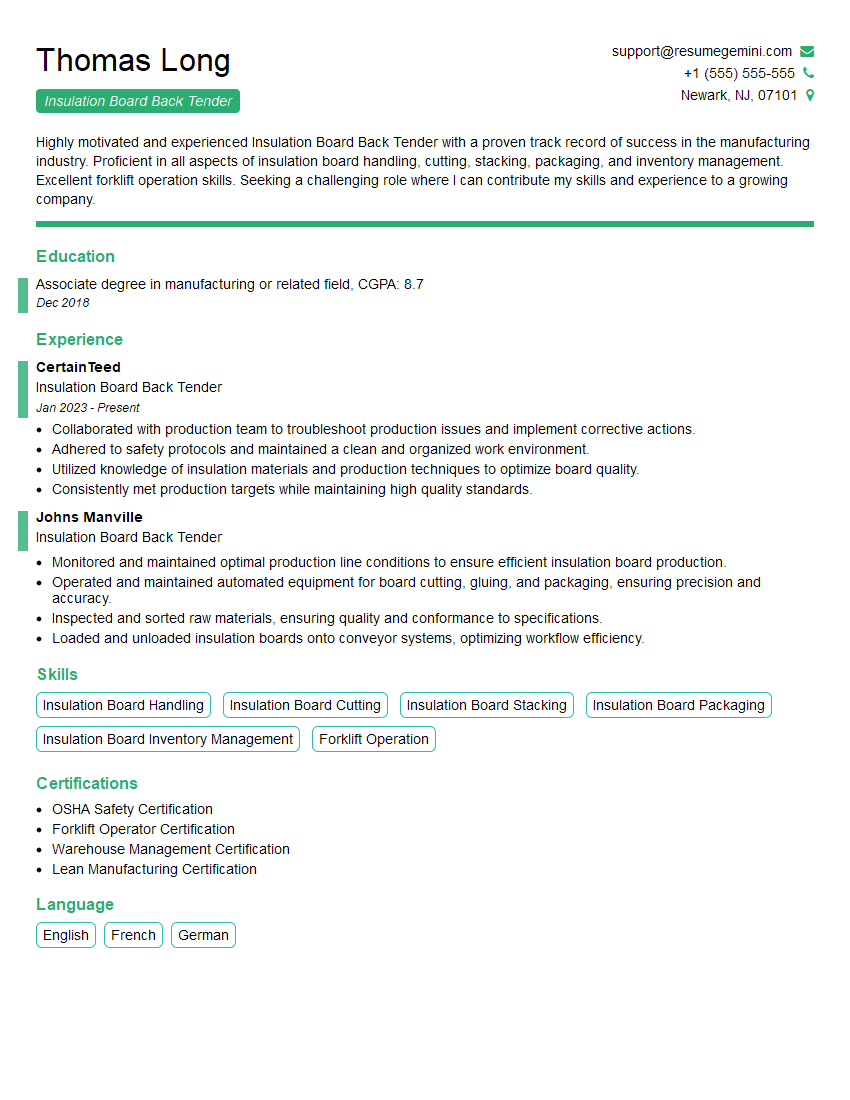
Interviewers often ask about specific skills and experiences. With ResumeGemini‘s customizable templates, you can tailor your resume to showcase the skills most relevant to the position, making a powerful first impression. Also check out Resume Template specially tailored for Insulation Board Back Tender.
Career Expert Tips:
- Ace those interviews! Prepare effectively by reviewing the Top 50 Most Common Interview Questions on ResumeGemini.
- Navigate your job search with confidence! Explore a wide range of Career Tips on ResumeGemini. Learn about common challenges and recommendations to overcome them.
- Craft the perfect resume! Master the Art of Resume Writing with ResumeGemini’s guide. Showcase your unique qualifications and achievements effectively.
- Great Savings With New Year Deals and Discounts! In 2025, boost your job search and build your dream resume with ResumeGemini’s ATS optimized templates.
Researching the company and tailoring your answers is essential. Once you have a clear understanding of the Insulation Board Back Tender‘s requirements, you can use ResumeGemini to adjust your resume to perfectly match the job description.
Key Job Responsibilities
Insulation Board Back Tenders play a crucial role in the production of insulation boards, ensuring their quality and efficiency. Their primary responsibilities include the following:
1. Operation of Machinery
They are responsible for operating and monitoring various machines involved in the production process, such as mixers, presses, and conveyors.
- Mixing and preparing raw materials according to specified formulations
- Loading raw materials into the press and operating it to form the insulation boards
2. Quality Control
They perform ongoing quality checks throughout the production process to ensure that the insulation boards meet the required specifications.
- Checking the thickness, density, and dimensions of the boards
- Identifying and correcting any defects or variations in the boards
3. Material Handling
They are involved in the handling of raw materials, finished boards, and scrap materials, ensuring their proper storage and transportation.
- Unloading raw materials from incoming trucks and storing them appropriately
- Packaging and loading finished insulation boards onto outgoing trucks
4. Maintenance and Cleaning
They are responsible for maintaining and cleaning the equipment and work area, ensuring a safe and efficient working environment.
- Cleaning and lubricating machines regularly
- Notifying maintenance personnel of any issues or malfunctions
Interview Tips
To ace an interview for the position of Insulation Board Back Tender, candidates should consider the following tips:
1. Research the Company and Position
Familiarize yourself with the company’s history, mission, and current projects. Research the specific responsibilities of the Back Tender position and how it aligns with your skills and experience.
2. Highlight Relevant Skills and Experience
Emphasize your experience and qualifications that directly relate to the job requirements. Showcase your abilities in operating machinery, performing quality control checks, and handling materials.
3. Demonstrate Safety Awareness
Insulation board production involves working with heavy machinery and hazardous materials. Highlight your understanding of safety protocols and your commitment to maintaining a safe work environment.
4. Practice Common Interview Questions
Prepare for common interview questions, such as “Tell me about yourself” and “Why are you interested in this position?” Practice your answers thoughtfully and concisely.
5. Ask Thoughtful Questions
At the end of the interview, ask insightful questions about the company, the position, or the industry. This demonstrates your enthusiasm and interest in the role.
Next Step:
Armed with this knowledge, you’re now well-equipped to tackle the Insulation Board Back Tender interview with confidence. Remember, a well-crafted resume is your first impression. Take the time to tailor your resume to highlight your relevant skills and experiences. And don’t forget to practice your answers to common interview questions. With a little preparation, you’ll be on your way to landing your dream job. So what are you waiting for? Start building your resume and start applying! Build an amazing resume with ResumeGemini.