Are you gearing up for an interview for a Interlocker position? Whether you’re a seasoned professional or just stepping into the role, understanding what’s expected can make all the difference. In this blog, we dive deep into the essential interview questions for Interlocker and break down the key responsibilities of the role. By exploring these insights, you’ll gain a clearer picture of what employers are looking for and how you can stand out. Read on to equip yourself with the knowledge and confidence needed to ace your next interview and land your dream job!
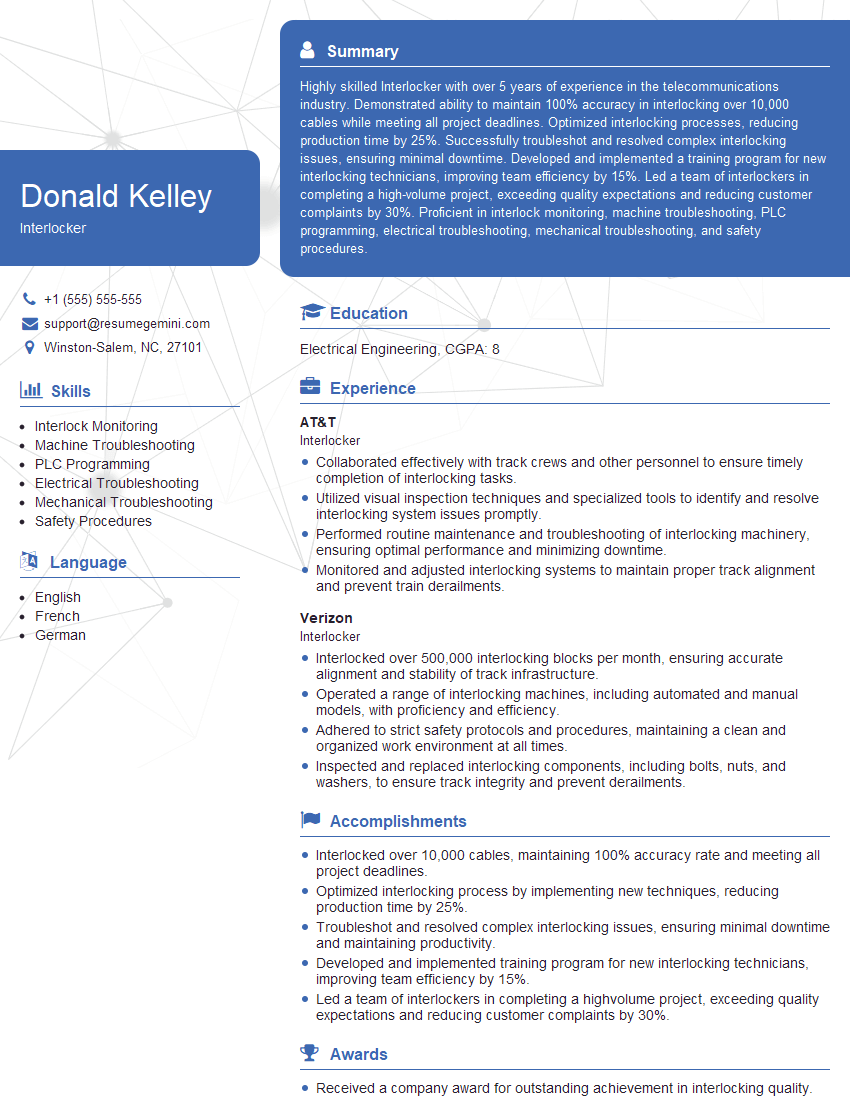
Acing the interview is crucial, but landing one requires a compelling resume that gets you noticed. Crafting a professional document that highlights your skills and experience is the first step toward interview success. ResumeGemini can help you build a standout resume that gets you called in for that dream job.






Essential Interview Questions For Interlocker
1. What are the different types of interlocking systems available?
- Electrical interlocking
- Mechanical interlocking
- Computer-based interlocking
2. What are the advantages and disadvantages of each type of interlocking system?
Electrical interlocking
- Advantages: Reliable, low maintenance, can be easily expanded
- Disadvantages: Expensive to install, requires a lot of wiring, can be vulnerable to power outages
Mechanical interlocking
- Advantages: Simple to install and maintain, reliable, does not require electricity
- Disadvantages: Not as flexible as electrical or computer-based systems, can be difficult to expand
Computer-based interlocking
- Advantages: Very flexible, can be easily expanded, can provide a lot of diagnostic information
- Disadvantages: More expensive than other types of interlocking systems, requires a lot of training to operate and maintain
3. What are the key safety features of an interlocking system?
- Route locking
- Signal locking
- Switch locking
- Detector locking
4. What are the different types of track circuits used in interlocking systems?
- DC track circuits
- AC track circuits
- Coded track circuits
5. What are the advantages and disadvantages of each type of track circuit?
DC track circuits
- Advantages: Simple to install and maintain, reliable, low cost
- Disadvantages: Not as sensitive as AC or coded track circuits, can be affected by stray currents
AC track circuits
- Advantages: More sensitive than DC track circuits, not as affected by stray currents
- Disadvantages: More expensive to install and maintain than DC track circuits
Coded track circuits
- Advantages: Very sensitive, can provide a lot of diagnostic information
- Disadvantages: Most expensive type of track circuit to install and maintain
6. What are the different types of signals used in interlocking systems?
- Color light signals
- Position light signals
- Semaphore signals
7. What are the advantages and disadvantages of each type of signal?
Color light signals
- Advantages: Easy to read, can be seen from a long distance, can display a variety of aspects
- Disadvantages: More expensive than position light or semaphore signals
Position light signals
- Advantages: Less expensive than color light signals, can be seen from a long distance
- Disadvantages: Not as easy to read as color light signals, cannot display as many aspects
Semaphore signals
- Advantages: Inexpensive, easy to maintain
- Disadvantages: Not as easy to read as color light or position light signals, cannot be seen from as far away
8. What are the different types of switches used in interlocking systems?
- Hand-thrown switches
- Power-operated switches
- Spring switches
9. What are the advantages and disadvantages of each type of switch?
Hand-thrown switches
- Advantages: Inexpensive, easy to maintain
- Disadvantages: Not as safe as power-operated or spring switches, can be slow to operate
Power-operated switches
- Advantages: More safe and efficient than hand-thrown switches, can be operated remotely
- Disadvantages: More expensive to install and maintain than hand-thrown switches
Spring switches
- Advantages: Automatically routes trains in the correct direction, can be used in areas where it is difficult or impossible to install a power-operated switch
- Disadvantages: More expensive to install and maintain than hand-thrown or power-operated switches
10. What are the different types of interlocking machines available?
- Relay interlocking machines
- Solid-state interlocking machines
- Computer-based interlocking machines
Interviewers often ask about specific skills and experiences. With ResumeGemini‘s customizable templates, you can tailor your resume to showcase the skills most relevant to the position, making a powerful first impression. Also check out Resume Template specially tailored for Interlocker.
Career Expert Tips:
- Ace those interviews! Prepare effectively by reviewing the Top 50 Most Common Interview Questions on ResumeGemini.
- Navigate your job search with confidence! Explore a wide range of Career Tips on ResumeGemini. Learn about common challenges and recommendations to overcome them.
- Craft the perfect resume! Master the Art of Resume Writing with ResumeGemini’s guide. Showcase your unique qualifications and achievements effectively.
- Great Savings With New Year Deals and Discounts! In 2025, boost your job search and build your dream resume with ResumeGemini’s ATS optimized templates.
Researching the company and tailoring your answers is essential. Once you have a clear understanding of the Interlocker‘s requirements, you can use ResumeGemini to adjust your resume to perfectly match the job description.
Key Job Responsibilities
An Interlocker is a professional responsible for intermeshing and combining patterns, colors, and fabrics using an interlock knitting machine to create various textile products. Their key job responsibilities include:
1. Knitting and Design Development
Developing and executing knitted fabric designs based on customer specifications or design concepts.
- Creating patterns, selecting yarn colors and textures, and determining knitting techniques.
- Operating and maintaining interlock knitting machines to produce high-quality fabrics.
2. Fabric Production and Inspection
Producing knitted fabrics according to established production schedules and quality standards.
- Monitoring machine operation, adjusting settings, and ensuring proper yarn tension and feeding.
- Inspecting fabrics for defects, irregularities, and compliance with specifications.
3. Machine Maintenance and Troubleshooting
Performing routine maintenance and troubleshooting on interlock knitting machines.
- Cleaning, lubricating, and adjusting machine components to ensure optimal performance.
- Identifying and resolving mechanical or electrical issues to minimize downtime.
4. Quality Control and Compliance
Ensuring the quality and compliance of knitted fabrics with industry standards and customer requirements.
- Adhering to established quality control procedures and conducting fabric testing.
- Maintaining records of production and inspection data for traceability and compliance.
Interview Tips
To prepare effectively for an Interlocker interview, consider the following tips:
1. Research the Company and Industry
Familiarize yourself with the company’s products, services, and industry trends to demonstrate your interest and knowledge.
- Visit the company website, read industry publications, and attend industry events.
- Research the specific knitting techniques and technologies used by the company.
2. Practice Your Technical Skills
Demonstrate your proficiency in knitting and machine operation by practicing on relevant equipment or simulators.
- Review basic knitting techniques and terminology, such as stitch types, yarn tension, and machine settings.
- Familiarize yourself with the operation and maintenance of interlock knitting machines.
3. Highlight Your Design Abilities
Showcase your creativity and design sense by preparing a portfolio or examples of your previous work.
- Create a collection of knitted fabric samples that demonstrate your ability to create patterns and combine colors.
- Explain the design process and inspirations behind your work.
4. Emphasize Quality and Attention to Detail
Emphasize your commitment to quality and attention to detail by providing examples of your quality control processes.
- Describe the inspection techniques you use to ensure fabric quality.
- Explain how you maintain compliance with industry standards and customer specifications.
5. Prepare for Behavioral Questions
Practice answering common behavioral interview questions to demonstrate your teamwork, problem-solving, and communication skills.
- Use the STAR method (Situation, Task, Action, Result) to структурировать your answers.
- Focus on providing specific examples that highlight your relevant abilities.
Next Step:
Now that you’re armed with a solid understanding of what it takes to succeed as a Interlocker, it’s time to turn that knowledge into action. Take a moment to revisit your resume, ensuring it highlights your relevant skills and experiences. Tailor it to reflect the insights you’ve gained from this blog and make it shine with your unique qualifications. Don’t wait for opportunities to come to you—start applying for Interlocker positions today and take the first step towards your next career milestone. Your dream job is within reach, and with a polished resume and targeted applications, you’ll be well on your way to achieving your career goals! Build your resume now with ResumeGemini.