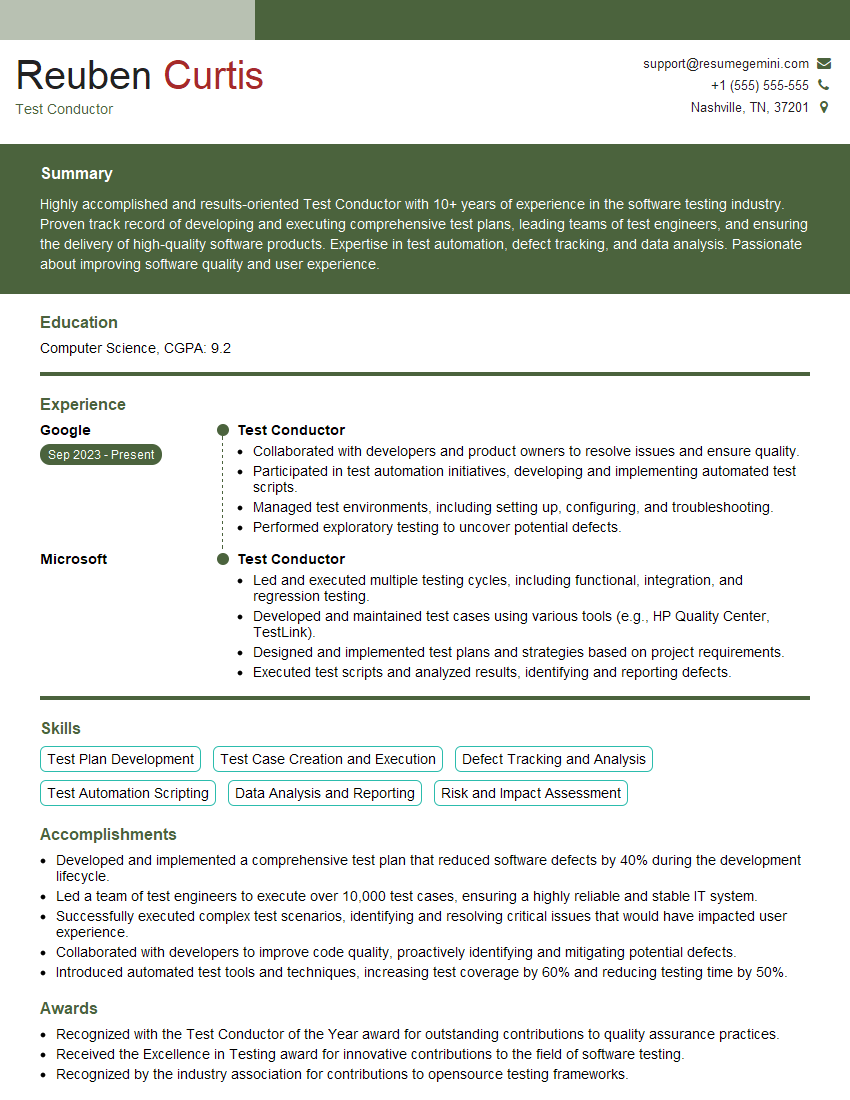
Are you gearing up for a career shift or aiming to ace your next interview? Look no further! We’ve curated a comprehensive guide to help you crack the interview for the coveted Test Conductor position. From understanding the key responsibilities to mastering the most commonly asked questions, this blog has you covered. So, buckle up and let’s embark on this journey together.
Acing the interview is crucial, but landing one requires a compelling resume that gets you noticed. Crafting a professional document that highlights your skills and experience is the first step toward interview success. ResumeGemini can help you build a standout resume that gets you called in for that dream job.






Essential Interview Questions For Test Conductor
1. Explain the process of creating a new test case in your preferred test management tool.
In my previous role, I used Jira as our test management tool. To create a new test case in Jira, I would follow these steps:
- Navigate to the “Projects” tab and select the project for which I wanted to create a test case.
- Click on the “Create” button and select “Test Case” from the drop-down menu.
- In the “New Test Case” dialog box, I would enter the following details:
- Test case name
- Test case description
- Test case steps
- Expected results
- Test case priority
- Test case type (e.g., functional, performance, regression)
- Once I had entered all the necessary details, I would click on the “Create” button to save the test case.
2. How do you prioritize test cases?
Factors to consider:
- Risk
- Impact
- Urgency
- Effort
Prioritization methods:
- MoSCoW method
- Risk-based prioritization
- Impact analysis
3. What is your approach to test case design?
My approach to test case design is to first understand the requirements of the software under test. I then use a variety of test design techniques to create test cases that will effectively test the software’s functionality. These techniques include:
- Black-box testing
- White-box testing
- Boundary value analysis
- Equivalence partitioning
- State transition testing
4. How do you handle test case defects?
When I encounter a test case defect, I follow these steps:
- Verify the defect to ensure that it is valid.
- Reproduce the defect to gather more information about its cause.
- Report the defect to the development team.
- Follow up with the development team to ensure that the defect has been fixed.
- Retest the software to verify that the defect has been fixed.
5. What is your experience with test automation?
I have experience with test automation using Selenium WebDriver. I have used Selenium to automate web-based applications for both functional and performance testing. I am also familiar with other test automation tools such as JMeter and SoapUI.
6. What are some of the challenges you have faced as a Test Conductor?
Some of the challenges I have faced as a Test Conductor include:
- Managing large and complex testing projects
- Coordinating with multiple stakeholders
- Ensuring that test cases are executed effectively and efficiently
- Staying up-to-date on the latest testing tools and technologies
7. What are your strengths as a Test Conductor?
My strengths as a Test Conductor include:
- Excellent communication and interpersonal skills
- Strong technical skills
- Experience with a variety of testing tools and technologies
- Ability to work independently and as part of a team
- Commitment to quality and customer satisfaction
8. What are your goals for your career as a Test Conductor?
My goals for my career as a Test Conductor include:
- Becoming a recognized expert in the field of software testing
- Leading and managing large and complex testing projects
- Developing and implementing innovative testing strategies
- Mentoring and training other testers
9. What is your experience with agile testing?
I have experience with agile testing in both Scrum and Kanban environments. I am familiar with the agile testing principles and practices, such as test-driven development, continuous integration, and automated testing. I have also used agile testing tools such as Jira and Zephyr.
10. What are your thoughts on the future of software testing?
I believe that the future of software testing is bright. As software becomes more complex and critical, the need for effective testing will only increase. I expect to see continued growth in the use of test automation, AI, and machine learning in the testing process. I also believe that the role of the tester will become more strategic, as testers are increasingly involved in the early stages of the software development process.
Interviewers often ask about specific skills and experiences. With ResumeGemini‘s customizable templates, you can tailor your resume to showcase the skills most relevant to the position, making a powerful first impression. Also check out Resume Template specially tailored for Test Conductor.
Career Expert Tips:
- Ace those interviews! Prepare effectively by reviewing the Top 50 Most Common Interview Questions on ResumeGemini.
- Navigate your job search with confidence! Explore a wide range of Career Tips on ResumeGemini. Learn about common challenges and recommendations to overcome them.
- Craft the perfect resume! Master the Art of Resume Writing with ResumeGemini’s guide. Showcase your unique qualifications and achievements effectively.
- Great Savings With New Year Deals and Discounts! In 2025, boost your job search and build your dream resume with ResumeGemini’s ATS optimized templates.
Researching the company and tailoring your answers is essential. Once you have a clear understanding of the Test Conductor‘s requirements, you can use ResumeGemini to adjust your resume to perfectly match the job description.
Key Job Responsibilities
Test Conductors are professionals responsible for creating, executing, and managing test plans and ensuring the quality of software products. Their core responsibilities encompass various aspects of software testing, including planning, execution, analysis, and reporting.
1. Test Planning and Management
Plan and develop comprehensive test strategies, including test cases, test scripts, and test environments
- Define test scope, objectives, and timelines
- Identify and prioritize test requirements
2. Test Execution and Analysis
Execute test plans and monitor test progress
- Track and manage test execution
- Analyze test results and identify defects
3. Reporting and Communication
Prepare and deliver test reports to stakeholders
- Present test findings and recommendations
- Communicate with development teams and management
4. Tool Proficiency
Proficient in using various testing tools and technologies
- Test management tools (e.g., Jira, TestRail)
- Defect tracking tools (e.g., Bugzilla, Asana)
Interview Tips
Preparing for a Test Conductor interview requires a thorough understanding of the role and its responsibilities. Here are some tips to help you succeed:
1. Research the Company and Position
Research the company’s products, industry, and culture. Understand the specific requirements of the Test Conductor position and how your skills align with them.
- Identify the company’s software development process and testing methodologies
- Familiarize yourself with the company’s products and their target audience
2. Highlight Your Technical Skills
Demonstrate your proficiency in test planning, execution, and analysis techniques. Provide specific examples of your experience using testing tools and technologies.
- Describe your experience in creating and executing test plans
- Share examples of how you identified and resolved software defects
3. Emphasize Your Communication and Reporting Skills
Test Conductors need to effectively communicate with developers, managers, and other stakeholders. Highlight your ability to present test findings and recommendations clearly and concisely.
- Provide examples of how you communicated test results to technical and non-technical audiences
- Explain how you used data analysis and visualization techniques to present your findings
4. Prepare for Behavioral Questions
Interviewers will often ask behavioral questions to assess your problem-solving, teamwork, and communication skills.
- Use the STAR method (Situation, Task, Action, Result) to structure your answers
- Provide specific examples that demonstrate your ability to work independently and as part of a team
5. Practice and Seek Feedback
Practice answering common interview questions and seek feedback from others. This will help you improve your delivery and increase your confidence.
- Conduct mock interviews with friends or colleagues
- Record yourself answering questions and review your performance
Next Step:
Now that you’re armed with a solid understanding of what it takes to succeed as a Test Conductor, it’s time to turn that knowledge into action. Take a moment to revisit your resume, ensuring it highlights your relevant skills and experiences. Tailor it to reflect the insights you’ve gained from this blog and make it shine with your unique qualifications. Don’t wait for opportunities to come to you—start applying for Test Conductor positions today and take the first step towards your next career milestone. Your dream job is within reach, and with a polished resume and targeted applications, you’ll be well on your way to achieving your career goals! Build your resume now with ResumeGemini.