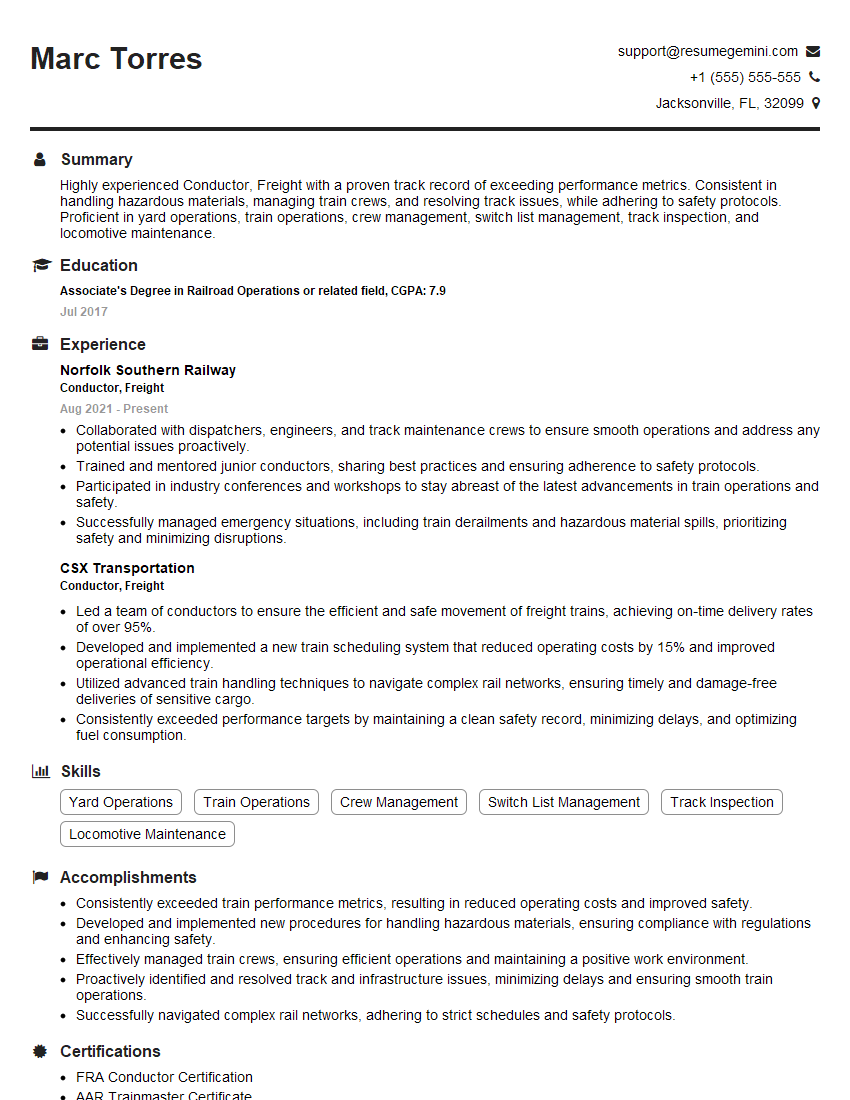
Are you gearing up for an interview for a Conductor, Freight position? Whether you’re a seasoned professional or just stepping into the role, understanding what’s expected can make all the difference. In this blog, we dive deep into the essential interview questions for Conductor, Freight and break down the key responsibilities of the role. By exploring these insights, you’ll gain a clearer picture of what employers are looking for and how you can stand out. Read on to equip yourself with the knowledge and confidence needed to ace your next interview and land your dream job!
Acing the interview is crucial, but landing one requires a compelling resume that gets you noticed. Crafting a professional document that highlights your skills and experience is the first step toward interview success. ResumeGemini can help you build a standout resume that gets you called in for that dream job.






Essential Interview Questions For Conductor, Freight
1. What are the primary responsibilities of a Conductor, Freight?
As a Conductor, Freight, I would be responsible for:
- Supervising the movement of freight trains to ensure safe and efficient transportation.
- Communicating with dispatchers and engineers to coordinate train operations.
- Inspecting trains to ensure they are properly assembled and loaded.
- Monitoring train performance and identifying any potential issues.
- Managing and directing crew members, including engineers, brakemen, and flagmen.
2. How do you handle unexpected delays or disruptions during freight operations?
Prioritizing Safety
- Ensuring the safety of the crew, passengers, and cargo is paramount.
- Immediately assessing the situation and determining the appropriate course of action.
Communicating Effectively
- Providing clear and timely updates to dispatchers, supervisors, and relevant parties.
- Coordinating with other departments, such as maintenance or engineering, to resolve the issue.
Problem-Solving
- Analyzing the situation to identify the root cause of the delay or disruption.
- Developing and implementing contingency plans to minimize the impact on operations.
3. What are the key regulations and safety protocols that must be followed by Conductors, Freight?
- Federal Railroad Administration (FRA) regulations and rules.
- Company-specific operating procedures and safety policies.
- Industry best practices and standards.
- Compliance with hazardous materials transportation regulations.
- Emergency response procedures, including accident reporting and evacuation protocols.
4. How do you ensure the proper maintenance and inspection of freight trains?
- Conducting regular visual inspections of trains, including locomotives, cars, and cargo.
- Working with maintenance personnel to identify and address any mechanical issues.
- Ensuring that all safety equipment, such as brakes, lights, and communication systems, is in good working order.
- Maintaining records of inspections and repairs for regulatory compliance and safety management.
5. What technologies do you use to enhance freight operations and ensure efficiency?
- Train control systems, such as positive train control (PTC), to ensure safe and efficient train movement.
- GPS tracking and monitoring systems to track train location and performance.
- Automated inspection technologies to improve equipment reliability and reduce maintenance costs.
- Data analytics to identify areas for improvement in operations and safety.
- Communication systems, including radios and mobile devices, to facilitate crew coordination and situational awareness.
6. How do you communicate effectively with crew members and other stakeholders?
- Using clear and concise language both in verbal and written communication.
- Active listening and feedback to ensure understanding and avoid misunderstandings.
- Building strong relationships with crew members to foster teamwork and cooperation.
- Maintaining open communication channels with dispatchers, supervisors, and other departments.
7. How do you prioritize safety in all aspects of freight operations?
- Adhering strictly to established safety protocols and regulations.
- Conducting thorough risk assessments and implementing appropriate mitigation measures.
- Promoting a culture of safety awareness among crew members.
- Continuously monitoring operations to identify and address potential hazards.
- Participating in safety training and development programs to stay up-to-date on best practices.
8. Describe your experience in managing and supervising freight train crews.
- Providing clear instructions and ensuring crew members understand their roles and responsibilities.
- Coordinating crew activities and monitoring performance to ensure efficient operations.
- Addressing crew concerns and providing support to maintain a positive and productive work environment.
- Enforcing safety regulations and protocols to maintain a safe working environment.
- Recognizing and rewarding crew members for exceptional performance.
9. How do you ensure compliance with environmental regulations in freight transportation?
- Following established environmental guidelines and protocols.
- Properly handling and disposing of hazardous materials.
- Reducing fuel consumption and emissions through eco-friendly operating practices.
- Collaborating with environmental agencies and industry groups to stay informed about new regulations and best practices.
10. What are your strengths and weaknesses as a Conductor, Freight?
Strengths
- Thorough knowledge of freight railroad operations and regulations.
- Excellent communication and interpersonal skills.
- Proven ability to lead and motivate crew members.
- Strong problem-solving and decision-making abilities.
- Commitment to safety and compliance.
Weaknesses
- Limited experience in managing large-scale freight operations.
- Need to further develop proficiency in advanced train control systems.
Interviewers often ask about specific skills and experiences. With ResumeGemini‘s customizable templates, you can tailor your resume to showcase the skills most relevant to the position, making a powerful first impression. Also check out Resume Template specially tailored for Conductor, Freight.
Career Expert Tips:
- Ace those interviews! Prepare effectively by reviewing the Top 50 Most Common Interview Questions on ResumeGemini.
- Navigate your job search with confidence! Explore a wide range of Career Tips on ResumeGemini. Learn about common challenges and recommendations to overcome them.
- Craft the perfect resume! Master the Art of Resume Writing with ResumeGemini’s guide. Showcase your unique qualifications and achievements effectively.
- Great Savings With New Year Deals and Discounts! In 2025, boost your job search and build your dream resume with ResumeGemini’s ATS optimized templates.
Researching the company and tailoring your answers is essential. Once you have a clear understanding of the Conductor, Freight‘s requirements, you can use ResumeGemini to adjust your resume to perfectly match the job description.
Key Job Responsibilities
Conductors, Freight are responsible for the safe and efficient movement of freight trains. They work closely with engineers and other crew members to ensure that trains are operated in accordance with established procedures and regulations.
1. Operate Locomotives
Conductors, Freight operate locomotives to move freight trains. They must be able to control the locomotive’s speed and direction, and they must be able to operate the locomotive’s brakes and other equipment.
- Control the speed and direction of the locomotive
- Operate the locomotive’s brakes and other equipment
- Monitor the locomotive’s gauges and instruments
- Troubleshoot and repair minor locomotive problems
2. Manage Train Crews
Conductors, Freight are responsible for managing train crews. They must assign tasks to crew members, and they must ensure that crew members are following established procedures and regulations.
- Assign tasks to crew members
- Ensure that crew members are following established procedures and regulations
- Train and develop crew members
- Maintain a positive and productive work environment
3. Communicate with Dispatchers and Other Employees
Conductors, Freight must communicate with dispatchers and other employees to ensure that trains are operated in accordance with established procedures and regulations. They must be able to receive and transmit information clearly and concisely.
- Receive and transmit information clearly and concisely
- Communicate with dispatchers to receive train orders and instructions
- Communicate with other employees to coordinate train movements
4. Inspect Trains and Equipment
Conductors, Freight must inspect trains and equipment to ensure that they are safe and in good working order. They must be able to identify and report any problems that they find.
- Inspect trains and equipment to ensure that they are safe and in good working order
- Identify and report any problems that they find
- Maintain a log of inspections and repairs
Interview Tips
Preparing for an interview can be daunting, but there are some simple tips you can follow to increase your chances of success. Here are a few tips to help you ace your interview for a Conductor, Freight position:
1. Research the Company and the Position
Before you go to the interview, take some time to research the company and the position. This will help you to understand the company’s culture and values, as well as the specific requirements of the position. You can research the company’s website, read articles about the company in the news, and talk to people who work for the company.
- Visit the company’s website to learn about their history, mission, and values.
- Read articles about the company in the news to get an idea of their recent activities and accomplishments.
- Talk to people who work for the company to get their insights on the company culture and the position you’re applying for.
2. Practice Answering Common Interview Questions
There are some common interview questions that you are likely to be asked, such as “Tell me about yourself” or “Why are you interested in this position?” It is helpful to practice answering these questions in advance so that you can deliver your answers confidently and concisely.
- Practice answering common interview questions in front of a mirror or with a friend or family member.
- Tailor your answers to the specific position you’re applying for.
- Be prepared to talk about your skills and experience, and how they relate to the requirements of the position.
3. Dress Professionally
First impressions matter, so it is important to dress professionally for your interview. This means wearing clothes that are clean, pressed, and appropriate for the work environment. You should also avoid wearing clothes that are too revealing or too casual.
- Wear a suit or dress that is clean, pressed, and appropriate for the work environment.
- Avoid wearing clothes that are too revealing or too casual.
- Make sure your shoes are clean and polished.
4. Be Punctual
Punctuality shows that you are respectful of the interviewer’s time. Arrive for your interview on time, or even a few minutes early. If you are running late, call the interviewer to let them know.
- Arrive for your interview on time, or even a few minutes early.
- If you are running late, call the interviewer to let them know.
5. Be Yourself
The most important thing is to be yourself during the interview. The interviewer wants to get to know the real you, so don’t try to be someone you’re not. Be honest and authentic, and let your personality shine through.
- Be honest and authentic during the interview.
- Let your personality shine through.
- Be yourself and don’t try to be someone you’re not.
Next Step:
Now that you’re armed with a solid understanding of what it takes to succeed as a Conductor, Freight, it’s time to turn that knowledge into action. Take a moment to revisit your resume, ensuring it highlights your relevant skills and experiences. Tailor it to reflect the insights you’ve gained from this blog and make it shine with your unique qualifications. Don’t wait for opportunities to come to you—start applying for Conductor, Freight positions today and take the first step towards your next career milestone. Your dream job is within reach, and with a polished resume and targeted applications, you’ll be well on your way to achieving your career goals! Build your resume now with ResumeGemini.