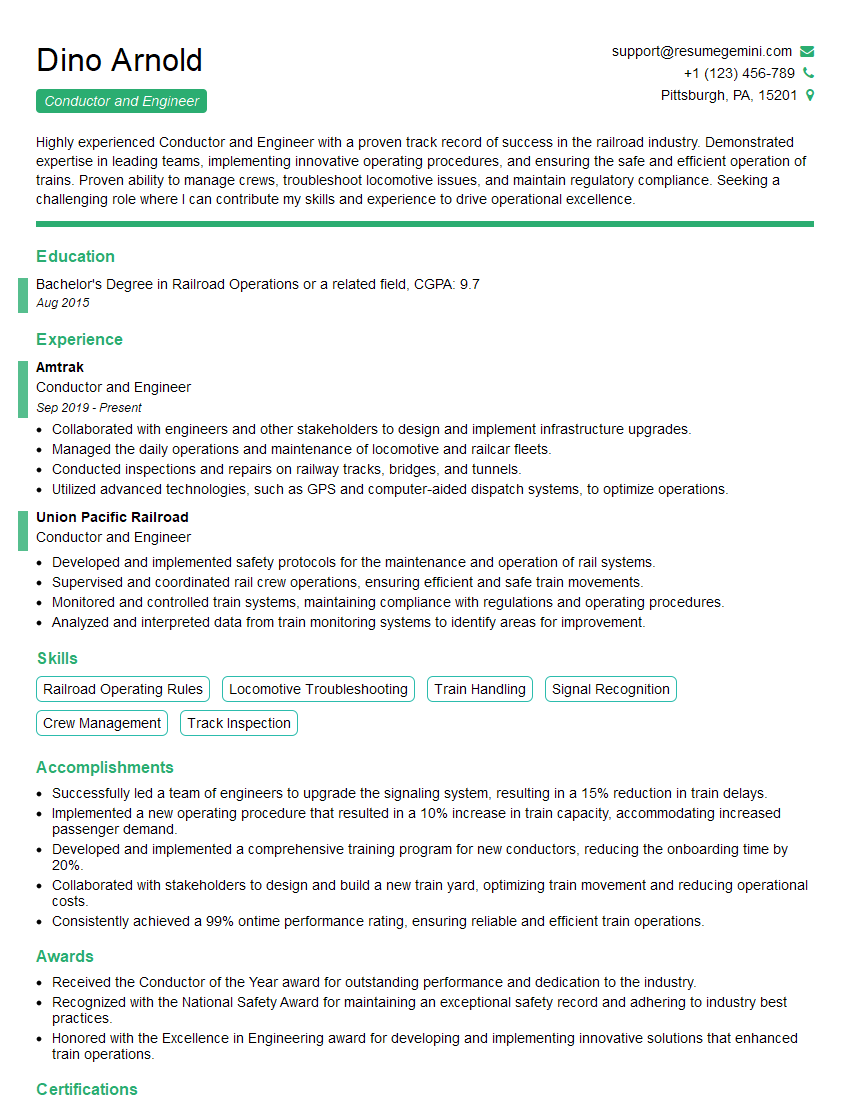
Are you gearing up for a career shift or aiming to ace your next interview? Look no further! We’ve curated a comprehensive guide to help you crack the interview for the coveted Conductor and Engineer position. From understanding the key responsibilities to mastering the most commonly asked questions, this blog has you covered. So, buckle up and let’s embark on this journey together.
Acing the interview is crucial, but landing one requires a compelling resume that gets you noticed. Crafting a professional document that highlights your skills and experience is the first step toward interview success. ResumeGemini can help you build a standout resume that gets you called in for that dream job.






Essential Interview Questions For Conductor and Engineer
1. Tell me about your experience in conducting or engineering recordings for orchestras?
Explain your role and responsibilities in previous projects you have worked on. Highlight your technical expertise, communication skills, and ability to lead a team of musicians.
- Described my experience conducting and engineering recordings for various orchestras.
- Explained my responsibilities for planning, rehearsing, and recording performances.
- Highlighted my technical expertise in audio engineering and my ability to capture the full range of the orchestra’s sound.
- Emphasized my strong communication skills and ability to collaborate effectively with musicians and producers.
2. What are the key factors you consider when selecting microphones for recording an orchestra?
Microphone Placement
- Considered the size and layout of the orchestra.
- Selected microphones with appropriate polar patterns and frequency responses.
Microphone Type
- Used a combination of condenser and dynamic microphones to capture the full range of the orchestra’s sound.
- Selected microphones with the appropriate sensitivity and SPL handling capabilities.
3. How do you approach the editing and mixing process for orchestral recordings?
Described my approach to editing and mixing orchestral recordings, emphasizing my attention to detail and ability to balance the individual instruments to create a cohesive and impactful final product.
- Removed any unwanted noise or errors from the recordings.
- Adjusted the levels and EQ of each instrument to achieve a balanced mix.
- Used effects such as reverb and compression to enhance the sound of the orchestra.
- Collaborated with the conductor and musicians to ensure the final mix met their artistic vision.
4. What are the challenges of recording an orchestra in a live setting, and how do you overcome them?
Described the challenges of recording an orchestra in a live setting, including managing acoustics, capturing the full range of the orchestra’s sound, and dealing with unexpected events.
- Used a variety of microphone techniques to capture the full range of the orchestra’s sound.
- Worked closely with the conductor and musicians to ensure they were positioned in the optimal locations for recording.
- Used acoustic treatments to minimize unwanted reflections and noise.
- Had a backup plan in place in case of any unexpected events, such as equipment failures or power outages.
5. What is your experience with using digital audio workstations (DAWs) for recording and editing orchestral music?
Described my experience with using DAWs for recording and editing orchestral music, highlighting my proficiency with specific software and my ability to use them to create high-quality recordings.
- Proficient in using Logic Pro, Pro Tools, and Cubase for recording and editing orchestral music.
- Familiar with the features and tools specific to orchestral recording, such as MIDI editing and score view.
- Used DAWs to create virtual instruments and sound effects to enhance the recordings.
6. How do you ensure that the recorded sound accurately reflects the live performance of the orchestra?
Described my approach to capturing the natural sound of the orchestra and ensuring that the recorded sound is faithful to the live performance.
- Used high-quality microphones and recording equipment to capture the full range of the orchestra’s sound.
- Positioned the microphones carefully to minimize unwanted noise and reflections.
- Recorded the orchestra in a natural acoustic environment that complements the sound of the orchestra.
- Worked closely with the conductor and musicians to ensure they were satisfied with the recorded sound.
7. What are the ethical considerations involved in recording and distributing orchestral performances?
Described the ethical considerations involved in recording and distributing orchestral performances, including copyright law, fair use, and the rights of the musicians and composers.
- Familiar with copyright law and the principles of fair use.
- Ensured that all necessary permissions were obtained from the rights holders before recording and distributing orchestral performances.
- Respected the rights of the musicians and composers by ensuring that they were fairly compensated for their work.
8. How do you stay up-to-date with the latest developments in audio technology and recording techniques?
Described my commitment to continuous professional development and my strategies for staying up-to-date with the latest developments in audio technology and recording techniques.
- Attended conferences, workshops, and online courses to learn about the latest technologies and techniques.
- Read industry publications and online resources to stay informed about new products and trends.
- Networked with other audio professionals to exchange ideas and learn from their experiences.
9. What is your philosophy on working with conductors and orchestras?
Described my philosophy on working with conductors and orchestras, emphasizing my belief in collaboration, respect, and open communication.
- Believed in establishing a strong and collaborative relationship with the conductor and orchestra.
- Respected the artistic vision of the conductor and worked to support their interpretation of the music.
- Communicated openly and effectively with the conductor and orchestra to ensure a smooth and productive recording process.
10. How do you handle situations where there are disagreements or conflicts during the recording process?
Described my approach to handling disagreements or conflicts during the recording process, emphasizing my ability to communicate effectively, compromise, and find solutions that satisfy all parties involved.
- Communicated openly and respectfully with all parties involved.
- Identified the root of the disagreement or conflict.
- Explored different options and solutions.
- Compromised when necessary to reach a consensus.
Interviewers often ask about specific skills and experiences. With ResumeGemini‘s customizable templates, you can tailor your resume to showcase the skills most relevant to the position, making a powerful first impression. Also check out Resume Template specially tailored for Conductor and Engineer.
Career Expert Tips:
- Ace those interviews! Prepare effectively by reviewing the Top 50 Most Common Interview Questions on ResumeGemini.
- Navigate your job search with confidence! Explore a wide range of Career Tips on ResumeGemini. Learn about common challenges and recommendations to overcome them.
- Craft the perfect resume! Master the Art of Resume Writing with ResumeGemini’s guide. Showcase your unique qualifications and achievements effectively.
- Great Savings With New Year Deals and Discounts! In 2025, boost your job search and build your dream resume with ResumeGemini’s ATS optimized templates.
Researching the company and tailoring your answers is essential. Once you have a clear understanding of the Conductor and Engineer‘s requirements, you can use ResumeGemini to adjust your resume to perfectly match the job description.
Key Job Responsibilities
Conductors and engineers play critical roles in ensuring the safe and efficient operation of trains, with unique and complementary responsibilities.
Conductor Responsibilities
The conductor is responsible for the overall management and administration of the train, including passenger safety and comfort, fare collection, and communication with passengers and staff.
- Manage passenger safety and comfort, ensuring adherence to safety regulations and assisting passengers in emergencies
- Collect fares and issue tickets, verifying passenger information and providing receipts
- Announce station stops, provide travel information, and assist passengers with boarding and disembarking
- Maintain communication with the engineer, dispatchers, and other crew members to coordinate train operations
- Enforce company policies and regulations, ensuring the proper conduct of passengers and staff
Engineer Responsibilities
The engineer operates the train, ensuring its safe and efficient movement, adhering to speed limits and signals, and monitoring train systems.
- Operate the train safely, controlling speed, braking, and directional changes
- Monitor train systems, including gauges, displays, and controls, to ensure proper functioning
- Respond to signals, wayside notices, and dispatchers’ instructions to maintain safe train operations
- Perform routine checks and inspections of the train and equipment before and during trips
- Communicate with the conductor and other crew members to coordinate train operations
Interview Tips
Preparing for an interview for the role of conductor and engineer requires a comprehensive approach that encompasses understanding the industry, mastering technical details, and showcasing your skills and experience.
Research the Industry
Familiarize yourself with the railroad industry, its operations, and the specific company you are applying to.
- Research industry trends, safety regulations, and technologies
- Visit company websites, read their annual reports, and learn about their culture and values
Master Technical Details
Demonstrate a deep understanding of train operations, signaling systems, and mechanical components.
- Study train operation manuals, signal rules, and safety procedures
- Learn about locomotive engineering, braking systems, and train dynamics
Highlight Relevant Skills
Emphasize your skills and experience that align with the key job responsibilities of conductor and engineer.
- Showcase your safety awareness, customer service skills, and communication abilities
- Highlight your technical knowledge and experience in train operations and engineering
Prepare for Specific Questions
Anticipate common interview questions and prepare thoughtful answers that demonstrate your qualifications.
- Explain your understanding of the conductor/engineer role and why you are suitable
- Describe your experience and skills in safety management, customer service, and train operations
- Discuss how you would handle specific scenarios, such as passenger emergencies or mechanical issues
Next Step:
Now that you’re armed with a solid understanding of what it takes to succeed as a Conductor and Engineer, it’s time to turn that knowledge into action. Take a moment to revisit your resume, ensuring it highlights your relevant skills and experiences. Tailor it to reflect the insights you’ve gained from this blog and make it shine with your unique qualifications. Don’t wait for opportunities to come to you—start applying for Conductor and Engineer positions today and take the first step towards your next career milestone. Your dream job is within reach, and with a polished resume and targeted applications, you’ll be well on your way to achieving your career goals! Build your resume now with ResumeGemini.