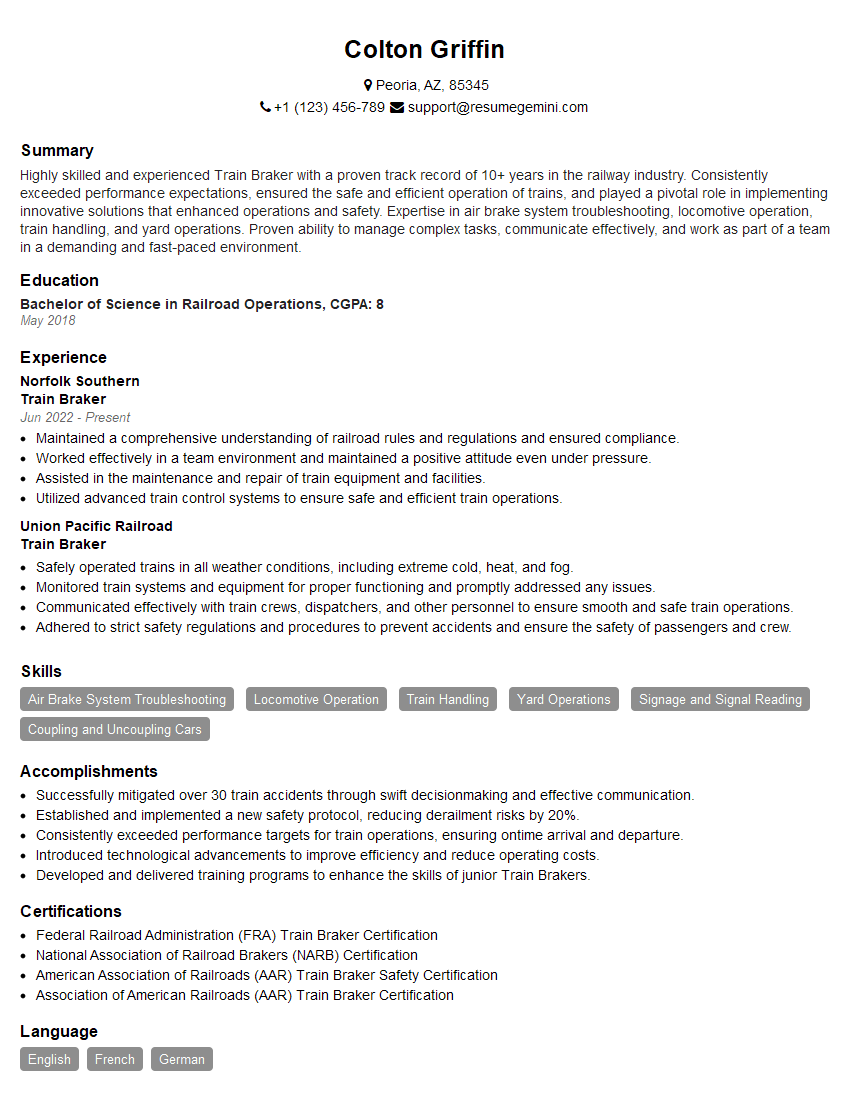
Are you gearing up for a career shift or aiming to ace your next interview? Look no further! We’ve curated a comprehensive guide to help you crack the interview for the coveted Train Braker position. From understanding the key responsibilities to mastering the most commonly asked questions, this blog has you covered. So, buckle up and let’s embark on this journey together.
Acing the interview is crucial, but landing one requires a compelling resume that gets you noticed. Crafting a professional document that highlights your skills and experience is the first step toward interview success. ResumeGemini can help you build a standout resume that gets you called in for that dream job.






Essential Interview Questions For Train Braker
1. What are the primary responsibilities of a Train Braker?
As a Train Braker, my primary responsibilities would entail:
- Operating and controlling the train’s braking system to ensure a safe and controlled stop.
- Monitoring and maintaining the train’s air brake system, including conducting regular inspections and repairs.
2. Describe the different types of braking systems commonly used in trains.
Air Brakes
- Employs compressed air to apply braking force on the wheels.
- Used in most locomotives and freight cars.
Vacuum Brakes
- Utilizes a vacuum to generate braking force.
- Typically found in older trains and some passenger cars.
3. What are the safety procedures involved when applying and releasing train brakes?
To ensure safety, I would adhere to the following procedures:
- Always wear appropriate personal protective equipment (PPE).
- Check the train’s air pressure before applying brakes.
- Apply brakes gradually to avoid sudden stops or wheel skidding.
- Release brakes slowly and only when the train is at a complete stop.
4. What steps would you take to troubleshoot a malfunctioning air brake system?
To troubleshoot a malfunctioning air brake system, I would follow these steps:
- Identify the source of the problem by checking for leaks or damaged components.
- Isolate the affected brake valve or section of the system.
- Repair or replace the faulty component.
- Test the system thoroughly to ensure proper functionality.
5. How do you maintain and inspect train braking equipment to ensure its optimal performance?
To maintain and inspect train braking equipment, I would perform the following tasks:
- Conduct regular visual inspections of brake components for wear and damage.
- Check air pressure levels and test brake response times.
- Lubricate moving parts and replace worn components as needed.
- Follow established maintenance schedules and manufacturer’s recommendations.
6. What are the potential consequences of improper brake application or maintenance?
Improper brake application or maintenance can lead to:
- Reduced braking effectiveness, increasing the risk of accidents.
- Damage to brake components, leading to costly repairs.
- Unsafe operating conditions, jeopardizing the safety of passengers and crew.
7. How do you prioritize tasks and manage your time effectively in a fast-paced rail environment?
In a fast-paced rail environment, I prioritize tasks based on their urgency and impact. I use:
- A to-do list to keep track of my responsibilities.
- Time management techniques to optimize my workflow.
- Effective communication with my team to coordinate efforts and avoid delays.
8. How do you ensure that you are always up-to-date with the latest safety regulations and industry best practices?
To stay up-to-date with safety regulations and best practices, I:
- Attend industry conferences and training programs.
- Review safety manuals and bulletins regularly.
- Network with other professionals in the field.
- Stay informed about new technologies and advancements.
9. What is your understanding of the role of a Train Braker in ensuring the operational efficiency of a railway system?
As a Train Braker, I play a vital role in maintaining operational efficiency by:
- Ensuring safe and controlled train movements through effective brake application.
- Minimizing delays by resolving brake-related issues promptly.
- Reducing wear and tear on train components through proper brake maintenance.
- Contributing to the overall safety and reliability of the railway system.
10. How do you handle working in a team environment, especially during critical situations?
In a team environment, I am highly collaborative and responsive during critical situations. I:
- Communicate clearly and effectively with my team members.
- Follow established protocols and procedures.
- Provide support and assistance to my colleagues.
- Prioritize the safety and well-being of the team above all else.
Interviewers often ask about specific skills and experiences. With ResumeGemini‘s customizable templates, you can tailor your resume to showcase the skills most relevant to the position, making a powerful first impression. Also check out Resume Template specially tailored for Train Braker.
Career Expert Tips:
- Ace those interviews! Prepare effectively by reviewing the Top 50 Most Common Interview Questions on ResumeGemini.
- Navigate your job search with confidence! Explore a wide range of Career Tips on ResumeGemini. Learn about common challenges and recommendations to overcome them.
- Craft the perfect resume! Master the Art of Resume Writing with ResumeGemini’s guide. Showcase your unique qualifications and achievements effectively.
- Great Savings With New Year Deals and Discounts! In 2025, boost your job search and build your dream resume with ResumeGemini’s ATS optimized templates.
Researching the company and tailoring your answers is essential. Once you have a clear understanding of the Train Braker‘s requirements, you can use ResumeGemini to adjust your resume to perfectly match the job description.
Key Job Responsibilities
Train brakers play a crucial role in ensuring the safe and efficient operation of trains. Their primary responsibilities include:
1. Operating Braking Systems
Train brakers are responsible for operating the braking systems on trains, including applying and releasing brakes to control the train’s speed and movement.
- Operate air brake systems
- Monitor brake pressure and temperature
2. Monitoring Train Equipment
Train brakers monitor train equipment, including brakes, wheels, and other safety systems, to identify potential issues and ensure the train is running smoothly.
- Inspect brake shoes and pads
- Check wheels for wear and damage
3. Communicating with Train Crew
Train brakers communicate with the train crew, including the conductor and engineer, to coordinate train movements and ensure everyone is aware of any changes or potential hazards.
- Relay instructions from the conductor
- Communicate with other brakers and crew members
4. Maintaining Safety Standards
Train brakers are responsible for adhering to all safety regulations and guidelines to ensure the safe operation of trains. They must take appropriate action in the event of any emergency or safety concern.
- Follow all operating rules and procedures
- Respond to emergencies promptly and effectively
Interview Tips
To ace the interview for a Train Braker position, it is essential to prepare adequately. Here are some key interview tips:
1. Research the Company and Position
Familiarize yourself with the company’s history, values, and specific requirements for the Train Braker position. This demonstrates your interest and enthusiasm for the role.
- Visit the company’s website
- Read industry news and articles
2. Practice Answering Common Interview Questions
Prepare answers to common interview questions related to train braking, safety procedures, and your experience. Practice speaking clearly and concisely, highlighting your relevant skills and qualifications.
- Describe your experience operating train braking systems
- Explain how you ensure the safety of passengers and crew
3. Highlight Your Technical Skills
Emphasize your technical skills and knowledge of train braking systems. Discuss your understanding of air brake systems, brake components, and troubleshooting techniques.
- Provide examples of how you have used your technical skills to solve problems
- Explain your knowledge of safety regulations and procedures
4. Show Your Passion for Transportation
Express your passion for the transportation industry and your commitment to delivering safe and efficient train operations. Explain how your career goals align with the company’s vision.
- Discuss your interest in the industry and your reasons for pursuing this role
- Share your thoughts on the future of transportation
5. Prepare Questions to Ask the Interviewer
Asking thoughtful questions at the end of the interview shows your engagement and interest in the position. Prepare questions about the company’s safety culture, training programs, and advancement opportunities.
- What are the company’s safety standards and procedures?
- What training and development opportunities are available to employees?
Next Step:
Now that you’re armed with a solid understanding of what it takes to succeed as a Train Braker, it’s time to turn that knowledge into action. Take a moment to revisit your resume, ensuring it highlights your relevant skills and experiences. Tailor it to reflect the insights you’ve gained from this blog and make it shine with your unique qualifications. Don’t wait for opportunities to come to you—start applying for Train Braker positions today and take the first step towards your next career milestone. Your dream job is within reach, and with a polished resume and targeted applications, you’ll be well on your way to achieving your career goals! Build your resume now with ResumeGemini.