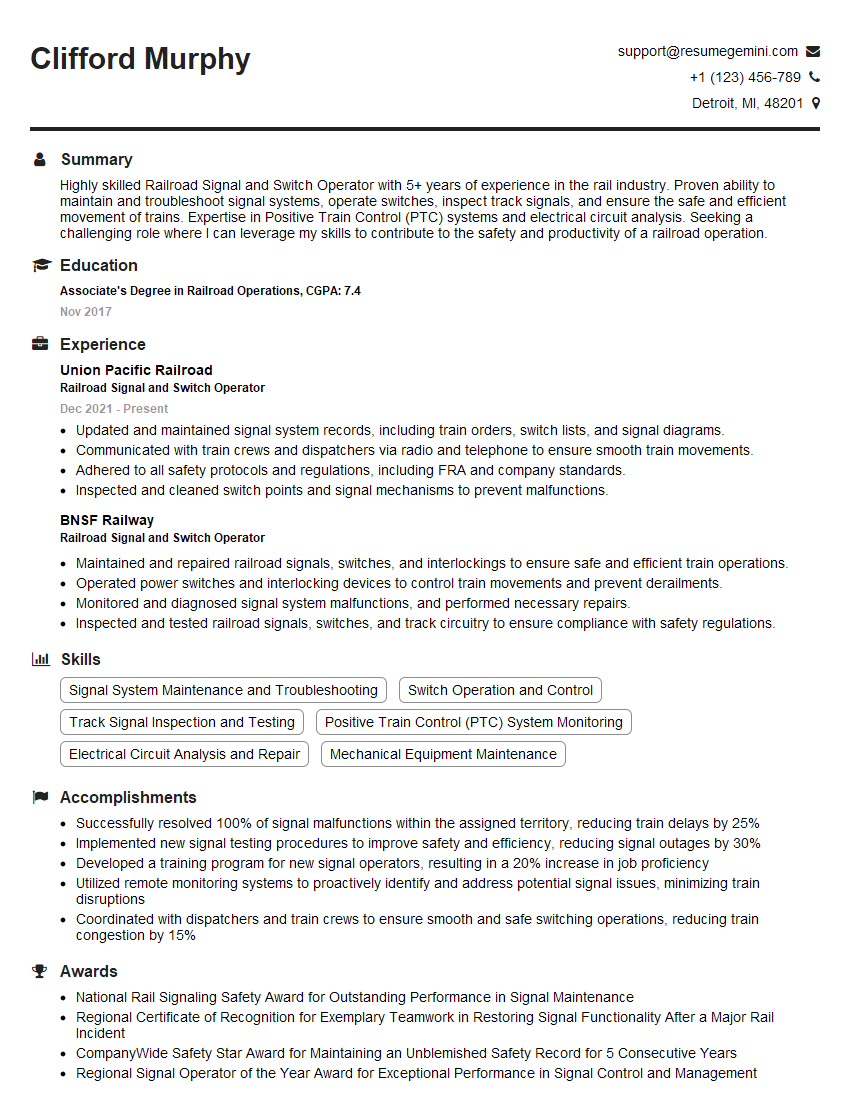
Feeling lost in a sea of interview questions? Landed that dream interview for Railroad Signal and Switch Operator but worried you might not have the answers? You’re not alone! This blog is your guide for interview success. We’ll break down the most common Railroad Signal and Switch Operator interview questions, providing insightful answers and tips to leave a lasting impression. Plus, we’ll delve into the key responsibilities of this exciting role, so you can walk into your interview feeling confident and prepared.
Acing the interview is crucial, but landing one requires a compelling resume that gets you noticed. Crafting a professional document that highlights your skills and experience is the first step toward interview success. ResumeGemini can help you build a standout resume that gets you called in for that dream job.






Essential Interview Questions For Railroad Signal and Switch Operator
1. What are the primary responsibilities of a Railroad Signal and Switch Operator?
As a Railroad Signal and Switch Operator, my primary responsibilities include:
- Operating signals and switches to control the movement of trains and ensure safe and efficient rail operations.
- Communicating with train crews, dispatchers, and other personnel to ensure smooth train operations
- Monitoring and inspecting signals, switches, and other track equipment to ensure they are in good working condition.
2. How do you handle emergency situations, such as a train derailment or a track obstruction?
Prioritizing safety
- My first priority in an emergency is to ensure the safety of myself, train crews, and the public.
- I would immediately notify the dispatcher and other relevant authorities.
Assessing the situation
- I would assess the situation to determine the extent of the emergency and identify any potential hazards.
- I would gather information from train crews and other witnesses to understand the events leading to the emergency.
Taking appropriate actions
- Based on my assessment, I would take appropriate actions to respond to the emergency.
- This may involve isolating the affected track, rerouting trains, or coordinating with emergency services.
3. What are the different types of signals and switches used in railroad operations?
There are various types of signals and switches used in railroad operations, including:
- Signals: Color-light signals, position-light signals, and semaphore signals provide visual indications to train crews regarding train movements, track conditions, and speed restrictions.
- Switches: Hand-operated switches, power switches, and remote-controlled switches allow trains to move from one track to another, creating routes and directing train movements.
4. How do you ensure that signals and switches are functioning properly?
Ensuring the proper functioning of signals and switches is crucial for safe rail operations. I perform the following tasks:
- Regular inspections: I conduct regular inspections of signals and switches to check their physical condition, electrical connections, and overall functionality.
- Testing and calibration: I test and calibrate signals and switches according to established procedures to ensure they are operating as intended.
- Troubleshooting: In case of any malfunctions or issues, I troubleshoot the problem to identify the root cause and take necessary repair or maintenance actions.
5. What are the key safety regulations and procedures that you follow in your role?
As a Railroad Signal and Switch Operator, I strictly adhere to various safety regulations and procedures, including:
- Federal Railroad Administration (FRA) regulations: I comply with all applicable FRA regulations related to signal and switch operations, ensuring adherence to safety standards.
- Company operating rules: I follow established company operating rules and procedures specific to the railroad I work for, which provide detailed guidelines for safe and efficient operations.
- Signal maintenance and inspection manuals: I refer to signal maintenance and inspection manuals to ensure proper maintenance and testing of signals and switches.
6. How do you communicate with train crews and other personnel during operations?
Effective communication is vital in my role as a Railroad Signal and Switch Operator. I use various methods to communicate with train crews and other personnel:
- Radio: I use a radio to communicate with train crews, dispatchers, and other operators to convey instructions, provide updates, and coordinate operations.
- Telephone: I use a telephone to communicate with personnel in different locations, such as dispatchers, maintenance crews, and supervisors.
- Hand signals: When necessary, I use hand signals to communicate with train crews, especially in situations where radio or telephone communication is not feasible.
7. How do you handle situations where train schedules are disrupted due to unforeseen circumstances?
Unforeseen circumstances can disrupt train schedules, and it is crucial to handle these situations effectively.
- Assessing the situation: I assess the situation to understand the nature and extent of the disruption.
- Communicating with dispatchers: I promptly communicate with dispatchers and other relevant personnel to inform them of the situation and coordinate a response.
- Adjusting switch and signal settings: I make necessary adjustments to switch and signal settings to reroute trains or hold them as required.
- Monitoring train movements: I closely monitor train movements and make further adjustments as needed to minimize delays and ensure safe operations.
8. What is the importance of teamwork in your role as a Railroad Signal and Switch Operator?
Teamwork plays a critical role in my role as a Railroad Signal and Switch Operator:
- Coordinating with train crews: I work closely with train crews to ensure smooth train movements and provide necessary instructions.
- Collaborating with maintenance personnel: I collaborate with maintenance personnel to resolve signal or switch issues and maintain the infrastructure.
- Communicating with dispatchers: I communicate effectively with dispatchers to coordinate train movements and relay important information.
9. How do you stay up-to-date with advancements in railroad signaling and switching technologies?
Staying up-to-date with advancements is essential in my field:
- Attending industry conferences: I attend industry conferences and workshops to learn about new technologies and best practices.
- Reading technical publications: I read technical publications, such as industry magazines and journals, to stay informed about the latest developments.
- Participating in training programs: I participate in training programs offered by my company or industry organizations to enhance my knowledge and skills.
10. How do you manage stress and maintain focus in a high-pressure work environment?
Managing stress and maintaining focus are important for my role:
- Prioritizing tasks: I prioritize tasks and focus on completing the most important ones first to avoid feeling overwhelmed.
- Taking breaks: I take short breaks throughout the day to clear my mind and refresh my focus.
- Communicating with colleagues: I communicate openly with colleagues and supervisors to discuss challenges and seek support when needed.
Interviewers often ask about specific skills and experiences. With ResumeGemini‘s customizable templates, you can tailor your resume to showcase the skills most relevant to the position, making a powerful first impression. Also check out Resume Template specially tailored for Railroad Signal and Switch Operator.
Career Expert Tips:
- Ace those interviews! Prepare effectively by reviewing the Top 50 Most Common Interview Questions on ResumeGemini.
- Navigate your job search with confidence! Explore a wide range of Career Tips on ResumeGemini. Learn about common challenges and recommendations to overcome them.
- Craft the perfect resume! Master the Art of Resume Writing with ResumeGemini’s guide. Showcase your unique qualifications and achievements effectively.
- Great Savings With New Year Deals and Discounts! In 2025, boost your job search and build your dream resume with ResumeGemini’s ATS optimized templates.
Researching the company and tailoring your answers is essential. Once you have a clear understanding of the Railroad Signal and Switch Operator‘s requirements, you can use ResumeGemini to adjust your resume to perfectly match the job description.
Key Job Responsibilities
Railroad Signal and Switch Operators are crucial to the safe and efficient operations of rail lines. Their primary role involves monitoring and controlling railroad signals and switches to ensure the smooth movement of trains and prevent accidents.
1. Signal Operation
Operate and monitor railroad signals, such as semaphores, color lights, and electronic displays, to control train movements.
- Interpret signal indications and follow established procedures to ensure trains follow proper routes.
- Troubleshoot and respond to signal malfunctions or emergencies.
2. Switch Operation
Operate railroad switches to change the direction of trains, create junctions, and connect different tracks.
- Ensure switches are properly aligned and locked to prevent derailments.
- Inspect switches regularly and report any defects or maintenance issues.
3. Communication
Maintain effective communication with train crews, dispatchers, and other railroad personnel to coordinate train movements and ensure safety.
- Use radio, telephone, or other communication systems to receive and transmit instructions.
- Report any unusual occurrences or hazards to appropriate authorities.
4. Safety and Compliance
Adhere to all safety regulations and procedures to protect themselves, train crews, and the public.
- Follow established safety protocols and wear appropriate protective gear.
- Report any unsafe conditions or violations to supervisors.
Interview Tips
Preparing for an interview as a Railroad Signal and Switch Operator requires thorough research, practice, and a strong understanding of the job responsibilities. Here are some tips to help you ace your interview:
1. Research the Role
Before the interview, thoroughly research the specific responsibilities and requirements of the Railroad Signal and Switch Operator role at the company you’re applying to. Familiarize yourself with the company’s operations, safety protocols, and any specific technologies or equipment they use.
- Visit the company’s website, read job descriptions, and search for any relevant news articles or industry publications.
- Network with current or former employees in the field to gain insights into the day-to-day responsibilities and challenges of the job.
2. Highlight Safety and Attention to Detail
Railroad Signal and Switch Operators play a critical role in ensuring the safety of train operations. Emphasize your strong attention to detail, adherence to safety regulations, and ability to work independently and follow instructions precisely.
- In your resume and interview answers, provide specific examples of how you have maintained a safety-first mindset in previous roles.
- Highlight your experience with safety protocols and regulations related to railroad operations.
3. Demonstrate Communication and Problem-Solving Skills
Effective communication and problem-solving are essential for Railroad Signal and Switch Operators. Showcase your ability to communicate clearly and concisely with train crews, dispatchers, and other personnel.
- Describe situations where you have successfully resolved issues or challenges related to signal or switch operations.
- Prepare examples of how you have communicated complex information or instructions effectively.
4. Prepare for Technical Questions
Expect technical questions related to railroad signal and switch systems, such as different types of signals, switch mechanisms, and troubleshooting procedures. Research common signal and switch technologies and familiarize yourself with industry standards.
- Review basic electrical and mechanical principles related to railroad signaling and switching.
- Practice answering questions about specific signal or switch components and their functions.
5. Practice and Mock Interviews
Practice your answers to common interview questions and conduct mock interviews with a friend, family member, or career counselor. This will help you become more comfortable and confident during the actual interview.
- Prepare for questions about your experience, skills, and qualifications.
- Practice answering technical questions and explaining your understanding of railroad signaling and switching systems.
Next Step:
Now that you’re armed with the knowledge of Railroad Signal and Switch Operator interview questions and responsibilities, it’s time to take the next step. Build or refine your resume to highlight your skills and experiences that align with this role. Don’t be afraid to tailor your resume to each specific job application. Finally, start applying for Railroad Signal and Switch Operator positions with confidence. Remember, preparation is key, and with the right approach, you’ll be well on your way to landing your dream job. Build an amazing resume with ResumeGemini