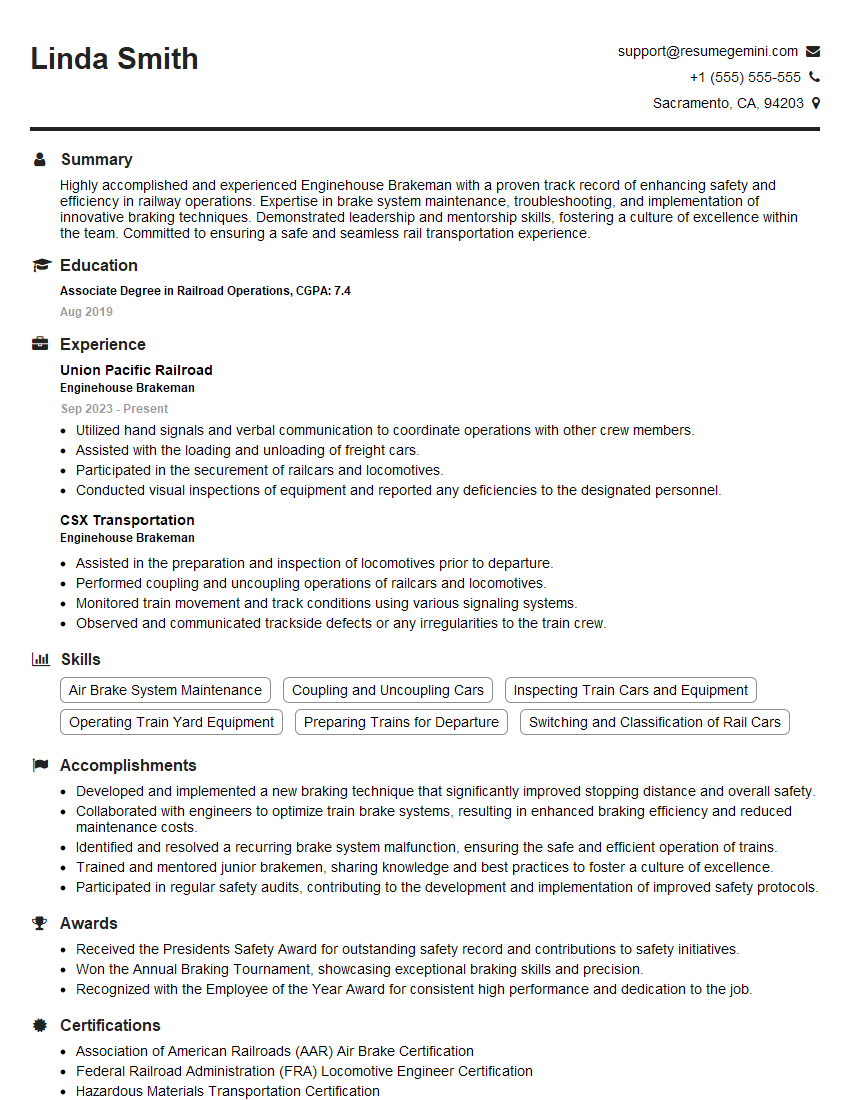
Are you gearing up for an interview for a Enginehouse Brakeman position? Whether you’re a seasoned professional or just stepping into the role, understanding what’s expected can make all the difference. In this blog, we dive deep into the essential interview questions for Enginehouse Brakeman and break down the key responsibilities of the role. By exploring these insights, you’ll gain a clearer picture of what employers are looking for and how you can stand out. Read on to equip yourself with the knowledge and confidence needed to ace your next interview and land your dream job!
Acing the interview is crucial, but landing one requires a compelling resume that gets you noticed. Crafting a professional document that highlights your skills and experience is the first step toward interview success. ResumeGemini can help you build a standout resume that gets you called in for that dream job.






Essential Interview Questions For Enginehouse Brakeman
1. Describe the process of brake system inspection you typically follow?
Upon receiving a locomotive, I begin my inspection by examining the brake shoe for any missing, cracked, or broken components. I then proceed to measure the brake shoe thickness and ensure it meets safety standards. Next, I inspect the brake pads for wear and tear and replace any that exhibit excessive wear or damage. Additionally, I check the brake rigging for proper alignment and lubrication, addressing any issues to ensure optimal brake performance.
2. How do you handle a situation where the brake system fails during a train operation?
Immediate response
- Notify the train crew and passengers immediately
- Initiate emergency braking procedures
Assessment and diagnosis
- Identify the cause of the brake failure
- Assess the severity of the situation
Corrective actions
- Implement temporary repair measures if possible
- Coordinate with maintenance personnel to resolve the issue
- Monitor the situation and make necessary adjustments
3. Explain how you maintain and troubleshoot air brake systems on locomotives.
To maintain air brake systems, I perform routine inspections, cleaning, and lubrication. I check for any leaks or damage to the air lines, hoses, and fittings. I also ensure that the air compressor and governor are operating correctly. For troubleshooting, I use diagnostic tools to identify the source of any issues. I assess the air pressure, inspect the valves, and check for any electrical faults. Based on my findings, I implement appropriate repairs or replacements to restore the air brake system to optimal functionality.
4. How do you ensure that the brakes are applied and released smoothly and effectively during train operations?
- Properly handle the brake valve to control the application and release of brakes
- Monitor brake pressure gauges and observe the train’s response to ensure smooth operation
- Adjust the brake valve settings to achieve the desired braking force
- Communicate with the train crew to coordinate braking actions
5. Describe the safety precautions you take when working on locomotive brake systems.
- Wear appropriate personal protective equipment (PPE)
- Ensure the locomotive is safely parked and the brakes are applied
- Bleed off any residual air pressure before starting work
- Use proper tools and techniques to avoid injury or damage
- Follow established safety protocols and procedures
6. Explain how you would respond to a situation where a train experiences uneven braking.
- Identify the cause of the uneven braking (e.g., faulty brake rigging, defective brake components)
- Adjust the brake valve settings to compensate for the uneven braking
- Communicate with the train crew to monitor the situation and adjust braking accordingly
- Report the issue to maintenance personnel for further investigation and repair
7. Describe the different types of brake systems used on locomotives and their advantages and disadvantages.
- Advantages: Reliable, widely used, provides gradual braking
- Disadvantages: Requires regular maintenance, can be affected by air leaks
- Advantages: Quick response, regenerative braking capability
- Disadvantages: Higher maintenance costs, limited to certain locomotive types
- Advantages: Compact, provides high braking force
- Disadvantages: Requires special fluids, can be more complex to maintain
Air brake system
Electric brake system
Hydraulic brake system
8. How do you stay up-to-date on the latest developments and best practices in locomotive brake system maintenance?
- Attend industry conferences and workshops
- Read technical journals and articles
- Consult with experienced colleagues
- Participate in online forums and discussion groups
- Seek guidance from manufacturers and regulatory bodies
9. What are the key performance indicators (KPIs) you track to measure the effectiveness of locomotive brake system maintenance?
- Brake shoe wear rate
- Brake pad life
- Air pressure levels
- Response time of brake systems
- Number of brake-related incidents
10. How do you prioritize your workload and manage multiple tasks related to locomotive brake system maintenance?
- Assess the urgency and importance of each task
- Create a prioritized to-do list
- Delegate tasks to other team members when necessary
- Use time management techniques to optimize efficiency
- Communicate regularly with supervisors and colleagues to ensure alignment
Interviewers often ask about specific skills and experiences. With ResumeGemini‘s customizable templates, you can tailor your resume to showcase the skills most relevant to the position, making a powerful first impression. Also check out Resume Template specially tailored for Enginehouse Brakeman.
Career Expert Tips:
- Ace those interviews! Prepare effectively by reviewing the Top 50 Most Common Interview Questions on ResumeGemini.
- Navigate your job search with confidence! Explore a wide range of Career Tips on ResumeGemini. Learn about common challenges and recommendations to overcome them.
- Craft the perfect resume! Master the Art of Resume Writing with ResumeGemini’s guide. Showcase your unique qualifications and achievements effectively.
- Great Savings With New Year Deals and Discounts! In 2025, boost your job search and build your dream resume with ResumeGemini’s ATS optimized templates.
Researching the company and tailoring your answers is essential. Once you have a clear understanding of the Enginehouse Brakeman‘s requirements, you can use ResumeGemini to adjust your resume to perfectly match the job description.
Key Job Responsibilities
Enginehouse Brakemen are responsible for ensuring the smooth and safe operation of railroad trains. They are responsible for coupling and uncoupling railcars, applying and releasing brakes, and performing other tasks as needed to ensure the safe movement of trains.
1. Coupling and Uncoupling Railcars
Enginehouse Brakemen are responsible for coupling and uncoupling railcars to form and break up trains. This task requires a high level of precision and attention to detail, as improper coupling can lead to train derailments or other accidents.
2. Applying and Releasing Brakes
Enginehouse Brakemen are responsible for applying and releasing the brakes on trains. This task is critical to ensuring the safe operation of trains, as improper braking can lead to train collisions or other accidents.
3. Inspecting Trains and Equipment
Enginehouse Brakemen are responsible for inspecting trains and equipment to ensure that they are in good working order. This task includes checking for any damage or defects that could compromise the safe operation of the train.
4. Maintaining Train Records
Enginehouse Brakemen are responsible for maintaining train records, such as train orders and switch lists. These records are essential for ensuring the safe and efficient operation of trains.
Interview Tips
Interviewing for an Enginehouse Brakeman position can be a competitive process. However, there are a few tips that you can follow to increase your chances of success.
1. Research the Company and the Position
Before you go on an interview, it is important to research the company and the position. This will help you to understand the company’s culture and the specific requirements of the job. You can research the company’s website, read news articles, and talk to people who work for the company.
2. Prepare for Common Interview Questions
There are a few common interview questions that you are likely to be asked during an interview for an Enginehouse Brakeman position. These questions include:
- Tell me about yourself.
- Why are you interested in working as an Enginehouse Brakeman?
- What are your qualifications for this position?
- What are your strengths and weaknesses?
- What are your salary expectations?
You can prepare for these questions by practicing your answers ahead of time.
3. Be Yourself
It is important to be yourself during an interview. The interviewer wants to know who you are and what you are like to work with. Don’t try to be someone you’re not, because the interviewer will be able to tell. Just be honest and authentic, and let your personality shine through.
4. Follow Up
After your interview, it is important to follow up with the interviewer. This shows that you are interested in the position and that you are serious about getting the job. You can follow up by sending a thank-you note or by calling the interviewer to ask about the status of your application.
Next Step:
Armed with this knowledge, you’re now well-equipped to tackle the Enginehouse Brakeman interview with confidence. Remember, a well-crafted resume is your first impression. Take the time to tailor your resume to highlight your relevant skills and experiences. And don’t forget to practice your answers to common interview questions. With a little preparation, you’ll be on your way to landing your dream job. So what are you waiting for? Start building your resume and start applying! Build an amazing resume with ResumeGemini.