





Congratulations, new graduate! You’ve put in the hard work and dedication, and now it’s time to step into the exciting world of post-college life. As you embark on your job search, one of the most crucial tools you’ll need is a standout resume that showcases your skills, experience, and potential. To help you create a resume that will land you your dream job, we’ve compiled a comprehensive guide to the nine essential elements of a recent graduate resume.
The Job Market for Recent Graduates and How to Stand Out
The job market for recent graduates can be competitive, but don’t let that discourage you. By tailoring your resume to each job application, highlighting your relevant skills and experience, and quantifying your accomplishments, you can increase your chances of landing the job you deserve.
With careful preparation and utilization of resources like ResumeGemini, you can create a resume that will set you apart from other candidates and open doors to exciting career opportunities.
Section 1: Craft a Powerful Objective Statement
Your objective statement is a concise summary of your career goals and how they align with the position you’re applying for. It should be tailored to each job application, highlighting the skills and experience that are most relevant to the role. Keep it brief and to the point, around two to three sentences, and ensure it’s free of grammatical errors or typos.
Section 2: Highlight Your Education and Relevant Coursework
List your educational background in reverse chronological order, starting with your most recent degree. Include the name of your university, degree obtained, major, GPA (if it’s impressive), and graduation date. Additionally, highlight any relevant coursework, projects, or research experiences that demonstrate your skills and knowledge in the field.
Section 3: Showcase Your Skills and Experience
This section is where you can showcase your skills and experience, both relevant and transferable. List your hard skills first, such as proficiency in specific software or programming languages, followed by your soft skills, such as communication, teamwork, and problem-solving.
If you have limited professional experience, include any internships, volunteer work, or extracurricular activities that demonstrate your skills and abilities. Quantify your accomplishments whenever possible, using specific numbers and metrics to highlight your impact.
Section 4: Quantify Your Accomplishments and Impact
When describing your accomplishments, don’t just list your responsibilities. Instead, focus on the results you achieved and the impact you made. Use action verbs and specific numbers to quantify your accomplishments and demonstrate your value to potential employers.
For example, instead of writing “Managed social media accounts”, write “Increased social media engagement by 25% through targeted campaigns”.
Section 5: Leverage ResumeGemini’s Library for Graduate-Specific Content
ResumeGemini offers a comprehensive library of resume content specifically tailored to recent graduates. This library includes pre-written objective statements, skill descriptions, and accomplishment examples that you can easily adapt to your own resume. By leveraging these resources, you can save time and ensure that your resume is up-to-date with the latest industry trends. Visit ResumeGemini today to explore the library and enhance your resume.
Section 6: Tailor Your Resume to Each Job Application
Take the time to tailor your resume to each job application. This means highlighting the skills and experience that are most relevant to the specific role you’re applying for. Read the job description carefully and identify the keywords that describe the ideal candidate.
Incorporate these keywords into your resume, but avoid keyword stuffing. Instead, focus on naturally integrating them into your content, demonstrating how your skills and experience align with the job requirements.
Section 7: Include a Strong Call-to-Action
Your resume should end with a strong call-to-action, inviting the hiring manager to take the next step in the application process. This could be a request for an interview, a link to your portfolio, or an invitation to connect on LinkedIn.
Make sure your call-to-action is clear and concise, and that it conveys your enthusiasm for the position. For example, you could write “I am eager to learn more about the Marketing Associate position at your esteemed company. I am confident that my skills and experience would make me a valuable asset to your team”.
Section 8: Proofread and Edit Carefully
Before submitting your resume, proofread it carefully for any errors in grammar, spelling, or punctuation. Ask a friend, family member, or career counselor to review your resume as well. Fresh eyes can often spot errors that you may have missed.
A well-proofread resume not only demonstrates your attention to detail but also increases your chances of making a positive first impression on potential employers.
Section 9: Get Feedback from Professionals
If you want to take your resume to the next level, consider getting feedback from professionals. There are many resources available to help you, such as career counselors, resume writing services, and online resume review tools.
Professional feedback can provide valuable insights into how to improve your resume’s structure, content, and overall impact. By investing in professional feedback, you can increase your chances of creating a resume that will land you the job you deserve.
Career Expert Tips:
- Select the ideal resume template to showcase your professional experience effectively.
- Master the art of resume writing to highlight your unique qualifications and achievements.
- Checkout the resume writing tips for guidance and best practices.
- Make your 2025 brighter with a new job. Build a powerful resume with ResumeGemini and save big, enjoy exclusive discounts on premium templates.
Frequently Asked Questions (FAQs)
What are the most important sections to include on a recent graduate resume?
As a recent graduate, it’s crucial to highlight your education, skills, and any relevant experience you gained during internships, projects, or extracurricular activities. Here are the essential sections to include on your resume:
- Contact Information: Include your full name, address, phone number, email address, and LinkedIn profile.
- Education: List your university, degree, major, GPA, and graduation date. If you have any academic honors or awards, mention them here.
- Skills: Showcase your technical and soft skills relevant to the jobs you’re applying for. Use a combination of hard skills (e.g., proficiency in software or programming languages) and soft skills (e.g., communication, teamwork).
- Experience: Even if you don’t have traditional work experience, highlight any relevant internships, volunteer work, or projects that demonstrate your abilities.
- Objective Statement or Summary: A brief statement that introduces you, highlights your key skills, and expresses your career goals.
How can I write a strong objective statement as a recent graduate?
Your objective statement should be tailored to each job application, highlighting the skills and experience that align with the specific requirements of the role. Consider using the following structure:
- Begin with a strong hook: Grab the reader’s attention with a brief statement that showcases your passion for the industry or highlights a relevant achievement.
- Quantify your skills and experience: Use numbers and metrics to demonstrate the impact of your work or contributions. For example, “Increased sales by 15%” or “Developed a website that generated over 100,000 visitors.”
- Express your career goals: Clearly state the position and industry you’re interested in pursuing.
- Call to action: End with a call to action, such as expressing your interest in scheduling an interview or learning more about the company.
What type of skills and experience should I highlight on my resume?
Identify the skills and experience that are most relevant to the jobs you’re applying for. Consider the following categories:
- Hard skills: These are specific, technical skills that can be learned through education or training, such as proficiency in software, programming languages, or specialized knowledge in a particular field.
- Soft skills: These are transferable skills that are applicable to various roles and industries, such as communication, teamwork, problem-solving, and adaptability.
- Relevant experience: Highlight any internships, volunteer work, or projects that showcase your skills and abilities in a professional setting. Even if the experience is not directly related to your desired career, identify transferable skills that are applicable to the roles you’re pursuing.
- Leadership and extracurricular activities: Involvement in student organizations, clubs, or sports teams demonstrates your leadership abilities, teamwork skills, and commitment beyond academics.
How can I quantify my accomplishments without much work experience?
Even without traditional work experience, you can still quantify your accomplishments by focusing on the results and impact of your contributions. Consider using the following strategies:
- Use specific numbers and metrics: Quantify your achievements by providing concrete data, such as “Increased sales by 15%” or “Developed a marketing campaign that generated over 100,000 impressions.”
- Highlight the impact of your work: Describe the positive outcomes or benefits of your contributions. For example, “Developed a training program that improved employee productivity by 10%” or “Led a team project that resulted in a successful product launch.”
- Use action verbs: Use strong action verbs that convey your accomplishments, such as “developed,” “managed,” “increased,” or “improved.”
- Be specific and avoid generalizations: Provide specific details about your accomplishments rather than using general statements. For example, instead of saying “Improved communication skills,” say “Led a team of five in developing a communication strategy that resulted in a 20% increase in customer satisfaction.”
Can I use ResumeGemini to create a professional resume as a recent graduate?
Yes, ResumeGemini is an excellent tool for recent graduates to create professional resumes. With ResumeGemini, you can:
- Choose from a variety of templates: ResumeGemini offers a wide range of resume templates designed specifically for recent graduates, helping you create a polished and professional-looking resume.
- Get expert guidance: ResumeGemini provides helpful tips and guidance throughout the resume-building process, ensuring that your resume meets industry standards and best practices.
- Showcase your skills and experience: Highlight your relevant skills, experience, and education through easy-to-use sections and formatting options.
- Create a tailored resume: Customize your resume for each job application, ensuring that it aligns with the specific requirements of the role you’re pursuing.
How can I tailor my resume to specific job applications as a recent graduate?
Tailoring your resume to each job application is crucial for success. Here are some tips:
- Read the job description carefully: Identify the key requirements and qualifications for the role, and highlight the skills and experience in your resume that align with those requirements.
- Use keywords: Incorporate relevant keywords from the job description into your resume, especially in the skills and experience sections. This helps applicant tracking systems (ATS) identify your resume as a suitable match for the position.
- Customize your objective statement: Tailor your objective statement to match the specific role and company you’re applying for. Highlight the skills and experience that are most relevant to the position.
- Quantify your accomplishments: Use specific numbers and metrics to demonstrate the impact of your contributions in previous roles or projects. This helps employers understand the value you can bring to their organization.
What is the best way to present my education and coursework on my resume?
The education section of your resume should provide a clear overview of your academic qualifications. Here are some tips:
- List your degrees in reverse chronological order: Start with your most recent degree and work backward, including the name of your university, degree obtained, major, GPA (if high), and graduation date.
- Highlight relevant coursework: If there are specific coursework or projects that are particularly relevant to the jobs you’re applying for, consider listing them under a separate “Relevant Coursework” section.
- Use keywords: Incorporate keywords from the job description into your education section, especially when describing your coursework and projects. This helps ATS identify your resume as a suitable match for the position.
- Consider using a skills-based resume: If you have limited work experience, a skills-based resume can be an effective way to highlight your relevant skills and coursework.
How can I get feedback on my resume before submitting it?
Getting feedback on your resume before submitting it can help you improve its quality and effectiveness. Here are some ways to do it:
- Ask a friend or family member: Have someone you trust review your resume and provide feedback on its clarity, organization, and overall
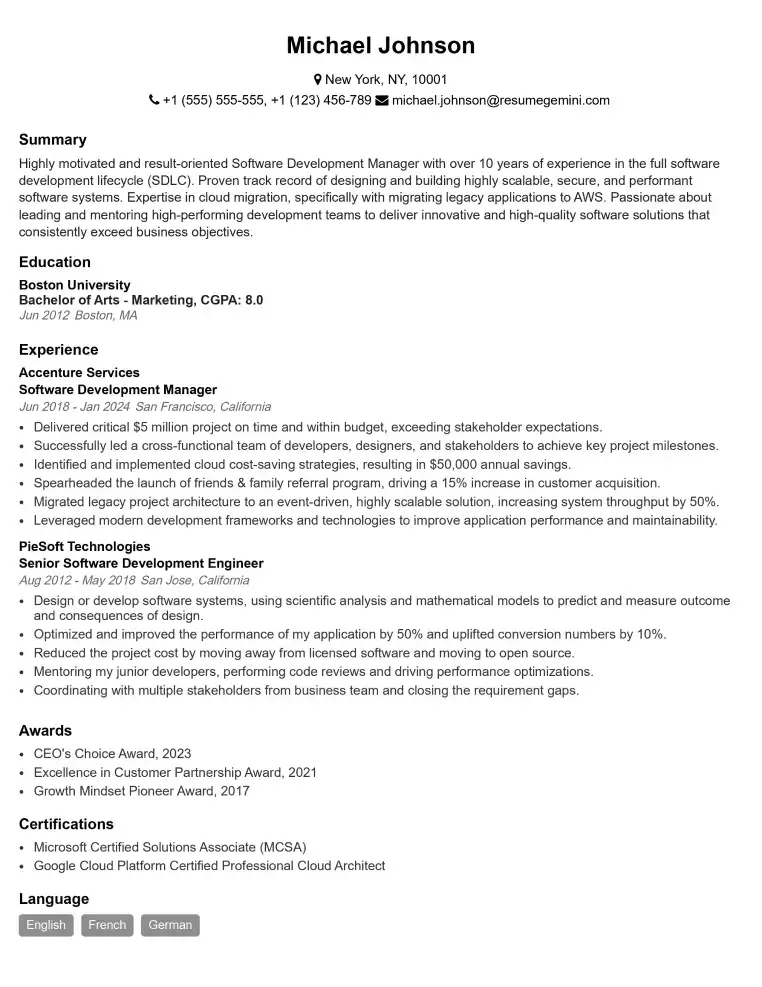
Elevate your job search with our premium resume templates. Here is an amazing resume template that can be used to build a professional and elegant resume. You can build a resume from scratch or revamp your existing resume. Impress hiring managers and secure your next opportunity.
- Top 50 Most Common Interview Questions
- The Psychology of a Great Resume: Hacks to Impress Recruiters
- What Mistakes to Avoid When Writing a Resume: A Comprehensive Guide
- Elevate Your Career with Expert Resume Building: Introducing ResumeGemini
- How to Write a Resume Using Google Gemini: Step-by-Step Guide