





In today’s competitive job market, it is important to have a strong resume that will make you stand out from the crowd. However, many people make common mistakes on their resumes that can hurt their chances of getting an interview. Here are six of the most common resume mistakes to avoid:
Lack of Focus
One of the most common mistakes on resumes is a lack of focus. Your resume should be tailored to each job you apply for, highlighting the skills and experience that are most relevant to the position. If your resume is too generic, it will not stand out from the crowd and you will be less likely to get an interview.
- Questions to ask yourself: Does my resume clearly define my value proposition and target roles?
- Tips to avoid this mistake: Research the job you’re applying for and tailor your resume accordingly. Highlight the skills and experience that are most relevant to the position.
Generic Content
Another common mistake is using boilerplate language and failing to showcase your unique strengths. Your resume should be written in a clear and concise style, and it should highlight your unique skills and experience. If your resume is full of generic language, it will not be memorable and you will be less likely to get an interview.
- Questions to ask yourself: Does my resume showcase my unique strengths and accomplishments?
- Tips to avoid this mistake: Use specific examples to highlight your skills and experience. Quantify your accomplishments whenever possible.
Missing Keywords
ATS (Applicant Tracking Systems) are used by many companies to screen resumes. These systems look for specific keywords in your resume, so it is important to include relevant keywords in your resume. If your resume is missing keywords, it may not be seen by recruiters and you will be less likely to get an interview.
- Questions to ask yourself: Does my resume contain relevant keywords that ATS systems look for?
- Tips to avoid this mistake: Research the job you’re applying for and identify the relevant keywords. Include these keywords in your resume, especially in the summary section.
Formatting and Design Errors
Poor formatting, font choices, and visual clutter can make your resume difficult to read. This can make it difficult for recruiters to quickly and easily find the information they are looking for, and it can also make your resume look unprofessional. If your resume is not well-formatted, it is less likely to get an interview.
- Questions to ask yourself: Is my resume easy to read and visually appealing?
- Tips to avoid this mistake: Use a clean and simple font. Use white space to make your resume easy to read. Avoid using too much color or graphics.
Typos and Grammar Mistakes
Unprofessional errors such as typos and grammar mistakes can damage your credibility and leave a negative impression on recruiters. If your resume is full of errors, it will make you look careless and unprofessional. This can make it less likely to get an interview.
- Questions to ask yourself: Is my resume free of typos and grammar mistakes?
- Tips to avoid this mistake: Proofread your resume carefully before submitting it. Ask a friend or family member to proofread it as well.
Lengthy Resumes
Resumes should be concise and to the point. If your resume is too long, it is less likely to be read by recruiters. In general, your resume should be no longer than two pages. If you have a lot of experience, you may need to use three pages, but any more than that is excessive.
- Questions to ask yourself: Is my resume concise and to the point?
- Tips to avoid this mistake: Edit your resume carefully and remove any unnecessary information. Use concise language and avoid using jargon.
By avoiding these common resume mistakes, you can increase your chances of getting an interview and landing the job you want. If you need help writing a strong resume, consider using a resume builder like ResumeGemini. ResumeGemini offers premium, ATS-friendly, customizable resume templates with over 3.6 million content examples. It provides a step-by-step process to help you create a resume, with tips on what to include in each section. Additional sections like Awards, Certifications, Languages, Accomplishments, Extra Curricular and References can be added based on industry and experience. Users can preview and personalize their resume with various templates, fonts, and color themes. The user can also choose the page size of the output PDF to be A4 or Letter. The service offers a one-time payment plan with no recurring charges. ResumeGemini also offers 45,000+ pre-built Resume Samples for different Job Titles so that the user can edit and download the same resume sample. ResumeGemini has 12 unique Templates with each template having 5 unique color themes, effectively giving 60 unique template options.
Career Expert Tips:
- Select the ideal resume template to showcase your professional experience effectively.
- Master the art of resume writing to highlight your unique qualifications and achievements.
- Checkout the resume writing tips for guidance and best practices.
- Make your 2025 brighter with a new job. Build a powerful resume with ResumeGemini and save big, enjoy exclusive discounts on premium templates.
Frequently Asked Questions (FAQs)
What are the most common mistakes people make on their resumes?
Mistakes on a resume can severely hinder your job search, costing you interviews and potential employment opportunities. Some of the most common and crucial mistakes include:
- Using a generic resume for all job applications: Failing to tailor your resume to the specific job requirements often leads to a rejection. Each resume should be meticulously crafted to highlight relevant skills and experience that align with the target role.
- Lack of focus and clarity: A well-optimized resume should be concise, clear, and focused on the most important information. Rambling or irrelevant content can make it difficult for hiring managers to quickly grasp your qualifications and determine your suitability for the role.
- Typos and grammatical errors: A resume riddled with errors reflects poorly on your attention to detail, professionalism, and overall communication skills. Proofread your resume carefully before submitting it to ensure it is free of typos, grammatical errors, and formatting issues.
- Inaccurate or exaggerated information: False or inflated information on your resume can damage your credibility and jeopardize your chances of employment. Always ensure that the information you provide is accurate, verifiable, and presented in a professional manner.
- Lack of ATS optimization: Applicant Tracking Systems (ATS) are widely used by companies to screen resumes. If your resume is not ATS-friendly, it may not even reach a human recruiter. Make sure your resume is formatted properly, uses relevant keywords, and is free of excessive graphics or images that can interfere with ATS scanning.
How can I make sure my resume is focused and tailored to specific roles?
Tailoring your resume to each job application significantly increases your chances of impressing hiring managers and landing interviews. To achieve this:
- Read the job description carefully: Identify the key requirements, skills, and qualifications sought by the employer. Use these as a guide to highlight your relevant experience and abilities in your resume.
- Use specific examples: Instead of generic statements, use concrete examples to demonstrate your accomplishments and skills. Quantify your results whenever possible to provide tangible evidence of your impact.
- Highlight transferable skills: If you don’t have direct experience in the specific industry or role, focus on transferable skills that are relevant to the job. These may include soft skills such as communication, problem-solving, and teamwork.
- Keep it concise: A resume should be no longer than one page for most job applications. Use clear and concise language, avoiding unnecessary details or jargon.
What are some ways to avoid using generic content on my resume?
To avoid generic content on your resume:
- Use specific and quantifiable accomplishments: Instead of saying “Managed a team,” say “Led a team of 10 engineers, resulting in a 20% increase in productivity.”
- Incorporate industry-specific keywords: Research the industry and specific job description to identify relevant keywords. Use these keywords naturally throughout your resume to show that you understand the field and its requirements.
- Highlight your unique skills and experience: What sets you apart from other candidates? Showcase your unique skills, talents, and experiences that are not easily replaceable.
- Tell a compelling narrative: Your resume should tell the story of your career journey. Use strong action verbs, vivid language, and anecdotes that illustrate your skills and accomplishments.
How do I incorporate relevant keywords into my resume without sounding unnatural?
Incorporating relevant keywords into your resume is important for ATS recognition, but it should be done subtly to maintain a professional and authentic tone. Here’s how:
- Use keywords naturally: Avoid keyword stuffing or using forced language. Aim to incorporate keywords seamlessly into your resume content, matching them with your skills and experience.
- Use synonyms and related terms: Don’t repeat the same keyword excessively. Use synonyms or related terms to convey the same meaning and expand your keyword reach.
- Incorporate keywords into various sections: Spread keywords throughout your resume, including in your skills section, work experience, education, and even your summary statement.
- Proofread carefully: After incorporating keywords, proofread your resume thoroughly to ensure it flows naturally and doesn’t sound robotic or unnatural.
What formatting and design tips can I follow to create a professional-looking resume?
A visually appealing and well-formatted resume can immediately grab attention. Here are some tips to enhance your resume’s design:
- Choose a professional font: Opt for fonts that are easy to read, such as Arial, Calibri, Times New Roman, or Georgia. Avoid fancy or decorative fonts that can be difficult to decipher.
- Use consistent formatting: Maintain consistency in font size, line spacing, and section headings throughout your resume. This creates a visually cohesive and organized document.
- Use white space effectively: Avoid overcrowding your resume with too much text. Use white space strategically to create a balanced and inviting layout.
- Highlight important information: Use bolding, italics, or underlining to emphasize critical information or headings. However, use these sparingly to avoid overwhelming the reader.
- Proofread carefully: As with the content, proofread your resume’s formatting and design to ensure there are no errors or inconsistencies.
How can I proofread my resume effectively to eliminate typos and grammar mistakes?
Proofreading your resume thoroughly is essential to catch any errors that may have slipped through. Here are some tips:
- Take a break and come back: Step away from your resume for a while before proofreading it. This allows you to return with fresh eyes and spot errors more easily.
- Read aloud: Reading your resume aloud can help you identify awkward phrasing, grammatical errors, and typos. The auditory feedback can make it easier to catch mistakes that you might miss when reading silently.
- Use a tool: Utilize online grammar and spell-checking tools to assist you in identifying errors. However, rely on these tools as a supplement to your own proofreading, as they may not catch everything.
- Ask someone else to review: If possible, ask a trusted friend, family member, or colleague to review your resume. They may provide a fresh perspective and notice errors that you might have missed.
What is the ideal length for a resume?
The ideal length for a resume varies depending on your experience and career level. However, a good rule of thumb is to keep it concise and within one page for most job applications. Hiring managers often have limited time to review resumes, so a concise and well-organized document is more likely to make a positive impression. If you have extensive experience and a long list of accomplishments, you may consider a two-page resume. However, ensure that the additional page adds substantial value and is not simply a repetition of information from the first page.
How can I ensure my resume is ATS-friendly?
To ensure your resume is ATS-friendly:
- Use a clear and consistent format: ATS systems prefer resumes with a structured format, such as reverse-chronological order. Avoid using tables, graphics, or images, as these can interfere with scanning.
- Incorporate relevant keywords: Identify keywords from the job description and incorporate them naturally
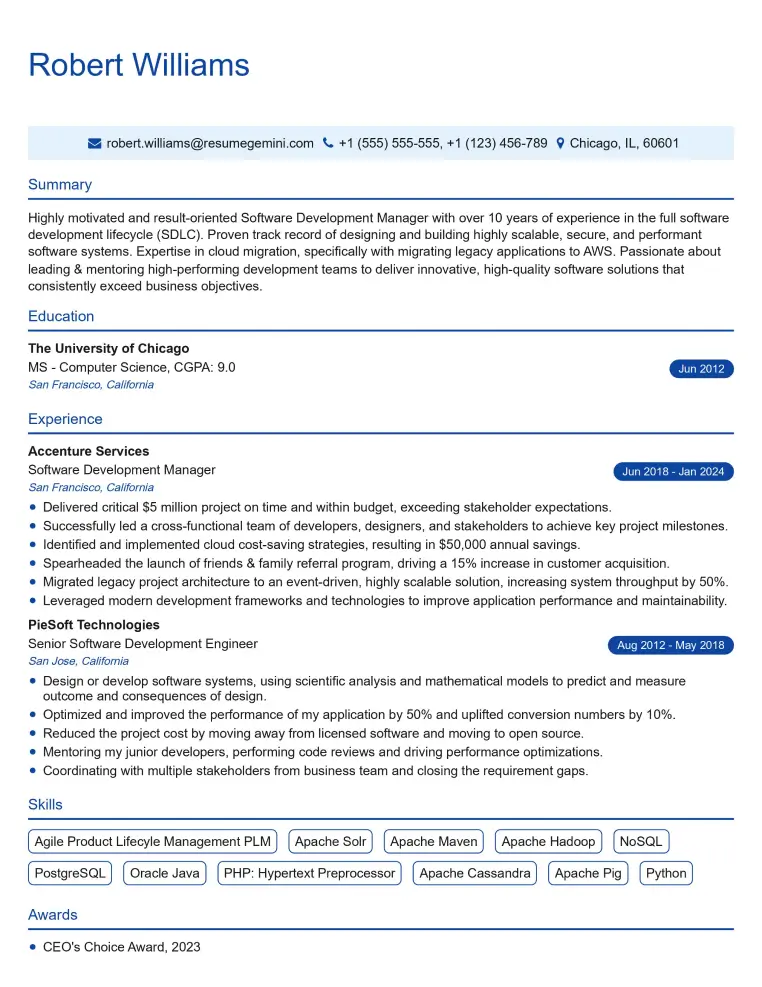
Elevate your job search with our premium resume templates. Here is an amazing resume template that can be used to build a professional and elegant resume. You can build a resume from scratch or revamp your existing resume. Impress hiring managers and secure your next opportunity.
- Top 50 Most Common Interview Questions
- The Psychology of a Great Resume: Hacks to Impress Recruiters
- What Mistakes to Avoid When Writing a Resume: A Comprehensive Guide
- Elevate Your Career with Expert Resume Building: Introducing ResumeGemini
- How to Write a Resume Using Google Gemini: Step-by-Step Guide