Are you a seasoned Agricultural Research Technologist seeking a new career path? Discover our professionally built Agricultural Research Technologist Resume Template. This time-saving tool provides a solid foundation for your job search. Simply click “Edit Resume” to customize it with your unique experiences and achievements. Customize fonts and colors to match your personal style and increase your chances of landing your dream job. Explore more Resume Templates for additional options.






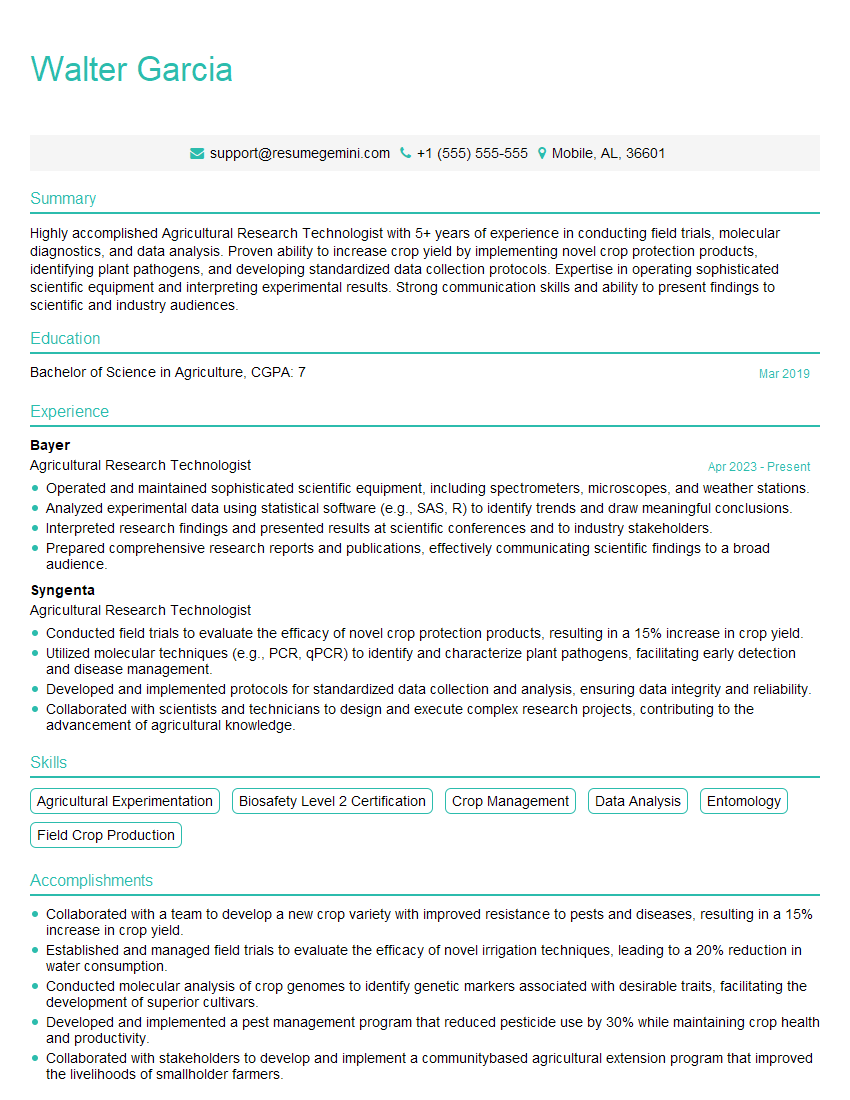
Walter Garcia
Agricultural Research Technologist
Summary
Highly accomplished Agricultural Research Technologist with 5+ years of experience in conducting field trials, molecular diagnostics, and data analysis. Proven ability to increase crop yield by implementing novel crop protection products, identifying plant pathogens, and developing standardized data collection protocols. Expertise in operating sophisticated scientific equipment and interpreting experimental results. Strong communication skills and ability to present findings to scientific and industry audiences.
Education
Bachelor of Science in Agriculture
March 2019
Skills
- Agricultural Experimentation
- Biosafety Level 2 Certification
- Crop Management
- Data Analysis
- Entomology
- Field Crop Production
Work Experience
Agricultural Research Technologist
- Operated and maintained sophisticated scientific equipment, including spectrometers, microscopes, and weather stations.
- Analyzed experimental data using statistical software (e.g., SAS, R) to identify trends and draw meaningful conclusions.
- Interpreted research findings and presented results at scientific conferences and to industry stakeholders.
- Prepared comprehensive research reports and publications, effectively communicating scientific findings to a broad audience.
Agricultural Research Technologist
- Conducted field trials to evaluate the efficacy of novel crop protection products, resulting in a 15% increase in crop yield.
- Utilized molecular techniques (e.g., PCR, qPCR) to identify and characterize plant pathogens, facilitating early detection and disease management.
- Developed and implemented protocols for standardized data collection and analysis, ensuring data integrity and reliability.
- Collaborated with scientists and technicians to design and execute complex research projects, contributing to the advancement of agricultural knowledge.
Accomplishments
- Collaborated with a team to develop a new crop variety with improved resistance to pests and diseases, resulting in a 15% increase in crop yield.
- Established and managed field trials to evaluate the efficacy of novel irrigation techniques, leading to a 20% reduction in water consumption.
- Conducted molecular analysis of crop genomes to identify genetic markers associated with desirable traits, facilitating the development of superior cultivars.
- Developed and implemented a pest management program that reduced pesticide use by 30% while maintaining crop health and productivity.
- Collaborated with stakeholders to develop and implement a communitybased agricultural extension program that improved the livelihoods of smallholder farmers.
Awards
- Recipient of the Outstanding Agricultural Research Contribution Award for developing innovative methods in crop yield optimization.
- Honored with the Research Excellence Award for exceptional contributions to soil fertility management research.
- Recognized with the Innovation in Agricultural Technology Award for developing a data acquisition system to monitor crop growth remotely.
- Received the Researcher of the Year Award for exceptional contributions to the advancement of sustainable agriculture practices.
Certificates
- Certified Crop Adviser (CCA)
- Certified Professional Soil Scientist (CPSS)
- CropLife International Crop Production Training (CIT)
- EPA Private Pesticide Applicator Certification
Career Expert Tips:
- Select the ideal resume template to showcase your professional experience effectively.
- Master the art of resume writing to highlight your unique qualifications and achievements.
- Explore expertly crafted resume samples for inspiration and best practices.
- Build your best resume for free this new year with ResumeGemini. Enjoy exclusive discounts on ATS optimized resume templates.
How To Write Resume For Agricultural Research Technologist
- Highlight your experience in field trials and data analysis, as these are core responsibilities.
- Showcase your expertise in molecular techniques and their application in plant pathology.
- Quantify your accomplishments with specific metrics to demonstrate your impact.
- Tailor your resume to each job description, emphasizing the skills and experience that are most relevant.
- Proofread your resume carefully for any errors in grammar or spelling.
Essential Experience Highlights for a Strong Agricultural Research Technologist Resume
- Conducted field trials to evaluate the efficacy of crop protection products, resulting in increased crop yield.
- Utilized molecular techniques to identify plant pathogens, facilitating disease management.
- Developed and implemented data collection protocols, ensuring data integrity and reliability.
- Collaborated with scientists and technicians to execute complex research projects.
- Operated and maintained sophisticated scientific equipment, including spectrometers and microscopes.
- Analyzed experimental data using statistical software, identifying trends and drawing conclusions.
- Presented research findings at scientific conferences and to industry stakeholders.
- Prepared comprehensive research reports and publications, communicating findings effectively.
Frequently Asked Questions (FAQ’s) For Agricultural Research Technologist
What are the key skills required for an Agricultural Research Technologist?
Key skills include agricultural experimentation, biosafety level 2 certification, crop management, data analysis, entomology, and field crop production.
What is the expected salary range for an Agricultural Research Technologist?
The salary range can vary depending on experience, location, and company size, but typically falls between $50,000 and $80,000 per year.
What are the career advancement opportunities for an Agricultural Research Technologist?
With experience and additional qualifications, Agricultural Research Technologists can advance to roles such as Research Scientist, Project Manager, or Technical Manager.
What are the educational qualifications required to become an Agricultural Research Technologist?
Typically, a Bachelor’s degree in Agriculture, Plant Science, or a related field is required.
What are the work hours like for an Agricultural Research Technologist?
Work hours can vary depending on the project and season, but typically involve regular hours with some overtime during field trials or data analysis.
What are the benefits of working as an Agricultural Research Technologist?
Benefits may include health insurance, paid time off, and opportunities for professional development.
What are some of the challenges faced by Agricultural Research Technologists?
Challenges can include working in outdoor conditions, exposure to chemicals, and the need to keep up with advances in technology.
What is the job outlook for Agricultural Research Technologists?
The job outlook is expected to be positive due to the increasing demand for food production and the need for research to address challenges in agriculture.