Are you a seasoned Advanced Practice Registered Nurse (APRN) seeking a new career path? Discover our professionally built Advanced Practice Registered Nurse (APRN) Resume Template. This time-saving tool provides a solid foundation for your job search. Simply click “Edit Resume” to customize it with your unique experiences and achievements. Customize fonts and colors to match your personal style and increase your chances of landing your dream job. Explore more Resume Templates for additional options.






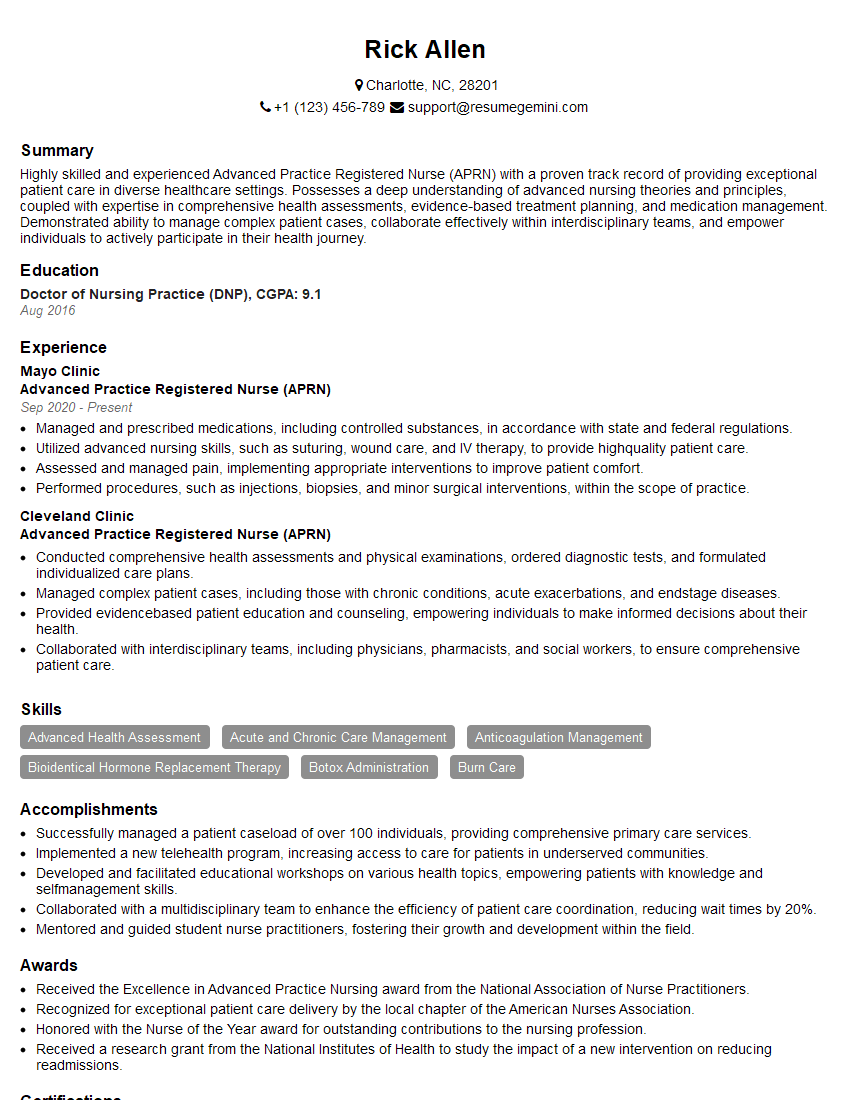
Rick Allen
Advanced Practice Registered Nurse (APRN)
Summary
Highly skilled and experienced Advanced Practice Registered Nurse (APRN) with a proven track record of providing exceptional patient care in diverse healthcare settings. Possesses a deep understanding of advanced nursing theories and principles, coupled with expertise in comprehensive health assessments, evidence-based treatment planning, and medication management. Demonstrated ability to manage complex patient cases, collaborate effectively within interdisciplinary teams, and empower individuals to actively participate in their health journey.
Education
Doctor of Nursing Practice (DNP)
August 2016
Skills
- Advanced Health Assessment
- Acute and Chronic Care Management
- Anticoagulation Management
- Bioidentical Hormone Replacement Therapy
- Botox Administration
- Burn Care
Work Experience
Advanced Practice Registered Nurse (APRN)
- Managed and prescribed medications, including controlled substances, in accordance with state and federal regulations.
- Utilized advanced nursing skills, such as suturing, wound care, and IV therapy, to provide highquality patient care.
- Assessed and managed pain, implementing appropriate interventions to improve patient comfort.
- Performed procedures, such as injections, biopsies, and minor surgical interventions, within the scope of practice.
Advanced Practice Registered Nurse (APRN)
- Conducted comprehensive health assessments and physical examinations, ordered diagnostic tests, and formulated individualized care plans.
- Managed complex patient cases, including those with chronic conditions, acute exacerbations, and endstage diseases.
- Provided evidencebased patient education and counseling, empowering individuals to make informed decisions about their health.
- Collaborated with interdisciplinary teams, including physicians, pharmacists, and social workers, to ensure comprehensive patient care.
Accomplishments
- Successfully managed a patient caseload of over 100 individuals, providing comprehensive primary care services.
- Implemented a new telehealth program, increasing access to care for patients in underserved communities.
- Developed and facilitated educational workshops on various health topics, empowering patients with knowledge and selfmanagement skills.
- Collaborated with a multidisciplinary team to enhance the efficiency of patient care coordination, reducing wait times by 20%.
- Mentored and guided student nurse practitioners, fostering their growth and development within the field.
Awards
- Received the Excellence in Advanced Practice Nursing award from the National Association of Nurse Practitioners.
- Recognized for exceptional patient care delivery by the local chapter of the American Nurses Association.
- Honored with the Nurse of the Year award for outstanding contributions to the nursing profession.
- Received a research grant from the National Institutes of Health to study the impact of a new intervention on reducing readmissions.
Certificates
- ANCC Board Certification: Family Nurse Practitioner
- ANCC Board Certification: Psychiatric Mental Health Nurse Practitioner
- ANCC Board Certification: Acute Care Nurse Practitioner
- AANP Board Certification: Family Nurse Practitioner
Career Expert Tips:
- Select the ideal resume template to showcase your professional experience effectively.
- Master the art of resume writing to highlight your unique qualifications and achievements.
- Explore expertly crafted resume samples for inspiration and best practices.
- Build your best resume for free this new year with ResumeGemini. Enjoy exclusive discounts on ATS optimized resume templates.
How To Write Resume For Advanced Practice Registered Nurse (APRN)
- Highlight your advanced nursing skills and certifications, such as Family Nurse Practitioner (FNP), Adult-Gerontology Primary Care Nurse Practitioner (AGPCNP), or Neonatal Nurse Practitioner (NNP).
- Showcase your experience in managing complex patient cases and demonstrate your ability to provide evidence-based care in both acute and chronic settings.
- Emphasize your collaboration skills and ability to work effectively within interdisciplinary teams, ensuring seamless patient care transitions.
- Quantify your accomplishments whenever possible, using specific metrics and data to demonstrate the impact of your interventions on patient outcomes.
- Tailor your resume to each specific job application, highlighting the skills and experiences that are most relevant to the position you are applying for.
Essential Experience Highlights for a Strong Advanced Practice Registered Nurse (APRN) Resume
- Conduct comprehensive health assessments and physical examinations, utilizing critical thinking and advanced nursing skills to gather and analyze patient data.
- Develop and implement individualized care plans that address the unique needs of patients, taking into consideration their medical history, lifestyle, and preferences.
- Provide patient education and counseling on health conditions, treatment options, and healthy living practices, empowering individuals to make informed decisions about their care.
- Collaborate with physicians, pharmacists, social workers, and other healthcare professionals to ensure a cohesive and comprehensive approach to patient care.
- Manage and prescribe medications, including controlled substances, in accordance with state and federal regulations, ensuring patient safety and adherence to best practices.
- Utilize advanced nursing skills, such as suturing, wound care, and IV therapy, to provide high-quality patient care and address acute and chronic conditions.
- Asses and manage pain, implementing appropriate interventions to improve patient comfort and well-being.
Frequently Asked Questions (FAQ’s) For Advanced Practice Registered Nurse (APRN)
What are the educational requirements to become an APRN?
To become an APRN, you typically need to obtain a Master of Science in Nursing (MSN) or a Doctor of Nursing Practice (DNP) degree from an accredited nursing program. Some states may also require APRNs to complete a Post-Master’s Certificate program in Advanced Practice Nursing.
What are the different types of APRNs?
There are four main types of APRNs: Certified Registered Nurse Anesthetists (CRNAs), Certified Nurse-Midwives (CNMs), Clinical Nurse Specialists (CNSs), and Nurse Practitioners (NPs). Each type of APRN has a unique scope of practice and area of specialization.
What is the scope of practice for APRNs?
The scope of practice for APRNs varies depending on their state of licensure and certification. Generally, APRNs can perform a wide range of tasks, including conducting physical exams, diagnosing and treating illnesses, prescribing medications, and ordering diagnostic tests.
Is there a high demand for APRNs?
Yes, there is a high demand for APRNs due to the increasing need for healthcare services and the shortage of physicians. APRNs are playing an increasingly important role in providing primary and specialty care to patients in a variety of settings.
What is the salary range for APRNs?
The salary range for APRNs varies depending on their specialty, level of experience, and geographic location. According to the U.S. Bureau of Labor Statistics, the median annual salary for Nurse Practitioners was $114,500 in May 2022.
What are the career advancement opportunities for APRNs?
APRNs have a variety of career advancement opportunities, including moving into leadership positions, such as nurse manager or director of nursing, obtaining additional certifications or degrees, or pursuing research or teaching roles.