Are you a seasoned Cardiovascular Sonographer seeking a new career path? Discover our professionally built Cardiovascular Sonographer Resume Template. This time-saving tool provides a solid foundation for your job search. Simply click “Edit Resume” to customize it with your unique experiences and achievements. Customize fonts and colors to match your personal style and increase your chances of landing your dream job. Explore more Resume Templates for additional options.






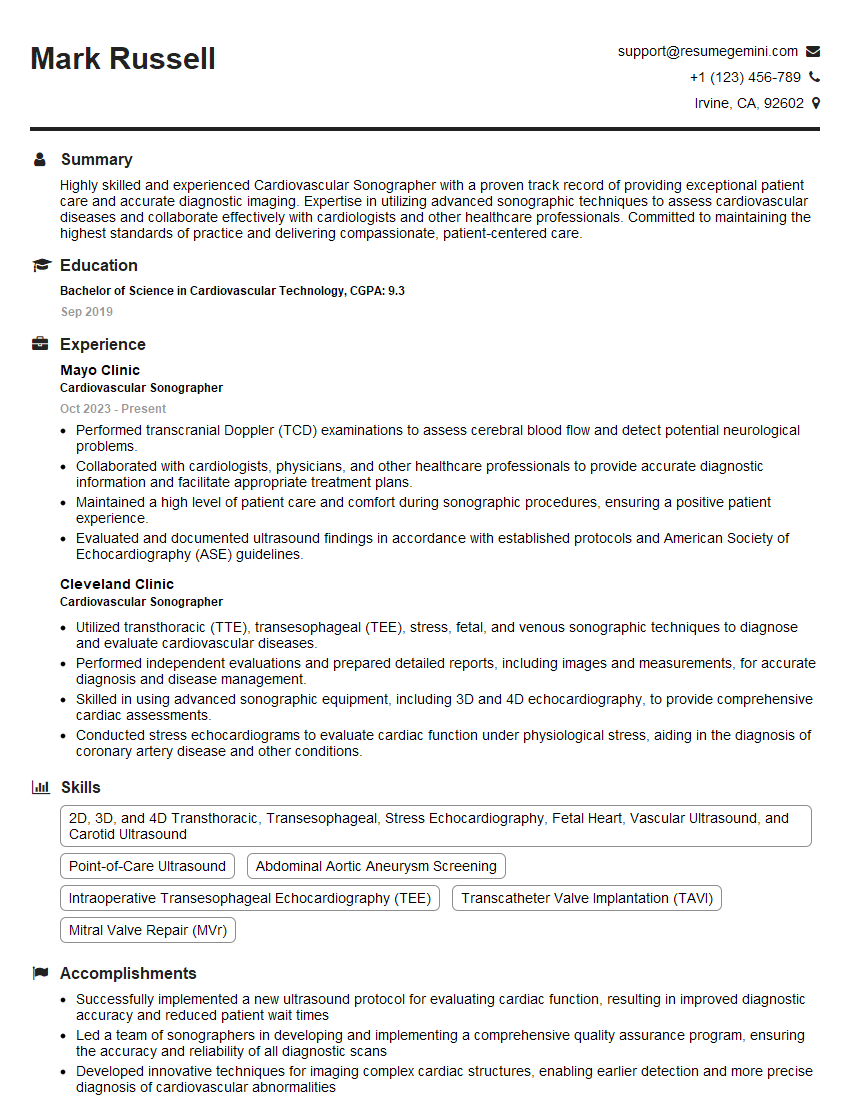
Mark Russell
Cardiovascular Sonographer
Summary
Highly skilled and experienced Cardiovascular Sonographer with a proven track record of providing exceptional patient care and accurate diagnostic imaging. Expertise in utilizing advanced sonographic techniques to assess cardiovascular diseases and collaborate effectively with cardiologists and other healthcare professionals. Committed to maintaining the highest standards of practice and delivering compassionate, patient-centered care.
Education
Bachelor of Science in Cardiovascular Technology
September 2019
Skills
- 2D, 3D, and 4D Transthoracic, Transesophageal, Stress Echocardiography, Fetal Heart, Vascular Ultrasound, and Carotid Ultrasound
- Point-of-Care Ultrasound
- Abdominal Aortic Aneurysm Screening
- Intraoperative Transesophageal Echocardiography (TEE)
- Transcatheter Valve Implantation (TAVI)
- Mitral Valve Repair (MVr)
Work Experience
Cardiovascular Sonographer
- Performed transcranial Doppler (TCD) examinations to assess cerebral blood flow and detect potential neurological problems.
- Collaborated with cardiologists, physicians, and other healthcare professionals to provide accurate diagnostic information and facilitate appropriate treatment plans.
- Maintained a high level of patient care and comfort during sonographic procedures, ensuring a positive patient experience.
- Evaluated and documented ultrasound findings in accordance with established protocols and American Society of Echocardiography (ASE) guidelines.
Cardiovascular Sonographer
- Utilized transthoracic (TTE), transesophageal (TEE), stress, fetal, and venous sonographic techniques to diagnose and evaluate cardiovascular diseases.
- Performed independent evaluations and prepared detailed reports, including images and measurements, for accurate diagnosis and disease management.
- Skilled in using advanced sonographic equipment, including 3D and 4D echocardiography, to provide comprehensive cardiac assessments.
- Conducted stress echocardiograms to evaluate cardiac function under physiological stress, aiding in the diagnosis of coronary artery disease and other conditions.
Accomplishments
- Successfully implemented a new ultrasound protocol for evaluating cardiac function, resulting in improved diagnostic accuracy and reduced patient wait times
- Led a team of sonographers in developing and implementing a comprehensive quality assurance program, ensuring the accuracy and reliability of all diagnostic scans
- Developed innovative techniques for imaging complex cardiac structures, enabling earlier detection and more precise diagnosis of cardiovascular abnormalities
- Collaborated with cardiologists and interventionalists to provide intraoperative guidance during complex cardiac procedures, ensuring optimal outcomes
- Trained and mentored junior sonographers, fostering the growth and development of future professionals in the field
Awards
- Recipient of the American Society of Echocardiography (ASE) Excellence in Echocardiography Award
- Honored with the Society of Cardiovascular Ultrasound (SCU) Professional Recognition Award for outstanding contributions to the field
- Awarded the National Board of Echocardiography (NBE) Advanced Certification in Adult Transthoracic Echocardiography
- Received the Alliance for Physician Certification (APC) Advanced Cardiovascular Sonographer Credential (ACSCA)
Certificates
- Registered Cardiovascular Sonographer (RCVS)
- Diplomate of Cardiovascular Medicine (DCM)
- Registered Diagnostic Cardiac Sonographer (RDCS)
- Registered Vascular Sonographer (RVS)
Career Expert Tips:
- Select the ideal resume template to showcase your professional experience effectively.
- Master the art of resume writing to highlight your unique qualifications and achievements.
- Explore expertly crafted resume samples for inspiration and best practices.
- Build your best resume for free this new year with ResumeGemini. Enjoy exclusive discounts on ATS optimized resume templates.
How To Write Resume For Cardiovascular Sonographer
- Highlight your expertise in various sonographic techniques and advanced equipment.
- Quantify your accomplishments and provide specific examples of how your contributions impacted patient care.
- Demonstrate your commitment to professional development and maintaining up-to-date knowledge.
- Emphasize your strong communication and interpersonal skills, as well as your ability to work effectively in a team environment.
Essential Experience Highlights for a Strong Cardiovascular Sonographer Resume
- Performed transthoracic, transesophageal, stress, fetal, and venous sonographic examinations to diagnose and evaluate cardiovascular diseases.
- Independently evaluated and prepared detailed reports, including images and measurements, for accurate diagnosis and disease management.
- Skilled in using advanced sonographic equipment, including 3D and 4D echocardiography, to provide comprehensive cardiac assessments.
- Conducted stress echocardiograms to evaluate cardiac function under physiological stress, aiding in the diagnosis of coronary artery disease and other conditions.
- Performed transcranial Doppler (TCD) examinations to assess cerebral blood flow and detect potential neurological problems.
- Collaborated with cardiologists, physicians, and other healthcare professionals to provide accurate diagnostic information and facilitate appropriate treatment plans.
Frequently Asked Questions (FAQ’s) For Cardiovascular Sonographer
What is the primary role of a Cardiovascular Sonographer?
Cardiovascular Sonographers use non-invasive ultrasound technology to assess the structure and function of the heart and blood vessels, aiding in the diagnosis and management of cardiovascular diseases.
What are the key skills and qualifications required for this role?
Strong technical skills in sonography, a bachelor’s degree or equivalent in cardiovascular technology, certification from recognized organizations (e.g., ARRT, CCI), and excellent communication and interpersonal abilities.
What are the different types of sonographic techniques used by Cardiovascular Sonographers?
Transthoracic, transesophageal, stress, fetal, and venous sonography, as well as advanced techniques such as 3D and 4D echocardiography.
How do Cardiovascular Sonographers contribute to patient care?
By providing accurate and timely diagnostic information, assisting in treatment planning and monitoring, and collaborating with healthcare professionals to optimize patient outcomes.
What is the job outlook for Cardiovascular Sonographers?
The field of cardiovascular sonography is growing rapidly due to increasing demand for non-invasive diagnostic imaging techniques and the aging population. Employment opportunities are expected to be excellent in the coming years.
What are the earning prospects for Cardiovascular Sonographers?
The salary range for Cardiovascular Sonographers can vary based on experience, location, and employer, but typically falls within a competitive range.