Are you a seasoned Raftsman seeking a new career path? Discover our professionally built Raftsman Resume Template. This time-saving tool provides a solid foundation for your job search. Simply click “Edit Resume” to customize it with your unique experiences and achievements. Customize fonts and colors to match your personal style and increase your chances of landing your dream job. Explore more Resume Templates for additional options.






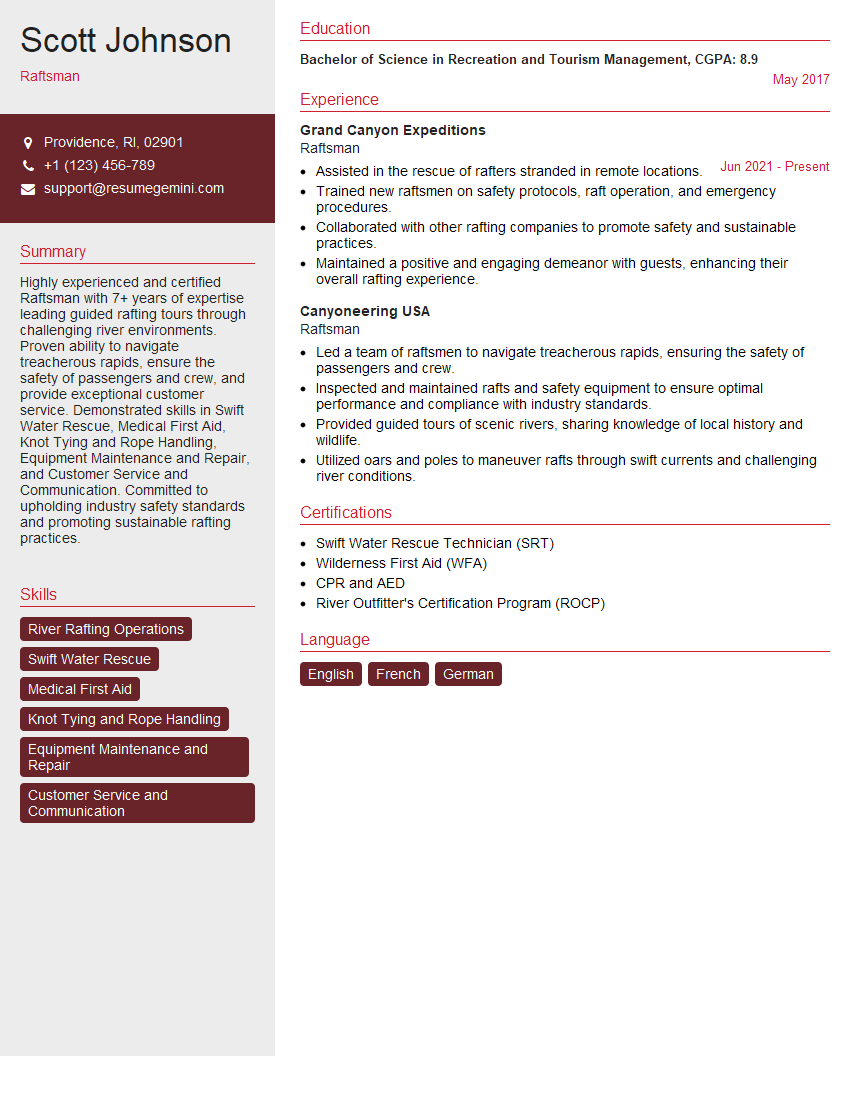
Scott Johnson
Raftsman
Summary
Highly experienced and certified Raftsman with 7+ years of expertise leading guided rafting tours through challenging river environments. Proven ability to navigate treacherous rapids, ensure the safety of passengers and crew, and provide exceptional customer service. Demonstrated skills in Swift Water Rescue, Medical First Aid, Knot Tying and Rope Handling, Equipment Maintenance and Repair, and Customer Service and Communication. Committed to upholding industry safety standards and promoting sustainable rafting practices.
Education
Bachelor of Science in Recreation and Tourism Management
May 2017
Skills
- River Rafting Operations
- Swift Water Rescue
- Medical First Aid
- Knot Tying and Rope Handling
- Equipment Maintenance and Repair
- Customer Service and Communication
Work Experience
Raftsman
- Assisted in the rescue of rafters stranded in remote locations.
- Trained new raftsmen on safety protocols, raft operation, and emergency procedures.
- Collaborated with other rafting companies to promote safety and sustainable practices.
- Maintained a positive and engaging demeanor with guests, enhancing their overall rafting experience.
Raftsman
- Led a team of raftsmen to navigate treacherous rapids, ensuring the safety of passengers and crew.
- Inspected and maintained rafts and safety equipment to ensure optimal performance and compliance with industry standards.
- Provided guided tours of scenic rivers, sharing knowledge of local history and wildlife.
- Utilized oars and poles to maneuver rafts through swift currents and challenging river conditions.
Certificates
- Swift Water Rescue Technician (SRT)
- Wilderness First Aid (WFA)
- CPR and AED
- River Outfitter’s Certification Program (ROCP)
Languages
- English
- French
- German
Career Expert Tips:
- Select the ideal resume template to showcase your professional experience effectively.
- Master the art of resume writing to highlight your unique qualifications and achievements.
- Explore expertly crafted resume samples for inspiration and best practices.
- Build your best resume for free this new year with ResumeGemini. Enjoy exclusive discounts on ATS optimized resume templates.
How To Write Resume For Raftsman
- Highlight your Swift Water Rescue certification and any additional safety training or experience to demonstrate your commitment to safety.
- Showcase your customer service skills by emphasizing your ability to create a positive and memorable experience for guests.
- Quantify your accomplishments whenever possible, such as the number of successful rescue operations or the number of guided tours you have led.
- Tailor your resume to each specific job you apply for, highlighting the skills and experience most relevant to the position.
- Consider including a video or portfolio of your rafting adventures to visually showcase your abilities and passion for the profession.
Essential Experience Highlights for a Strong Raftsman Resume
- Directed rafting trips through dynamic river conditions, skillfully navigating rapids and ensuring guest safety
- Inspected and maintained rafts, oars, and safety equipment to guarantee optimal performance, adhering to industry regulations
- Conducted guided tours, engaging guests with local history, wildlife, and river ecology, enriching their experience
- Coordinated rescue operations for stranded rafters, demonstrating quick thinking and proficiency in Swift Water Rescue
- Trained and mentored new raftsmen, imparting safety protocols, raft operation techniques, and emergency procedures
- Collaborated with other rafting companies to enhance safety standards and advocate for responsible rafting practices
- Maintained a positive and professional demeanor while interacting with guests, enhancing their overall rafting experience
Frequently Asked Questions (FAQ’s) For Raftsman
What are the primary responsibilities of a Raftsman?
Raftsmen are responsible for guiding and navigating rafts through rivers, ensuring the safety of passengers and crew, inspecting and maintaining rafts and safety equipment, providing guided tours, assisting in rescue operations, and training new raftsmen. They must also collaborate with other rafting companies to promote safety and sustainable practices, and maintain a positive and engaging demeanor with guests.
What qualifications and skills are required to become a Raftsman?
To become a Raftsman, you typically need a high school diploma or equivalent, as well as experience in rafting and river navigation. Additional qualifications, such as a degree in recreation or tourism management, and certifications in Swift Water Rescue and Medical First Aid, are highly desirable. Essential skills include the ability to navigate rivers, handle rafts, and rescue rafters in emergency situations, as well as strong communication and customer service skills.
What is the work environment of a Raftsman like?
Raftsmen work in a dynamic and challenging environment, often navigating through fast-moving rivers and rapids. They must be able to work independently and as part of a team, and be comfortable working in all weather conditions. Raftsmen must also be physically fit and able to withstand long hours of paddling and maneuvering rafts through demanding river conditions.
What are the career prospects for Raftsmen?
Raftsmen can advance their careers by gaining experience and certifications, and by taking on leadership roles within their organizations. They may also choose to specialize in a particular area of rafting, such as whitewater rafting or wilderness rafting. With experience and dedication, Raftsmen can progress to supervisory or management positions, or become trainers or instructors.
What are the safety protocols that Raftsmen must follow?
Raftsmen must adhere to strict safety protocols to ensure the safety of passengers and crew. These protocols include wearing appropriate safety gear, such as life jackets and helmets, inspecting rafts and equipment before and after each trip, and following established river navigation procedures. Raftsmen must also be trained in Swift Water Rescue techniques and be able to respond effectively to emergencies.
What are the physical and mental demands of being a Raftsman?
Raftsmen must be physically fit and able to withstand the demands of navigating rafts through challenging river conditions. They must be able to paddle for long periods of time, maneuver rafts through rapids, and lift and carry heavy equipment. Raftsmen must also be mentally alert and able to make quick decisions in emergency situations.
What are the rewards of being a Raftsman?
Raftsmen enjoy the rewards of working in a dynamic and challenging environment, and of sharing their love of rafting with others. They have the opportunity to explore beautiful and remote rivers, and to make a positive impact on the lives of their guests. Raftsmen also appreciate the camaraderie and teamwork that is essential to their profession.
What advice would you give to someone considering a career as a Raftsman?
If you are considering a career as a Raftsman, I would advise you to gain as much experience as possible on the water. Volunteer with rafting companies, take rafting courses, and practice your paddling and river navigation skills. You should also be prepared to work hard and to be dedicated to safety. Raftsmen must be able to handle the physical and mental demands of the job, and they must be committed to providing a safe and enjoyable experience for their guests.