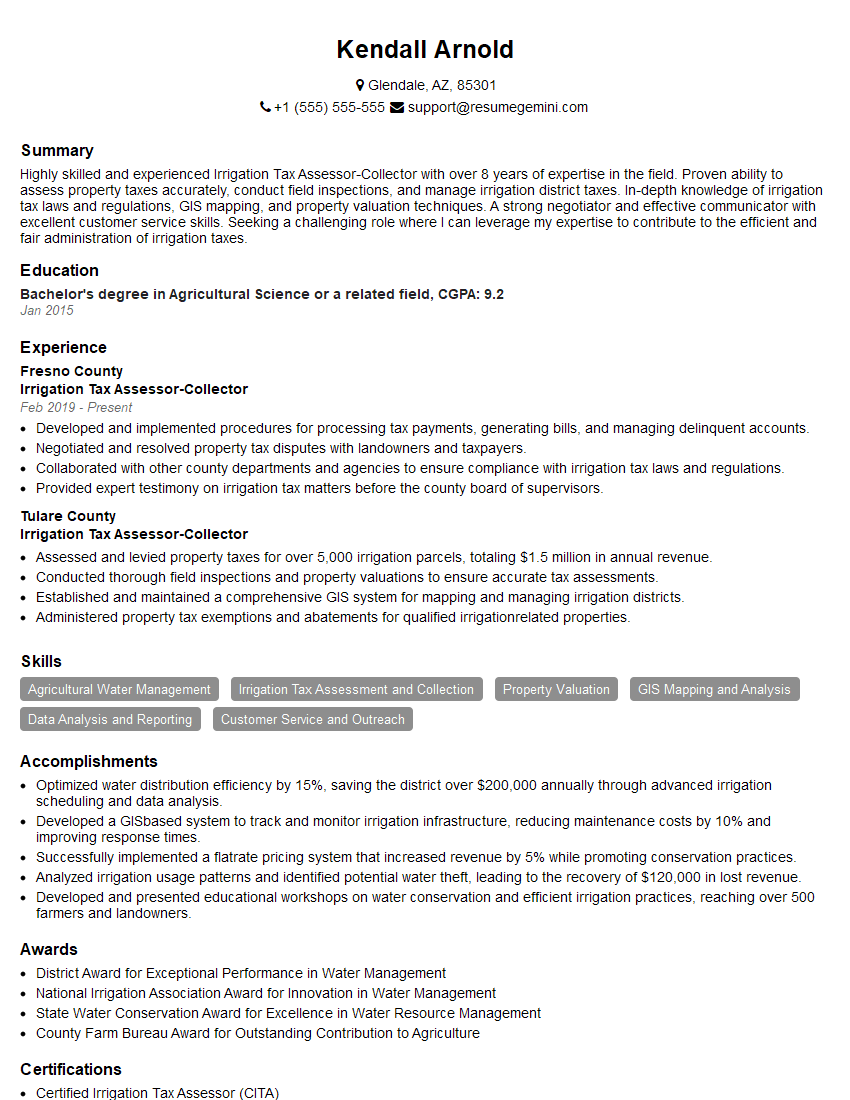
Are you gearing up for a career shift or aiming to ace your next interview? Look no further! We’ve curated a comprehensive guide to help you crack the interview for the coveted Irrigation Tax Assessor-Collector position. From understanding the key responsibilities to mastering the most commonly asked questions, this blog has you covered. So, buckle up and let’s embark on this journey together.
Acing the interview is crucial, but landing one requires a compelling resume that gets you noticed. Crafting a professional document that highlights your skills and experience is the first step toward interview success. ResumeGemini can help you build a standout resume that gets you called in for that dream job.






Essential Interview Questions For Irrigation Tax Assessor-Collector
1. What are the key responsibilities of an Irrigation Tax Assessor-Collector?
- Assess and collect irrigation taxes from landowners within the district.
- Maintain records of all assessments and collections.
- Investigate and resolve taxpayer complaints.
- Enforce irrigation tax laws and regulations.
- Prepare and submit financial reports to the board of directors.
2. How do you calculate irrigation taxes?
- Irrigation taxes are typically based on the amount of land irrigated and the type of crop being grown.
- I would first determine the acreage of irrigated land and then multiply that by the applicable tax rate.
- I would also consider any special assessments or exemptions that may apply.
3. What are the most common taxpayer complaints you encounter?
- The most common taxpayer complaints I encounter are related to the accuracy of the assessment.
- Taxpayers may believe that their land is being over-assessed or that they are being charged an incorrect tax rate.
- I would always investigate these complaints thoroughly and make any necessary adjustments.
4. How do you enforce irrigation tax laws and regulations?
- I would first try to work with taxpayers to resolve any issues.
- If a taxpayer refuses to pay their taxes, I may have to take legal action, such as filing a lien against their property.
- I would always follow all applicable laws and regulations when enforcing irrigation tax laws.
5. What are the challenges of working as an Irrigation Tax Assessor-Collector?
- One of the biggest challenges is dealing with taxpayers who are upset about their taxes.
- It is important to be able to remain calm and professional, even when dealing with difficult taxpayers.
- Another challenge is staying up-to-date on all of the applicable laws and regulations.
6. What are your strengths and weaknesses as an Irrigation Tax Assessor-Collector?
Strengths:
- I am a highly organized and detail-oriented individual.
- I have a strong understanding of irrigation tax laws and regulations.
- I am able to communicate effectively with taxpayers and resolve their complaints.
Weaknesses:
- I am relatively new to the field of irrigation tax assessment.
- I have not had much experience in enforcing irrigation tax laws and regulations.
7. Why are you interested in working as an Irrigation Tax Assessor-Collector?
- I am interested in working as an Irrigation Tax Assessor-Collector because I am passionate about helping to ensure that all taxpayers are treated fairly.
- I believe that my skills and experience would be a valuable asset to your team.
- I am also eager to learn more about the field of irrigation tax assessment and enforcement.
8. What are your salary expectations?
I am open to discussing salary expectations. I am confident that I can bring value to your organization and am willing to negotiate a fair salary.
9. Are you willing to relocate?
Yes, I am willing to relocate for the right opportunity.
10. Do you have any questions for me?
- What are the biggest challenges facing the irrigation district right now?
- What are your goals for the irrigation district in the next five years?
- How do you see the role of the Irrigation Tax Assessor-Collector evolving in the future?
Interviewers often ask about specific skills and experiences. With ResumeGemini‘s customizable templates, you can tailor your resume to showcase the skills most relevant to the position, making a powerful first impression. Also check out Resume Template specially tailored for Irrigation Tax Assessor-Collector.
Career Expert Tips:
- Ace those interviews! Prepare effectively by reviewing the Top 50 Most Common Interview Questions on ResumeGemini.
- Navigate your job search with confidence! Explore a wide range of Career Tips on ResumeGemini. Learn about common challenges and recommendations to overcome them.
- Craft the perfect resume! Master the Art of Resume Writing with ResumeGemini’s guide. Showcase your unique qualifications and achievements effectively.
- Great Savings With New Year Deals and Discounts! In 2025, boost your job search and build your dream resume with ResumeGemini’s ATS optimized templates.
Researching the company and tailoring your answers is essential. Once you have a clear understanding of the Irrigation Tax Assessor-Collector‘s requirements, you can use ResumeGemini to adjust your resume to perfectly match the job description.
Key Job Responsibilities
The Irrigation Tax Assessor-Collector is responsible for the assessment and collection of irrigation taxes within a specified jurisdiction. These taxes are levied on landowners and businesses that benefit from irrigation water. The key job responsibilities include:
1. Assessment of Irrigation Taxes
Determining the value of irrigable land and improvements
- Calculating irrigation tax rates based on land values and water usage
- Preparing tax rolls and sending out tax bills to property owners
2. Collection of Irrigation Taxes
Receiving and processing tax payments
- Enforcing tax collection through legal means if necessary
- Maintaining accurate records of tax payments and delinquencies
3. Customer Service
Answering questions from property owners about irrigation taxes
- Providing assistance with tax payment options
- Resolving tax disputes
4. Record Keeping and Reporting
Maintaining detailed records of assessments, collections, and other activities
- Preparing regular reports on irrigation tax revenue and expenditures
- Providing data for budgeting and planning purposes
Interview Tips
Preparing for an interview for an Irrigation Tax Assessor-Collector position requires research, practice, and a strategic approach. Here are some tips to help you ace the interview:
1. Research the Irrigation District
Thoroughly research the irrigation district where you are applying for the job. This will give you a good understanding of the district’s history, mission, and operations.
- Review the district’s website
- Attend public meetings
- Read local news articles about the district
2. Practice Answering Common Interview Questions
There are some common interview questions that you can expect to be asked, such as:
- Why are you interested in this position?
- What are your qualifications for this job?
- What are your strengths and weaknesses?
- How do you handle conflict?
3. Prepare Questions to Ask the Interviewer
Asking thoughtful questions at the end of the interview shows that you are engaged and interested in the job. Consider asking about:
- The district’s current challenges and opportunities
- The role of the Irrigation Tax Assessor-Collector within the district
- The district’s plans for the future
4. Dress Professionally and Arrive on Time
First impressions matter, so make sure you dress professionally and arrive for your interview on time. This shows that you respect the interviewer’s time and that you are serious about the position.
Next Step:
Now that you’re armed with the knowledge of Irrigation Tax Assessor-Collector interview questions and responsibilities, it’s time to take the next step. Build or refine your resume to highlight your skills and experiences that align with this role. Don’t be afraid to tailor your resume to each specific job application. Finally, start applying for Irrigation Tax Assessor-Collector positions with confidence. Remember, preparation is key, and with the right approach, you’ll be well on your way to landing your dream job. Build an amazing resume with ResumeGemini