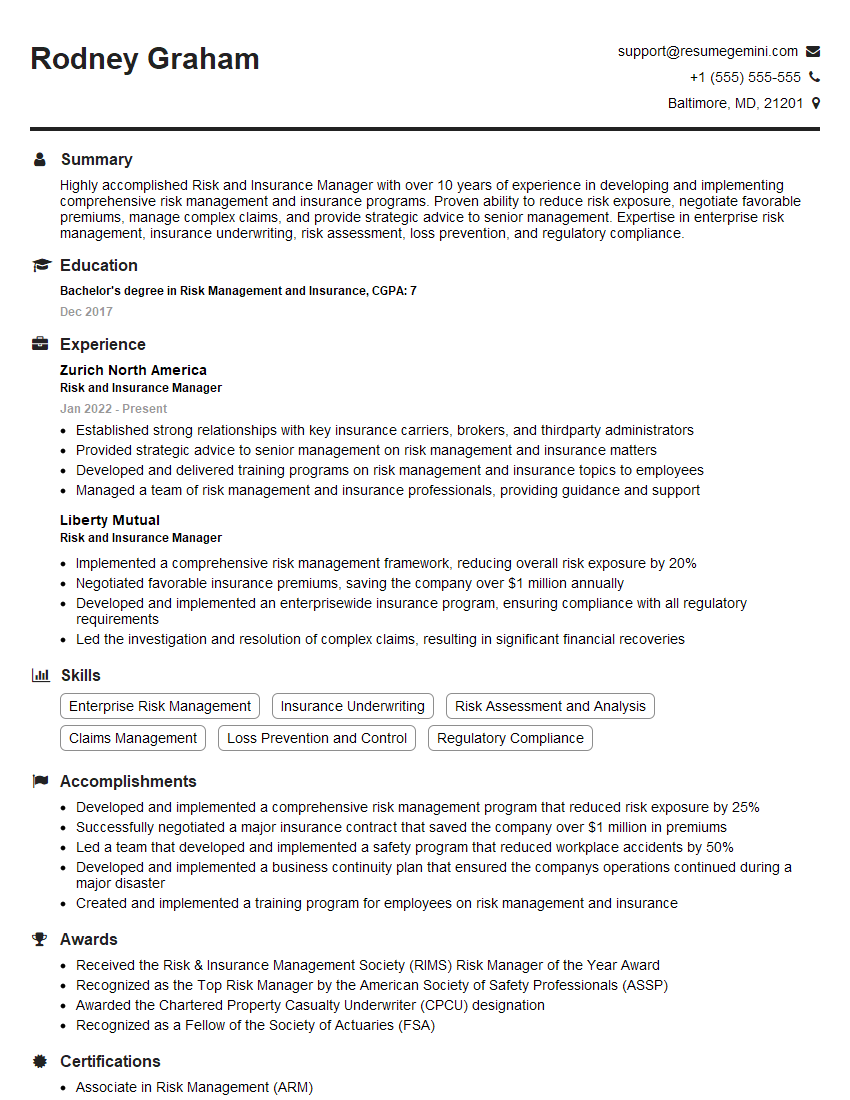
Ever felt underprepared for that crucial job interview? Or perhaps you’ve landed the interview but struggled to articulate your skills and experiences effectively? Fear not! We’ve got you covered. In this blog post, we’re diving deep into the Risk and Insurance Manager interview questions that you’re most likely to encounter. But that’s not all. We’ll also provide expert insights into the key responsibilities of a Risk and Insurance Manager so you can tailor your answers to impress potential employers.
Acing the interview is crucial, but landing one requires a compelling resume that gets you noticed. Crafting a professional document that highlights your skills and experience is the first step toward interview success. ResumeGemini can help you build a standout resume that gets you called in for that dream job.






Essential Interview Questions For Risk and Insurance Manager
1. How do you approach the process of identifying and assessing risks in a business environment?
- Begin by understanding the business’s objectives, operations, and external environment.
- Conduct risk assessments using various techniques, such as risk matrices, probability and impact analysis, and scenario planning.
- Identify potential risks, evaluate their likelihood and potential impact, and prioritize them based on their significance.
- Develop mitigation strategies to address identified risks and reduce their potential impact on the business.
2. What are the key principles of insurance underwriting?
- Assess the characteristics of the risk to determine its acceptability.
- Use underwriting guidelines to evaluate the risk’s insurability.
- Calculate the premium based on the risk’s characteristics and the insurer’s risk tolerance.
- Use actuarial techniques to determine appropriate premium rates.
- Draft policy language that clearly defines the terms and conditions of the coverage.
- Ensure the policy language is unambiguous and legally enforceable.
Risk Selection
Rate Making
Policy Wording
3. Explain the concept of risk financing and discuss the various methods available to businesses.
Risk financing involves managing and mitigating financial risks faced by businesses. Methods include:
- Risk Retention: Accepting and managing risks within the business’s own resources.
- Insurance: Transferring risks to an insurance company in exchange for premiums.
- Hedging: Using financial instruments to offset or reduce the impact of risks.
- Diversification: Spreading risks across different assets or businesses to reduce overall exposure.
4. What are the key elements of a comprehensive risk management program?
- Risk identification and assessment
- Risk mitigation and control
- Risk financing and insurance
- Risk monitoring and reporting
- Continuous improvement and review
5. How do you stay up-to-date with emerging risks and industry best practices in risk management?
- Attend conferences and industry events.
- Read industry publications and research reports.
- Network with other risk professionals.
- Obtain professional certifications and designations.
- Participate in online forums and discussion groups.
6. What are some of the challenges and opportunities you see in the future of risk management?
- Increasing complexity and interconnectedness of risks
- Cybersecurity threats
- Climate change and environmental risks
- Advancements in technology and data analytics
- Growing awareness of risk management
- Expansion of risk financing and insurance markets
Challenges
Opportunities
7. How do you approach the task of communicating risk-related information to non-technical stakeholders?
- Use simple and clear language
- Focus on the most important risks
- Provide context and examples
- Tailor the message to the audience
- Use visual aids and infographics
8. What is your experience in managing risk in the face of uncertainty and changing conditions?
Explain your approach to dealing with uncertainty, including:
- Assessing the likelihood and potential impact of different scenarios
- Developing contingency plans and mitigation strategies
- Monitoring and evaluating risks on an ongoing basis
- Adapting risk management strategies as conditions change
9. How do you measure and evaluate the effectiveness of risk management programs?
Metrics and methods include:
- Risk metrics (e.g., loss ratios, risk scores)
- Performance reviews and audits
- Feedback from stakeholders
- Comparison to industry benchmarks
- Measurement of risk reduction or mitigation
10. What are your strengths and weaknesses as a Risk and Insurance Manager?
- Strong technical skills in risk assessment, underwriting, and insurance.
- Excellent communication and interpersonal skills.
- Ability to think strategically and make sound decisions under pressure.
- Limited experience in certain specialized areas of risk management (e.g., cyber risk).
- Can be detail-oriented at times, which may slow down decision-making in urgent situations.
Strengths
Weaknesses
Interviewers often ask about specific skills and experiences. With ResumeGemini‘s customizable templates, you can tailor your resume to showcase the skills most relevant to the position, making a powerful first impression. Also check out Resume Template specially tailored for Risk and Insurance Manager.
Career Expert Tips:
- Ace those interviews! Prepare effectively by reviewing the Top 50 Most Common Interview Questions on ResumeGemini.
- Navigate your job search with confidence! Explore a wide range of Career Tips on ResumeGemini. Learn about common challenges and recommendations to overcome them.
- Craft the perfect resume! Master the Art of Resume Writing with ResumeGemini’s guide. Showcase your unique qualifications and achievements effectively.
- Great Savings With New Year Deals and Discounts! In 2025, boost your job search and build your dream resume with ResumeGemini’s ATS optimized templates.
Researching the company and tailoring your answers is essential. Once you have a clear understanding of the Risk and Insurance Manager‘s requirements, you can use ResumeGemini to adjust your resume to perfectly match the job description.
Key Job Responsibilities
The Risk and Insurance Manager is responsible for developing, implementing, and maintaining a comprehensive risk management and insurance program for the organization. This includes identifying, assessing, and mitigating risks, as well as procuring and managing insurance coverage. The Risk and Insurance Manager works closely with senior management to ensure that the organization’s risk management and insurance needs are aligned with its overall business objectives.
1. Risk Management
The Risk and Insurance Manager is responsible for developing and implementing a comprehensive risk management program for the organization. This includes identifying, assessing, and mitigating risks to the organization’s assets, operations, and reputation. The Risk and Insurance Manager also works with senior management to ensure that the organization’s risk management program is aligned with its overall business objectives.
- Identify and assess risks to the organization’s assets, operations, and reputation.
- Develop and implement risk management strategies to mitigate risks.
- Monitor and evaluate the effectiveness of risk management strategies.
- Report on risks and risk management activities to senior management.
2. Insurance Management
The Risk and Insurance Manager is responsible for procuring and managing insurance coverage for the organization. This includes selecting insurance carriers, negotiating insurance policies, and managing claims. The Risk and Insurance Manager also works with senior management to ensure that the organization’s insurance coverage is adequate and cost-effective.
- Select insurance carriers and negotiate insurance policies.
- Manage insurance claims.
- Monitor and evaluate the adequacy and cost-effectiveness of insurance coverage.
- Report on insurance coverage and claims to senior management.
3. Compliance
The Risk and Insurance Manager is responsible for ensuring that the organization complies with all applicable laws and regulations related to risk management and insurance. This includes maintaining accurate records, filing required reports, and cooperating with regulatory authorities.
- Maintain accurate records of risk management and insurance activities.
- File required reports to regulatory authorities.
- Cooperate with regulatory authorities in investigations and audits.
4. Education and Training
The Risk and Insurance Manager is responsible for educating and training employees on risk management and insurance. This includes developing and delivering training programs, as well as answering questions from employees.
- Develop and deliver training programs on risk management and insurance.
- Answer questions from employees about risk management and insurance.
- Stay up-to-date on the latest risk management and insurance trends.
Interview Tips
Preparing for an interview is essential for success. Here are a few tips to help you ace your interview for a Risk and Insurance Manager position.
1. Research the Company and the Position
Before the interview, take some time to learn more about the company and the position. This will help you to understand the company’s culture, business objectives, and risk management needs. You can research the company’s website, annual reports, and news articles.
- Visit the company’s website to learn about its history, mission, and values.
- Read the company’s annual report to learn about its financial performance and risk management practices.
- Search for news articles about the company to learn about its recent developments and challenges.
2. Practice Answering Common Interview Questions
There are a number of common interview questions that you are likely to be asked in an interview for a Risk and Insurance Manager position. It is helpful to practice answering these questions in advance so that you can deliver confident and thoughtful responses.
- Tell me about your experience in risk management.
- What are the most important qualities of a Risk and Insurance Manager?
- How would you approach developing a risk management program for a new organization?
- What are the biggest challenges facing risk managers today?
3. Prepare Questions for the Interviewer
Asking questions at the end of the interview shows that you are interested in the position and that you have done your research. It is also a good way to learn more about the company and the position.
- What are the company’s biggest risk management challenges?
- What is the company’s risk appetite?
- How does the company measure the effectiveness of its risk management program?
- What are the company’s plans for future growth and development?
4. Dress Professionally and Arrive on Time
It is important to dress professionally and arrive on time for your interview. This shows that you respect the interviewer’s time and that you are serious about the position.
- Wear a suit or business casual attire.
- Be punctual and arrive on time for your interview.
5. Be Yourself and Be Confident
It is important to be yourself and be confident in your abilities. The interviewer will be able to tell if you are being genuine, and they will be more likely to hire someone who is confident and enthusiastic about the position.
- Be yourself and don’t try to be someone you’re not.
- Be confident in your abilities and your qualifications.
Next Step:
Armed with this knowledge, you’re now well-equipped to tackle the Risk and Insurance Manager interview with confidence. Remember, a well-crafted resume is your first impression. Take the time to tailor your resume to highlight your relevant skills and experiences. And don’t forget to practice your answers to common interview questions. With a little preparation, you’ll be on your way to landing your dream job. So what are you waiting for? Start building your resume and start applying! Build an amazing resume with ResumeGemini.