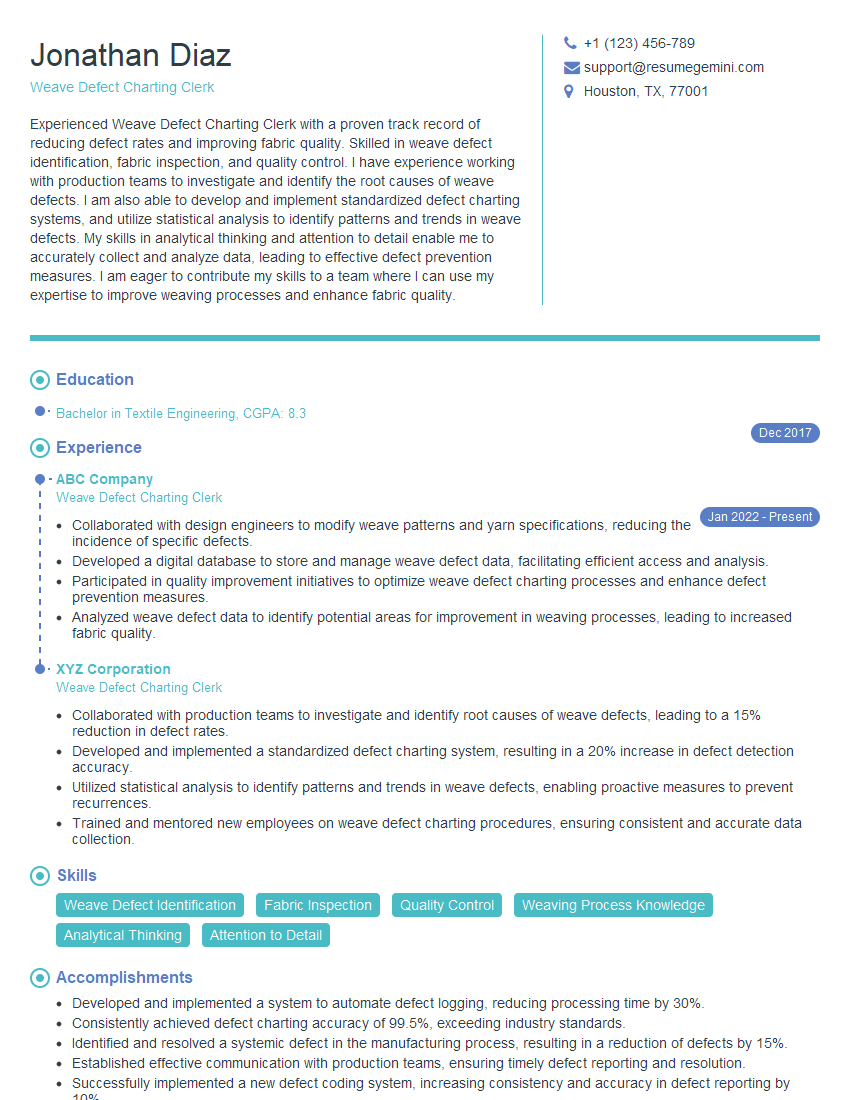
Feeling lost in a sea of interview questions? Landed that dream interview for Weave Defect Charting Clerk but worried you might not have the answers? You’re not alone! This blog is your guide for interview success. We’ll break down the most common Weave Defect Charting Clerk interview questions, providing insightful answers and tips to leave a lasting impression. Plus, we’ll delve into the key responsibilities of this exciting role, so you can walk into your interview feeling confident and prepared.
Acing the interview is crucial, but landing one requires a compelling resume that gets you noticed. Crafting a professional document that highlights your skills and experience is the first step toward interview success. ResumeGemini can help you build a standout resume that gets you called in for that dream job.






Essential Interview Questions For Weave Defect Charting Clerk
1. Explain your key responsibilities as a Weave Defect Charting Clerk?
As a Weave Defect Charting Clerk, my primary responsibilities revolve around accurately recording and documenting fabric defects during the weaving process. My duties include:
- Monitoring the weaving machines and visually inspecting the fabric for any defects or imperfections.
- Classifying and categorizing defects based on established standards and quality control guidelines.
2. Describe the techniques you use to identify and classify fabric defects?
To effectively identify and classify fabric defects, I employ a combination of visual inspection techniques and industry-standard defect charting methods. These techniques include:
- Using high-intensity lighting and magnifying glasses to enhance visibility and detect subtle flaws.
- Following established defect classification systems, such as the AQL (Acceptable Quality Level) standard or customer-specific guidelines, to ensure consistent and accurate defect identification.
3. How do you ensure the accuracy and reliability of your defect charting data?
Ensuring the accuracy and reliability of my defect charting data is crucial. I implement several measures to maintain data integrity:
- Performing regular self-audits and cross-checking my findings with other inspectors or supervisors to identify any potential errors.
- Adhering strictly to defect charting protocols and using standardized charting forms to minimize subjective interpretations.
4. How do you handle situations where you encounter unfamiliar or complex defects?
When faced with unfamiliar or complex defects, I take the following steps to ensure accurate classification:
- Consulting with more experienced inspectors, supervisors, or technical experts for their insights and guidance.
- Referring to reference materials, defect catalogs, or industry databases to find similar defects and establish appropriate classifications.
5. Explain how you communicate defect charting information to stakeholders?
Effectively communicating defect charting information is essential. I use various methods to convey my findings:
- Preparing detailed defect charts that provide clear documentation of defect types, severity, and locations.
- Attending regular quality control meetings to present and discuss defect trends, root cause analysis, and corrective action plans.
6. What software or tools do you use for defect charting and quality control?
I am proficient in using industry-standard defect charting software and quality control tools. These include:
- Defect tracking systems that allow for efficient defect logging, classification, and analysis.
- Statistical process control (SPC) software for data analysis and trend monitoring to identify quality improvement opportunities.
7. How do you stay up-to-date with the latest weaving technologies and quality control practices?
To maintain my expertise, I continuously engage in professional development activities:
- Attending industry conferences, workshops, and training programs to learn about new advancements and best practices.
- Reviewing technical literature, research articles, and industry publications to stay informed about emerging technologies and quality control techniques.
8. What is your approach to working as part of a quality control team?
In a team environment, I prioritize collaboration and open communication:
- Sharing my defect charting data with team members to facilitate comprehensive quality analysis and decision-making.
- Actively participating in root cause analysis and problem-solving efforts to improve overall fabric quality.
9. How do you prioritize defect charting activities when faced with multiple production lines?
Prioritizing defect charting activities is crucial. I follow these strategies:
- Working closely with production supervisors to understand production schedules and identify critical areas that require more frequent monitoring.
- Using defect trend analysis to allocate resources effectively and focus on areas with higher defect rates.
10. Describe a situation where you identified a recurring defect and played a role in implementing a solution?
In one instance, I consistently observed a specific type of defect on a particular weaving machine. Through detailed analysis and collaboration with the maintenance team, I identified a faulty sensor as the root cause. By working with the team, we implemented a solution that resulted in a significant reduction in defect occurrence.
Interviewers often ask about specific skills and experiences. With ResumeGemini‘s customizable templates, you can tailor your resume to showcase the skills most relevant to the position, making a powerful first impression. Also check out Resume Template specially tailored for Weave Defect Charting Clerk.
Career Expert Tips:
- Ace those interviews! Prepare effectively by reviewing the Top 50 Most Common Interview Questions on ResumeGemini.
- Navigate your job search with confidence! Explore a wide range of Career Tips on ResumeGemini. Learn about common challenges and recommendations to overcome them.
- Craft the perfect resume! Master the Art of Resume Writing with ResumeGemini’s guide. Showcase your unique qualifications and achievements effectively.
- Great Savings With New Year Deals and Discounts! In 2025, boost your job search and build your dream resume with ResumeGemini’s ATS optimized templates.
Researching the company and tailoring your answers is essential. Once you have a clear understanding of the Weave Defect Charting Clerk‘s requirements, you can use ResumeGemini to adjust your resume to perfectly match the job description.
Key Job Responsibilities
Weave Defect Charting Clerks play a crucial role in maintaining fabric quality and reducing production waste. Their primary responsibilities include:
1. Inspecting Fabrics
Examining fabrics thoroughly to identify and classify defects accurately, using established grading standards and quality criteria.
- Identifying defects such as stains, holes, yarn breaks, and weaving errors.
- Determining the severity and location of defects to facilitate repairs or discarding.
2. Charting Defects
Accurately and meticulously charting defects in a standardized format, using charting systems and symbols.
- Recording defect types, locations, and measurements on charting paper or electronic systems.
- Ensuring consistent charting practices to facilitate data analysis and tracking.
3. Reporting and Analysis
Providing regular reports and analysis to management on defect trends, quality levels, and improvement areas.
- Identifying common defects and root causes for corrective action.
- Assisting in quality improvement initiatives and problem-solving to enhance fabric quality.
4. Maintaining Records
Maintaining accurate and organized records of fabric inspections, defect charts, and reports.
- Storing and archiving records securely for quality control purposes and traceability.
- Providing documentation for audits and regulatory compliance.
Interview Preparation Tips
To ace an interview for a Weave Defect Charting Clerk position, candidates should focus on highlighting their technical skills, attention to detail, and problem-solving abilities. Here are some tips to help them prepare:
1. Research the Company and Industry
Research the potential employer’s history, mission, and products to understand their business operations and quality standards.
- Learn about the company’s reputation in the textiles industry.
- Identify industry trends and key challenges related to fabric quality.
2. Practice Charting Techniques
Familiarize yourself with the charting system and symbols used in the industry. Practice charting different types of defects on paper or electronic systems.
- Demonstrate proficiency in recording defect details accurately and consistently.
- Prepare examples of previous work or mock charts to showcase your skills.
3. Prepare for Common Questions
Review common interview questions for this role and prepare your responses by highlighting your relevant experience and qualifications.
- Explain your understanding of fabric inspection and defect charting procedures.
- Describe your experience in quality control and defect analysis.
- Share examples of how you have contributed to improving fabric quality.
4. Showcase Attention to Detail
Emphasize your meticulous nature and ability to identify and document defects accurately.
- Highlight your commitment to maintaining high-quality standards.
- Provide examples of how you pay attention to detail in other aspects of your life.
5. Be Prepared to Discuss Problem-Solving Skills
Discuss your ability to analyze defect data, identify root causes, and suggest solutions for quality improvement.
- Share examples of how you have identified and resolved quality issues in previous roles.
- Explain your approach to working in a team to solve problems.
Next Step:
Now that you’re armed with the knowledge of Weave Defect Charting Clerk interview questions and responsibilities, it’s time to take the next step. Build or refine your resume to highlight your skills and experiences that align with this role. Don’t be afraid to tailor your resume to each specific job application. Finally, start applying for Weave Defect Charting Clerk positions with confidence. Remember, preparation is key, and with the right approach, you’ll be well on your way to landing your dream job. Build an amazing resume with ResumeGemini