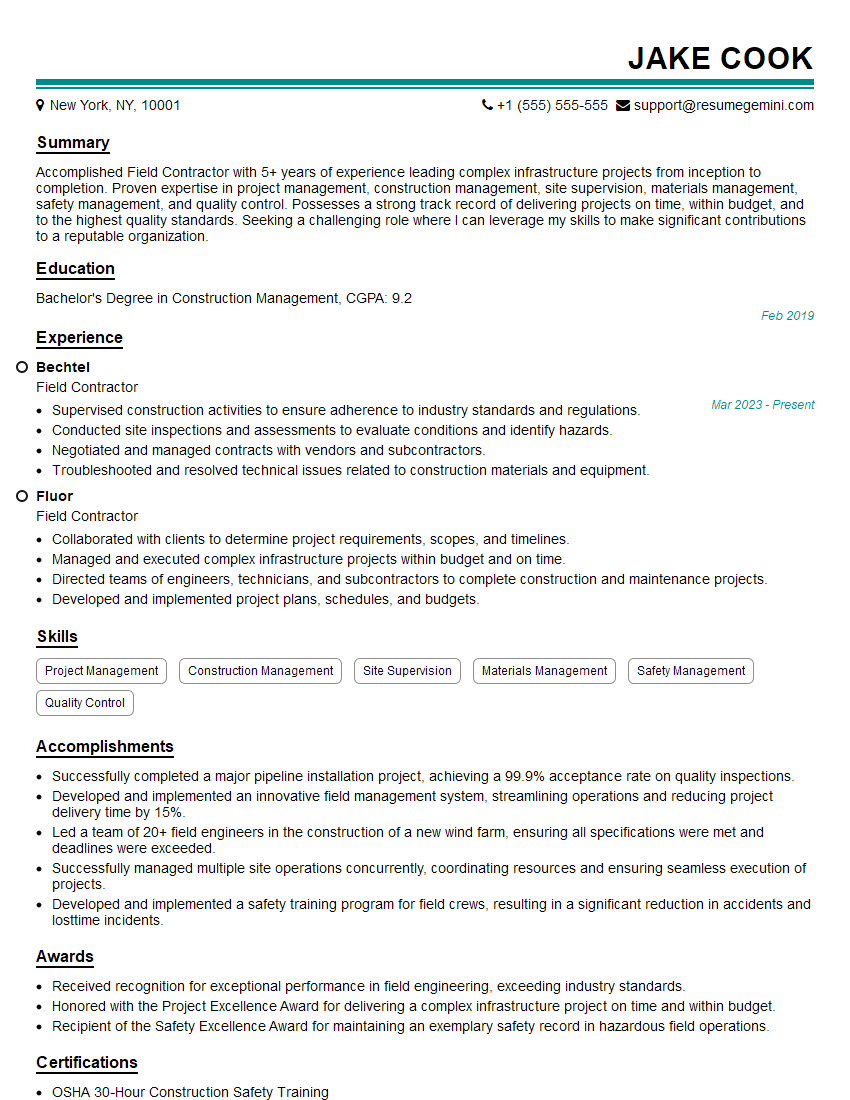
Are you gearing up for an interview for a Field Contractor position? Whether you’re a seasoned professional or just stepping into the role, understanding what’s expected can make all the difference. In this blog, we dive deep into the essential interview questions for Field Contractor and break down the key responsibilities of the role. By exploring these insights, you’ll gain a clearer picture of what employers are looking for and how you can stand out. Read on to equip yourself with the knowledge and confidence needed to ace your next interview and land your dream job!
Acing the interview is crucial, but landing one requires a compelling resume that gets you noticed. Crafting a professional document that highlights your skills and experience is the first step toward interview success. ResumeGemini can help you build a standout resume that gets you called in for that dream job.






Essential Interview Questions For Field Contractor
1. What are the key responsibilities of a Field Contractor?
As a Field Contractor, I would be responsible for:
- Supervising and managing construction projects on-site
- Ensuring that all projects meet safety regulations and specifications
- Coordinating with architects, engineers, and subcontractors
- Estimating project costs and timelines
- Negotiating contracts and resolving disputes
2. What are your strengths as a Field Contractor?
Technical Proficiency
- Expertise in construction methodologies and materials
- Strong understanding of building codes and regulations
- Proficient in project management software and tools
Leadership and Management Skills
- Ability to lead and motivate a team of workers
- Excellent communication and interpersonal skills
- Proven ability to manage multiple projects simultaneously
3. What are your areas for improvement as a Field Contractor?
While I am confident in my abilities, I recognize that there are always areas for improvement. I am particularly focused on:
- Expanding my knowledge of sustainable construction practices
- Improving my proficiency in project risk assessment
- Developing my skills in negotiating complex contracts
4. What are the most important qualities of a successful Field Contractor?
In my opinion, the most important qualities of a successful Field Contractor include:
- Technical expertise and a thorough understanding of construction principles
- Strong leadership and management skills
- Excellent communication and interpersonal abilities
- Attention to detail and a commitment to quality
- Adaptability and the ability to work effectively in a fast-paced environment
5. How do you stay up-to-date on the latest trends and technologies in the construction industry?
I make a conscious effort to stay abreast of the latest trends and technologies in the construction industry through a combination of methods:
- Attending industry conferences and workshops
- Reading trade publications and online resources
- Networking with other professionals in the field
- Participating in continuing education programs
6. What is your approach to ensuring safety on a construction site?
Safety is my top priority on any construction site. My approach involves:
- Developing and implementing a comprehensive safety plan
- Providing regular training and safety briefings to workers
- Conducting regular safety inspections and audits
- Enforcing safety rules and regulations consistently
- Fostering a positive safety culture among all workers
7. How do you handle unexpected challenges or setbacks on a construction project?
When faced with unexpected challenges or setbacks on a construction project, I follow a structured approach:
- Assess the situation and identify the root cause
- Evaluate the potential impact and develop contingency plans
- Communicate clearly with all stakeholders
- Explore alternative solutions and make informed decisions
- Implement appropriate measures to mitigate risks and minimize delays
8. What is your experience in managing large-scale construction projects?
I have extensive experience in managing large-scale construction projects, including:
- A high-rise office building in downtown San Francisco
- A major hospital expansion in Seattle
- A large-scale residential development in Los Angeles
In each case, I successfully led a team of professionals to complete the project on time, within budget, and to the highest standards of quality.
9. What is your approach to resolving disputes with subcontractors or other stakeholders?
My approach to resolving disputes involves:
- Open and honest communication
- A focus on identifying the root cause of the dispute
- Exploring mutually acceptable solutions
- Involving a third-party mediator if necessary
- Documenting all agreements and actions taken
10. Why are you interested in working for our company?
I am interested in working for your company because:
- I am impressed by your company’s reputation for excellence in the construction industry
- I believe that my skills and experience would be a valuable asset to your team
- I am eager to contribute to the success of your upcoming projects
- I am confident that I can make a significant contribution to your company’s continued growth and success
Interviewers often ask about specific skills and experiences. With ResumeGemini‘s customizable templates, you can tailor your resume to showcase the skills most relevant to the position, making a powerful first impression. Also check out Resume Template specially tailored for Field Contractor.
Career Expert Tips:
- Ace those interviews! Prepare effectively by reviewing the Top 50 Most Common Interview Questions on ResumeGemini.
- Navigate your job search with confidence! Explore a wide range of Career Tips on ResumeGemini. Learn about common challenges and recommendations to overcome them.
- Craft the perfect resume! Master the Art of Resume Writing with ResumeGemini’s guide. Showcase your unique qualifications and achievements effectively.
- Great Savings With New Year Deals and Discounts! In 2025, boost your job search and build your dream resume with ResumeGemini’s ATS optimized templates.
Researching the company and tailoring your answers is essential. Once you have a clear understanding of the Field Contractor‘s requirements, you can use ResumeGemini to adjust your resume to perfectly match the job description.
Key Job Responsibilities
Field Contractors play a critical role in the construction and maintenance of infrastructure projects. Their responsibilities span a range of tasks that require technical expertise, problem-solving abilities, and effective communication skills. The following are the key job responsibilities of a Field Contractor:
1. Project Management
Plan and execute construction and maintenance projects, managing schedules, resources, and expenses.
- Develop project plans and timelines
- Procure materials and equipment
2. Site Supervision
Lead and supervise project crews on-site, ensuring safety and adherence to project specifications.
- Monitor progress and identify potential issues
- Coordinate with stakeholders, including engineers, architects, and subcontractors
3. Quality Control
Maintain high standards of workmanship by inspecting materials and processes, ensuring compliance with project specifications and regulations.
- Conduct quality checks and inspections
- Document and report on quality control measures
4. Client Relations
Interact with clients to understand their requirements, provide regular updates on project progress, and maintain positive relationships.
- Meet with clients to discuss project details
- Provide progress reports and address client concerns
Interview Tips
Preparing thoroughly for a job interview gives you the confidence to present yourself well and showcase your skills. Here are some interview preparation tips and strategies to help you ace your Field Contractor interview:
1. Research the Company and Industry
Demonstrate your interest and knowledge by researching the company, their projects, and the industry landscape. This will help you tailor your answers and show that you’re informed about the field.
- Visit the company’s website and social media pages
- Read industry publications and articles
2. Practice Common Interview Questions
Prepare for common interview questions by anticipating what the interviewer might ask and practicing your responses. This will help you articulate your skills and experience effectively.
- Tell me about your experience in project management
- How do you ensure quality control on your projects?
3. Prepare Project Portfolio
Bring a portfolio that showcases your best work. This could include project plans, specifications, or examples of your quality control procedures.
- Highlight projects that demonstrate your skills and experience
- Be prepared to discuss the details and challenges you faced
4. Highlight Relevant Skills and Experience
Emphasize your relevant skills and experience that align with the job requirements. Quantify your accomplishments with specific metrics and examples.
- Use the STAR method (Situation, Task, Action, Result) to describe your experiences
- Discuss how your skills can benefit the company
5. Dress Professionally and Arrive on Time
First impressions matter. Dress appropriately for the interview and arrive on time. This shows respect for the interviewer’s time and conveys professionalism.
- Wear clean, pressed clothing
- Be punctual and arrive early if possible
Next Step:
Armed with this knowledge, you’re now well-equipped to tackle the Field Contractor interview with confidence. Remember, a well-crafted resume is your first impression. Take the time to tailor your resume to highlight your relevant skills and experiences. And don’t forget to practice your answers to common interview questions. With a little preparation, you’ll be on your way to landing your dream job. So what are you waiting for? Start building your resume and start applying! Build an amazing resume with ResumeGemini.