Are you gearing up for a career shift or aiming to ace your next interview? Look no further! We’ve curated a comprehensive guide to help you crack the interview for the coveted Hacker position. From understanding the key responsibilities to mastering the most commonly asked questions, this blog has you covered. So, buckle up and let’s embark on this journey together.
Acing the interview is crucial, but landing one requires a compelling resume that gets you noticed. Crafting a professional document that highlights your skills and experience is the first step toward interview success. ResumeGemini can help you build a standout resume that gets you called in for that dream job.






Essential Interview Questions For Hacker
1. What are the different stages of the hacking process?
The different stages of the hacking process are:
- Reconnaissance
- Scanning
- Gaining access
- Maintaining access
- Covering tracks
2. What are the different types of hacking tools?
Tools for reconnaissance
- Nmap
- Nessus
Tools for scanning
- Wireshark
- tcpdump
Tools for gaining access
- Metasploit
- John the Ripper
Tools for maintaining access
- Backdoor
- Rootkit
Tools for covering tracks
- Tor
- VPN
3. What are the different types of hacking attacks?
The different types of hacking attacks are:
- Malware attacks
- Phishing attacks
- DDoS attacks
- Man-in-the-middle attacks
- SQL injection attacks
4. What are the different types of hackers?
The different types of hackers are:
- Black hat hackers
- White hat hackers
- Gray hat hackers
5. What are the different ways to prevent hacking?
The different ways to prevent hacking are:
- Use strong passwords
- Keep software up to date
- Use a firewall
- Use antivirus software
- Be careful about what you click on
6. What are the different ways to respond to a hacking attack?
The different ways to respond to a hacking attack are:
- Contact your IT department
- Change your passwords
- Run a virus scan
- File a police report
7. What are the different ethical considerations for hackers?
The different ethical considerations for hackers are:
- Do not hack into systems without permission
- Do not damage or steal data
- Do not use hacking for personal gain
- Report any vulnerabilities you find
8. What are the different career opportunities for hackers?
The different career opportunities for hackers are:
- Security consultant
- Penetration tester
- Malware analyst
- Forensic investigator
- Security researcher
9. What are the different resources for learning about hacking?
The different resources for learning about hacking are:
- Books
- Online courses
- Conferences
- Meetup groups
- Online communities
10. What are the different certifications for hackers?
The different certifications for hackers are:
- Certified Ethical Hacker (CEH)
- Offensive Security Certified Professional (OSCP)
- Certified Information Systems Security Professional (CISSP)
- CompTIA Security+
- GIAC Security Essentials (GSEC)
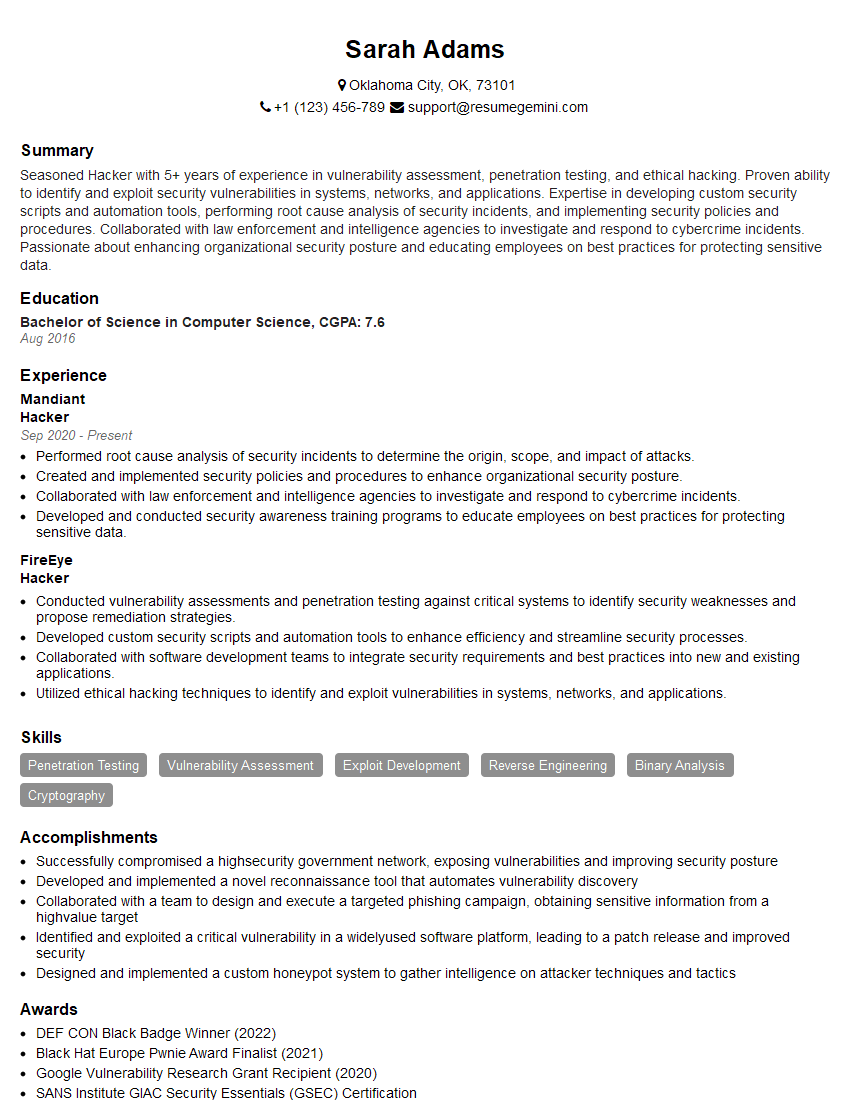
Interviewers often ask about specific skills and experiences. With ResumeGemini‘s customizable templates, you can tailor your resume to showcase the skills most relevant to the position, making a powerful first impression. Also check out Resume Template specially tailored for Hacker.
Career Expert Tips:
- Ace those interviews! Prepare effectively by reviewing the Top 50 Most Common Interview Questions on ResumeGemini.
- Navigate your job search with confidence! Explore a wide range of Career Tips on ResumeGemini. Learn about common challenges and recommendations to overcome them.
- Craft the perfect resume! Master the Art of Resume Writing with ResumeGemini’s guide. Showcase your unique qualifications and achievements effectively.
- Great Savings With New Year Deals and Discounts! In 2025, boost your job search and build your dream resume with ResumeGemini’s ATS optimized templates.
Researching the company and tailoring your answers is essential. Once you have a clear understanding of the Hacker‘s requirements, you can use ResumeGemini to adjust your resume to perfectly match the job description.
Key Job Responsibilities
Hackers are highly-skilled individuals who specialize in identifying and exploiting vulnerabilities in computer systems, networks, and software. They use their knowledge to gain unauthorized access to networks and data, and to perform a variety of malicious activities, including stealing sensitive information, disrupting services, or installing malware.
1. Vulnerability Assessment and Penetration Testing
Hackers perform vulnerability assessments to identify weaknesses in systems and networks that could be exploited by attackers. This includes identifying and analyzing security vulnerabilities in software, hardware, and network configurations.
- Conduct security audits and penetration tests to identify and exploit vulnerabilities in computer systems, networks, and software.
- Identify and assess security risks and vulnerabilities in systems and networks.
2. Exploit Development and Execution
Hackers develop and execute exploits to gain unauthorized access to systems and networks. This involves creating malicious software or code that can exploit vulnerabilities in target systems.
- Develop and execute exploits to gain unauthorized access to systems and networks.
- Reverse engineer software and analyze code to identify vulnerabilities.
3. Malware and Backdoor Development
Hackers develop and deploy malware, such as viruses, worms, and trojan horses, to infect target systems. They also create backdoors that allow them to maintain access to compromised systems.
- Develop and deploy malware, such as viruses, worms, and trojan horses, to infect target systems.
- Create backdoors to maintain access to compromised systems.
4. Data Exfiltration and Analysis
Hackers exfiltrate data from compromised systems and analyze it to obtain sensitive information, such as financial data, personal information, or trade secrets.
- Exfiltrate data from compromised systems.
- Analyze data to obtain sensitive information.
Interview Tips
Preparing for a hacking interview can be challenging, but by following these tips, you can increase your chances of success.
1. Review the Job Description
Before you start preparing for your interview, it’s important to review the job description carefully. This will give you a good understanding of the specific skills and experience that the employer is looking for.
- Identify the key skills and experience that the employer is looking for.
- Tailor your resume and cover letter to highlight your relevant skills and experience.
2. Practice Your Coding Skills
Coding is a fundamental skill for hackers. Employers will expect you to be able to code in a variety of programming languages, so it’s important to practice your skills before the interview. Focus on practicing the coding languages that are most relevant to the job description.
- Practice coding in a variety of programming languages, including Python, Java, and C++.
- Solve coding challenges on websites such as LeetCode and HackerRank.
3. Learn About Cryptography
Cryptography is another important skill for hackers. Employers will expect you to have a good understanding of cryptography concepts, such as encryption, decryption, and hashing. Learn about cryptography before the interview so that you can answer questions about it confidently.
- Learn about cryptography concepts, such as encryption, decryption, and hashing.
- Read books and articles about cryptography.
4. Prepare for Behavioral Questions
In addition to technical questions, you can also expect to be asked behavioral questions in your interview. These questions are designed to assess your soft skills, such as your communication skills, teamwork skills, and problem-solving skills. Prepare for behavioral questions by thinking about how you would answer them based on your own experiences.
- Prepare for behavioral questions by thinking about how you would answer them based on your own experiences.
- Practice answering behavioral questions with a friend or family member.
Next Step:
Armed with this knowledge, you’re now well-equipped to tackle the Hacker interview with confidence. Remember, preparation is key. So, start crafting your resume, highlighting your relevant skills and experiences. Don’t be afraid to tailor your application to each specific job posting. With the right approach and a bit of practice, you’ll be well on your way to landing your dream job. Build your resume now from scratch or optimize your existing resume with ResumeGemini. Wish you luck in your career journey!