Feeling lost in a sea of interview questions? Landed that dream interview for Battery Starter but worried you might not have the answers? You’re not alone! This blog is your guide for interview success. We’ll break down the most common Battery Starter interview questions, providing insightful answers and tips to leave a lasting impression. Plus, we’ll delve into the key responsibilities of this exciting role, so you can walk into your interview feeling confident and prepared.
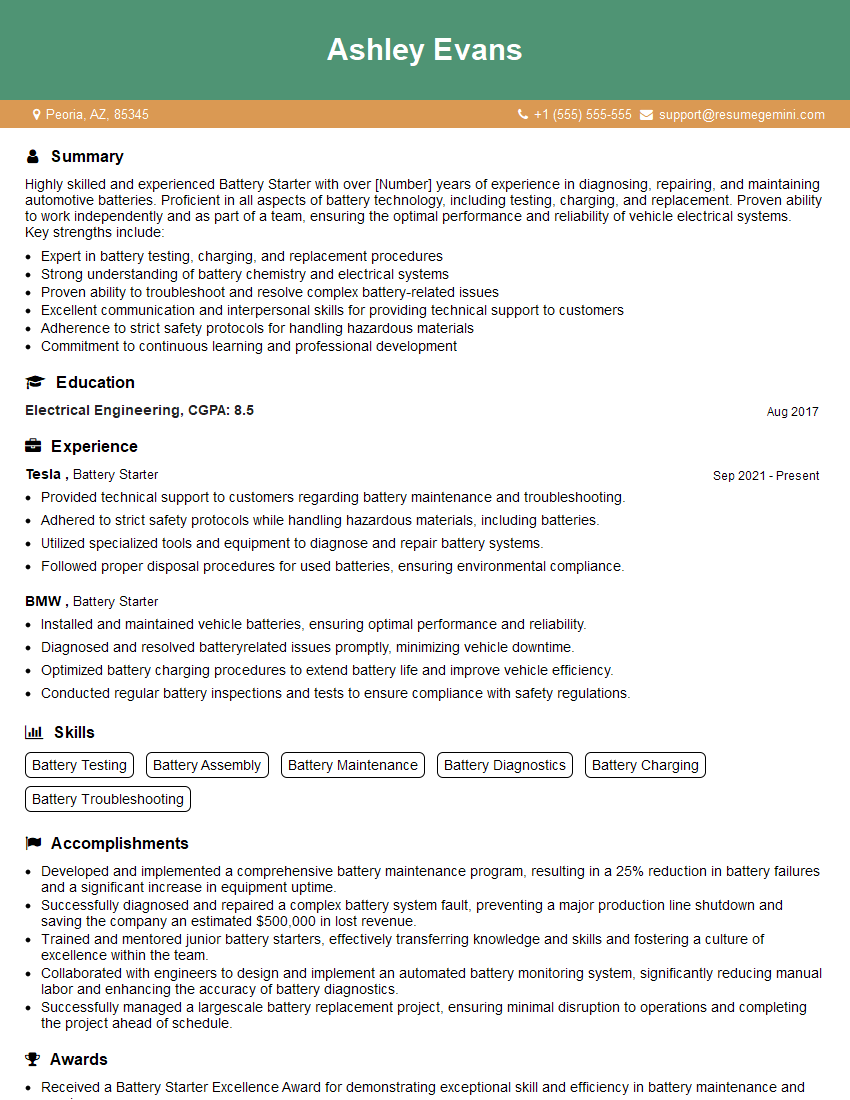
Acing the interview is crucial, but landing one requires a compelling resume that gets you noticed. Crafting a professional document that highlights your skills and experience is the first step toward interview success. ResumeGemini can help you build a standout resume that gets you called in for that dream job.






Essential Interview Questions For Battery Starter
1. Describe the different types of batteries used in starting systems and their advantages and disadvantages?
The three main types of batteries used in starting systems are lead-acid, AGM, and lithium-ion. Each type has its own advantages and disadvantages:
- Lead-acid batteries are the most common type of battery used in starting systems. They are relatively inexpensive, and they can provide a lot of power for a short period of time. However, lead-acid batteries are also heavy and bulky, and they can leak or spill acid if they are not properly maintained.
- AGM batteries are a type of lead-acid battery that is sealed and maintenance-free. AGM batteries are more expensive than traditional lead-acid batteries, but they are also lighter and more durable. AGM batteries are also less likely to leak or spill acid.
- Lithium-ion batteries are the newest type of battery used in starting systems. Lithium-ion batteries are lightweight, powerful, and long-lasting. However, lithium-ion batteries are also the most expensive type of battery.
2. What are the key specifications of a battery that are important for starting a vehicle?
Cold Cranking Amps (CCA)
- CCA is a measure of a battery’s ability to deliver power at low temperatures. The higher the CCA, the better the battery’s ability to start a vehicle in cold weather.
Reserve Capacity (RC)
- RC is a measure of a battery’s ability to provide power for a sustained period of time. The higher the RC, the longer the battery can power the vehicle’s electrical system without recharging.
3. What are the common causes of battery failure?
The most common causes of battery failure are:
- Overcharging: Overcharging can damage the battery’s plates and lead to sulfation, which can reduce the battery’s capacity and life.
- Undercharging: Undercharging can also damage the battery’s plates and lead to sulfation. Undercharging can also cause the battery to lose its charge and become unable to start the vehicle.
- Extreme temperatures: Extreme temperatures can damage the battery’s plates and lead to shortened life. Batteries are particularly vulnerable to damage when they are exposed to high temperatures.
- Vibration: Vibration can damage the battery’s internal components and lead to shortened life.
- Corrosion: Corrosion can damage the battery’s terminals and lead to poor electrical connections.
4. What are the steps involved in testing a battery?
The steps involved in testing a battery are:
- Visual inspection: Inspect the battery for any signs of damage, such as cracks, leaks, or corrosion.
- Load test: A load test measures the battery’s ability to deliver power under a load. A load tester can be used to perform a load test.
- Voltage test: A voltage test measures the battery’s voltage. A voltmeter can be used to perform a voltage test.
5. What are the different types of battery chargers and how do they work?
There are two main types of battery chargers: trickle chargers and fast chargers.
- Trickle chargers are designed to slowly charge a battery over a long period of time. Trickle chargers are typically used to maintain the charge of a battery that is not being used regularly.
- Fast chargers are designed to quickly charge a battery. Fast chargers are typically used to charge a battery that has been discharged or that is being used regularly.
6. What are the safety precautions that should be taken when working with batteries?
The following safety precautions should be taken when working with batteries:
- Wear eye protection: Batteries can contain acid that can cause eye damage if it is splashed.
- Wear gloves: Gloves will protect your hands from acid and other chemicals that can be present in batteries.
- Do not smoke or have open flames near batteries: Batteries can produce hydrogen gas, which is flammable.
- Do not charge batteries in a sealed enclosure: Batteries can produce hydrogen gas, which can build up in a sealed enclosure and cause an explosion.
- Dispose of batteries properly: Batteries contain hazardous materials that can be harmful to the environment if they are not disposed of properly.
7. What are the different types of battery terminals and how are they connected?
There are two main types of battery terminals: top posts and side posts.
- Top posts are located on the top of the battery and are typically used on older vehicles.
- Side posts are located on the side of the battery and are typically used on newer vehicles.
Battery terminals are connected using battery cables. Battery cables are typically made of copper and are sized to carry the amount of current that the battery can deliver.
8. What are the symptoms of a bad battery?
The following are some of the symptoms of a bad battery:
- Difficulty starting the vehicle: A bad battery may not be able to provide enough power to start the vehicle.
- Dim headlights: A bad battery may not be able to provide enough power to power the headlights.
- Electrical problems: A bad battery can cause electrical problems, such as flickering lights or a dead radio.
- Corrosion on the battery terminals: Corrosion on the battery terminals can prevent the battery from making good electrical connections.
- Leaking battery fluid: A leaking battery can indicate that the battery is damaged and needs to be replaced.
9. How can you extend the life of a battery?
The following tips can help to extend the life of a battery:
- Keep the battery clean: Corrosion can damage the battery’s terminals and lead to poor electrical connections. Clean the battery terminals regularly to prevent corrosion.
- Avoid exposing the battery to extreme temperatures: Extreme temperatures can damage the battery’s plates and lead to shortened life. Batteries are particularly vulnerable to damage when they are exposed to high temperatures.
- Avoid overcharging or undercharging the battery: Overcharging or undercharging can damage the battery’s plates and lead to shortened life.
- Charge the battery regularly: A battery that is not being used regularly will slowly discharge. Charging the battery regularly will help to keep it in good condition.
- Replace the battery when it starts to show signs of wear: A battery that is starting to show signs of wear, such as difficulty starting the vehicle or dim headlights, should be replaced.
10. What are the latest trends in battery technology?
The latest trends in battery technology include:
- The development of new battery materials: New battery materials are being developed that can improve the performance and lifespan of batteries.
- The development of new battery designs: New battery designs are being developed that can improve the efficiency and safety of batteries.
- The development of new battery manufacturing techniques: New battery manufacturing techniques are being developed that can reduce the cost of batteries.
Interviewers often ask about specific skills and experiences. With ResumeGemini‘s customizable templates, you can tailor your resume to showcase the skills most relevant to the position, making a powerful first impression. Also check out Resume Template specially tailored for Battery Starter.
Career Expert Tips:
- Ace those interviews! Prepare effectively by reviewing the Top 50 Most Common Interview Questions on ResumeGemini.
- Navigate your job search with confidence! Explore a wide range of Career Tips on ResumeGemini. Learn about common challenges and recommendations to overcome them.
- Craft the perfect resume! Master the Art of Resume Writing with ResumeGemini’s guide. Showcase your unique qualifications and achievements effectively.
- Great Savings With New Year Deals and Discounts! In 2025, boost your job search and build your dream resume with ResumeGemini’s ATS optimized templates.
Researching the company and tailoring your answers is essential. Once you have a clear understanding of the Battery Starter‘s requirements, you can use ResumeGemini to adjust your resume to perfectly match the job description.
Key Job Responsibilities
Battery Starters are responsible for inspecting, charging, and replacing batteries in vehicles. They also provide assistance to customers with their battery needs.
1. Inspect Batteries
Battery Starters inspect batteries to determine their condition. They check for corrosion, cracks, and other damage. They also test the battery’s voltage and amperage to ensure that it is functioning properly.
2. Charge Batteries
Battery Starters charge batteries that are weak or dead. They use a battery charger to connect the battery to a power source and allow it to charge.
3. Replace Batteries
Battery Starters replace batteries that are no longer functioning properly. They remove the old battery and install a new one.
4. Assist Customers
Battery Starters assist customers with their battery needs. They answer questions about batteries and provide advice on how to care for them. They also help customers to choose the right battery for their vehicle.
Interview Tips
When preparing for an interview for a Battery Starter position, there are a few things you can do to increase your chances of success.
1. Research the Company
Before your interview, take some time to research the company you are applying to. This will help you to understand the company’s culture and values, as well as the specific requirements of the position you are seeking.
2. Practice Answering Common Interview Questions
There are a number of common interview questions that you are likely to be asked, such as “Tell me about yourself” and “Why are you interested in this position?” Practice answering these questions in advance so that you can deliver your responses confidently and clearly.
3. Prepare Questions to Ask the Interviewer
Asking questions at the end of an interview shows that you are interested in the position and the company. It also gives you an opportunity to learn more about the job and the company culture.
4. Dress Professionally
First impressions matter, so make sure you dress professionally for your interview. This means wearing clean, pressed clothes and appropriate footwear.
Next Step:
Armed with this knowledge, you’re now well-equipped to tackle the Battery Starter interview with confidence. Remember, preparation is key. So, start crafting your resume, highlighting your relevant skills and experiences. Don’t be afraid to tailor your application to each specific job posting. With the right approach and a bit of practice, you’ll be well on your way to landing your dream job. Build your resume now from scratch or optimize your existing resume with ResumeGemini. Wish you luck in your career journey!