Are you gearing up for an interview for a Water Pollution Scientist position? Whether you’re a seasoned professional or just stepping into the role, understanding what’s expected can make all the difference. In this blog, we dive deep into the essential interview questions for Water Pollution Scientist and break down the key responsibilities of the role. By exploring these insights, you’ll gain a clearer picture of what employers are looking for and how you can stand out. Read on to equip yourself with the knowledge and confidence needed to ace your next interview and land your dream job!
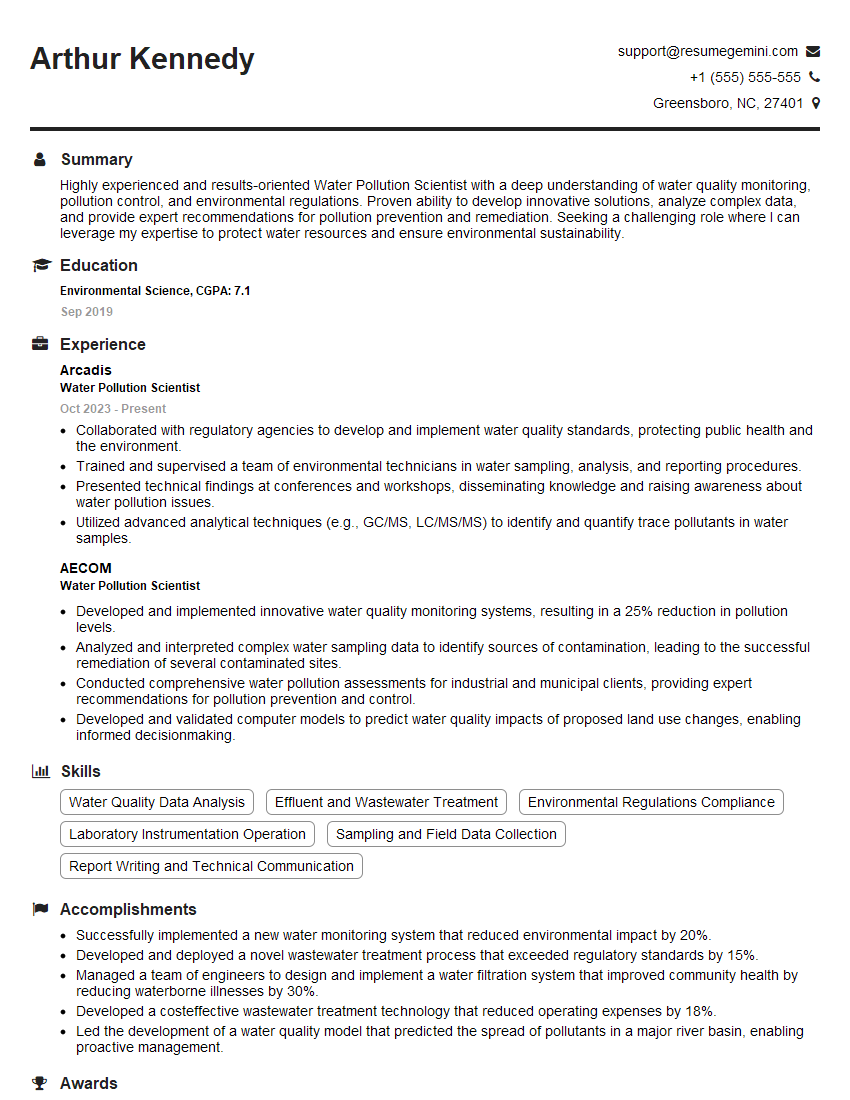
Acing the interview is crucial, but landing one requires a compelling resume that gets you noticed. Crafting a professional document that highlights your skills and experience is the first step toward interview success. ResumeGemini can help you build a standout resume that gets you called in for that dream job.






Essential Interview Questions For Water Pollution Scientist
1. Describe the key physical, chemical, and biological parameters that you would monitor to assess the health of a water body?
- Physical Parameters: Temperature, pH, dissolved oxygen (DO), salinity, turbidity
- Chemical Parameters: Metals, nutrients (nitrogen, phosphorus), toxic organic compounds (e.g., pesticides)
- Biological Parameters: Presence and abundance of aquatic organisms (e.g., fish, invertebrates, algae), microbial activity
2. Explain the principles of water quality modeling and how it can be used to predict the impact of pollution on a water body?
Water quality modeling involves simulating the physical, chemical, and biological processes in a water body to predict its response to pollution. Models consider factors such as pollutant inputs, water flow, and biodegradation. They can help identify sources of pollution, assess the effectiveness of mitigation measures, and predict future water quality conditions.
3. Discuss the different methods used to collect water samples for pollution analysis, and describe the advantages and disadvantages of each method?
- Grab Sampling: Single sample collected at a specific time; limited temporal and spatial information
- Composite Sampling: Mixing of samples over time or space; provides average pollutant concentrations
- Continuous Monitoring: Automated collection and analysis; provides real-time data
4. Describe the techniques used to analyze water samples for specific pollutants, including both conventional and advanced analytical methods?
- Conventional Methods: pH, DO, BOD, TSS
- Advanced Methods: Gas chromatography, mass spectrometry, immunoassays; can detect low levels of specific pollutants
5. Explain the principles of water treatment and discuss the different technologies used to remove pollutants from water?
- Physical Treatment: Screening, filtration, sedimentation
- Chemical Treatment: Coagulation, flocculation, disinfection
- Biological Treatment: Activated sludge, biofilters
6. Describe the regulatory framework for water pollution control in your country, including the key legislation and regulatory agencies involved?
Discuss the relevant laws, regulations, and agencies responsible for implementing and enforcing water pollution control measures.
7. Explain the role of water pollution scientists in developing and implementing water quality management plans?
- Data Collection and Analysis: Monitoring and assessment of water quality
- Pollution Source Identification: Determining sources of pollution
- Mitigation Strategy Development: Recommending measures to reduce pollution
- Plan Implementation and Evaluation: Monitoring and evaluating the effectiveness of management plans
8. Discuss the ethical responsibilities of water pollution scientists, including the importance of objectivity, integrity, and confidentiality?
- Objectivity: Maintaining scientific impartiality and avoiding bias
- Integrity: Adhering to ethical principles and standards
- Confidentiality: Protecting sensitive data and respecting privacy
9. Describe your experience in using statistical and modeling tools for water pollution analysis and prediction?
- Statistical Analysis: Summarizing and interpreting data, identifying trends
- Modeling: Simulating water pollution processes, predicting future conditions
- Software Proficiency: Expertise in statistical and modeling software (e.g., R, MATLAB)
10. Discuss the emerging challenges and advances in water pollution science and technology?
- Emerging Pollutants: Novel contaminants that require new detection and treatment methods
- Climate Change Impacts: Effects of climate change on water quality and pollution dynamics
- Advanced Technologies: Development of new tools for pollution monitoring and remediation
Interviewers often ask about specific skills and experiences. With ResumeGemini‘s customizable templates, you can tailor your resume to showcase the skills most relevant to the position, making a powerful first impression. Also check out Resume Template specially tailored for Water Pollution Scientist.
Career Expert Tips:
- Ace those interviews! Prepare effectively by reviewing the Top 50 Most Common Interview Questions on ResumeGemini.
- Navigate your job search with confidence! Explore a wide range of Career Tips on ResumeGemini. Learn about common challenges and recommendations to overcome them.
- Craft the perfect resume! Master the Art of Resume Writing with ResumeGemini’s guide. Showcase your unique qualifications and achievements effectively.
- Great Savings With New Year Deals and Discounts! In 2025, boost your job search and build your dream resume with ResumeGemini’s ATS optimized templates.
Researching the company and tailoring your answers is essential. Once you have a clear understanding of the Water Pollution Scientist‘s requirements, you can use ResumeGemini to adjust your resume to perfectly match the job description.
Key Job Responsibilities
Water Pollution Scientists play a vital role in protecting the environment by studying and addressing various aspects of water pollution. Their key responsibilities include:
1. Monitoring and Evaluation
Monitoring water quality in rivers, lakes, and other water bodies to detect and assess pollution levels.
- Collecting and analyzing water samples
- Identifying and quantifying pollutants
2. Research and Development
Conducting research to understand the causes and effects of water pollution, and developing solutions to mitigate it.
- Investigating new methods for pollution prevention and control
- Evaluating the effectiveness of existing water pollution control measures
3. Advising and Support
Providing expert advice to government agencies, industries, and the public on water pollution issues.
- Developing policies and regulations for water pollution management
- Educating the public about the importance of water conservation and pollution prevention
4. Collaboration and Outreach
Collaborating with other scientists, engineers, and stakeholders to address complex water pollution issues.
- Working with regulatory agencies to enforce water pollution regulations
- Partnering with industries to implement sustainable water management practices
Interview Tips
Preparing thoroughly for an interview is crucial to impress the hiring manager and increase your chances of success. Here are some tips to help you ace your interview for a Water Pollution Scientist position:
1. Research the Company and Role
Take the time to research the company and the specific role you are applying for. This will help you understand the company’s culture, values, and the responsibilities of the position. You can find this information on the company’s website, LinkedIn page, or through online research.
- Understand the company’s mission, vision, and environmental policies
- Identify the key responsibilities and qualifications for the role
2. Highlight Your Skills and Experience
During the interview, you will have the opportunity to showcase your skills and experience that align with the job requirements. Quantify your accomplishments and use specific examples to demonstrate your abilities.
- Emphasize your technical skills, such as water sampling, data analysis, and research methods
- Highlight your experience in developing and implementing water pollution mitigation strategies
3. Prepare Questions
Asking thoughtful questions at the end of the interview shows that you are engaged and interested in the position. It also gives you the opportunity to gain additional insights into the role and the company.
- Ask about the company’s approach to water pollution management
- Inquire about opportunities for professional development and growth
4. Dress Professionally and Arrive on Time
First impressions matter, so dress professionally and arrive on time for your interview. This shows that you respect the interviewer’s time and that you take the interview process seriously.
- Choose appropriate business attire, such as a suit or dress
- Plan your route in advance to avoid any delays
5. Practice Your Answers
Practice your answers to common interview questions to feel more confident and prepared during the actual interview. Consider using the STAR method (Situation, Task, Action, Result) to structure your responses.
- Prepare answers to questions about your experience, skills, and motivations
- Practice answering technical questions related to water pollution science
Next Step:
Now that you’re armed with a solid understanding of what it takes to succeed as a Water Pollution Scientist, it’s time to turn that knowledge into action. Take a moment to revisit your resume, ensuring it highlights your relevant skills and experiences. Tailor it to reflect the insights you’ve gained from this blog and make it shine with your unique qualifications. Don’t wait for opportunities to come to you—start applying for Water Pollution Scientist positions today and take the first step towards your next career milestone. Your dream job is within reach, and with a polished resume and targeted applications, you’ll be well on your way to achieving your career goals! Build your resume now with ResumeGemini.