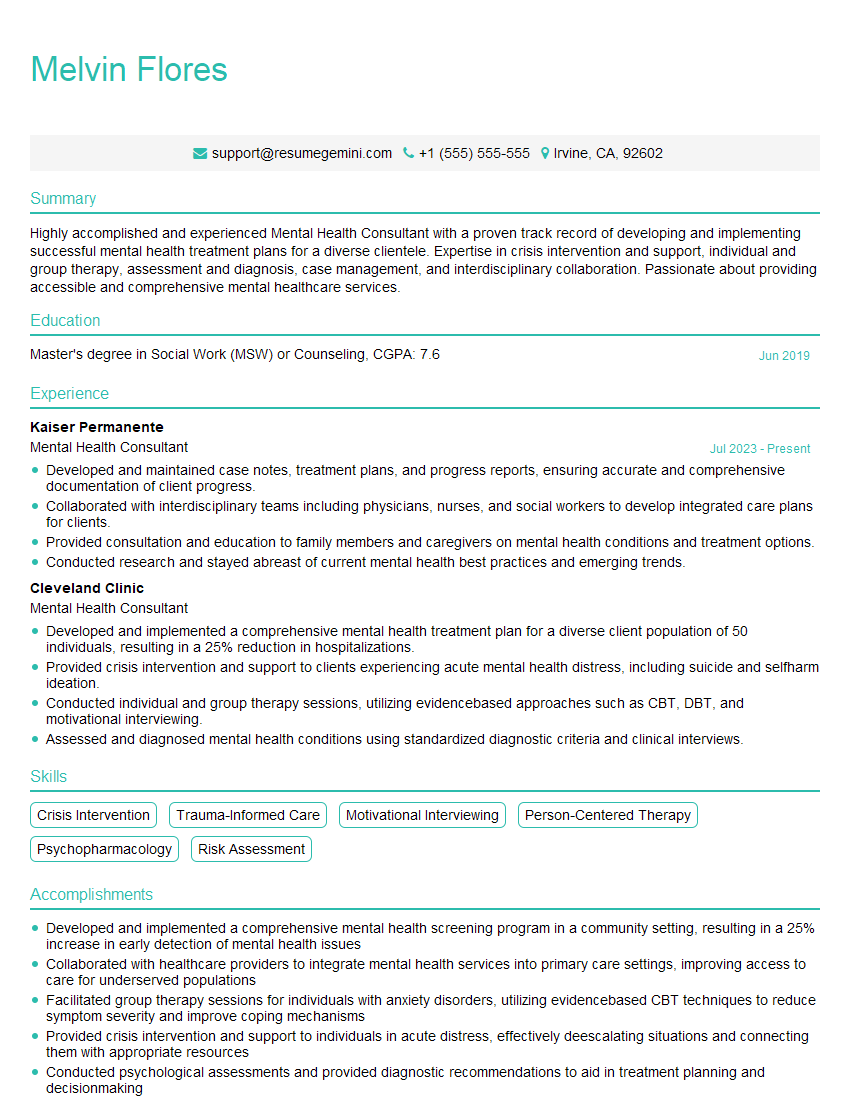
Are you gearing up for a career shift or aiming to ace your next interview? Look no further! We’ve curated a comprehensive guide to help you crack the interview for the coveted Mental Health Consultant position. From understanding the key responsibilities to mastering the most commonly asked questions, this blog has you covered. So, buckle up and let’s embark on this journey together
Acing the interview is crucial, but landing one requires a compelling resume that gets you noticed. Crafting a professional document that highlights your skills and experience is the first step toward interview success. ResumeGemini can help you build a standout resume that gets you called in for that dream job.






Essential Interview Questions For Mental Health Consultant
1. Describe your approach to assessing and diagnosing mental health conditions?
As a Mental Health Consultant, my approach to assessing and diagnosing mental health conditions is comprehensive and multifaceted. I adhere to the guidelines outlined in the Diagnostic and Statistical Manual of Mental Disorders (DSM-5). My assessment process typically involves:
- Conducting a thorough clinical interview to gather detailed information about the individual’s symptoms, history, and current life circumstances.
- Reviewing relevant medical and psychiatric records to obtain a comprehensive understanding of the individual’s overall health status and previous diagnoses.
- Utilizing standardized assessment tools, such as questionnaires and rating scales, to evaluate specific symptoms and measure the severity of the condition.
- Performing mental status examinations to assess the individual’s cognitive functioning, appearance, mood, and thought processes.
- Considering differential diagnoses and ruling out other potential medical or psychological explanations for the presenting symptoms.
2. How do you stay up-to-date on the latest advancements in mental health research and evidence-based practices?
Professional Development and Training:
- Attending conferences, workshops, and webinars organized by professional organizations such as the American Psychological Association (APA) and the National Alliance on Mental Illness (NAMI).
- Enrolling in continuing education courses and pursuing additional certifications to enhance my knowledge and skills in specialized areas of mental health.
Collaboration and Networking:
- Engaging in collaborative research projects with universities and mental health institutions to contribute to the advancement of the field.
- Networking with other mental health professionals, including psychiatrists, psychologists, and social workers, to exchange ideas and share best practices.
Evidence-Based Resources:
- Regularly reviewing peer-reviewed scientific journals and reputable sources, such as PubMed and Cochrane Library, to stay abreast of the latest research findings.
- Utilizing evidence-based practice guidelines developed by professional organizations and government agencies to inform my clinical decision-making.
3. How do you work with individuals from diverse cultural backgrounds and ensure culturally competent care?
Providing culturally competent care is paramount in my practice. I approach this by:
- Developing cultural awareness and sensitivity through training, reading, and interacting with people from diverse backgrounds.
- Understanding the cultural values, beliefs, and norms that may influence an individual’s mental health and help-seeking behaviors.
- Tailoring my assessment and treatment approach to align with the individual’s cultural context, including using culturally appropriate language and communication styles.
- Collaborating with interpreters or cultural brokers when necessary to facilitate effective communication and ensure comprehension.
- Seeking supervision or consultation from colleagues or experts in cultural competence to enhance my understanding and skills in working with diverse populations.
4. Describe your experience in developing and implementing mental health programs and interventions.
My experience in developing and implementing mental health programs and interventions includes:
- Conducting needs assessments to identify the unmet mental health needs of specific populations or communities.
- Collaborating with stakeholders, including service providers, community organizations, and individuals with lived experience, to design and tailor programs.
- Developing evidence-based interventions that are appropriate for the target population and align with best practices.
- Implementing programs through various channels, such as group therapy, workshops, or community-based initiatives.
- Evaluating the effectiveness of programs using appropriate metrics and making necessary adjustments based on the results.
5. How do you collaborate with other healthcare professionals to provide holistic patient care?
Collaboration is crucial for providing holistic patient care. I work effectively with other healthcare professionals by:
- Establishing strong relationships with psychiatrists, primary care physicians, social workers, and nurses.
- Participating in interdisciplinary treatment planning meetings to share perspectives and coordinate care.
- Providing consultation to other healthcare professionals on mental health-related issues that impact patient care.
- Making timely referrals to other specialists when necessary to ensure a comprehensive approach to patient management.
- Staying informed about the roles and responsibilities of other healthcare professionals to facilitate effective collaboration.
6. Describe your approach to crisis intervention and management.
Crisis intervention and management are critical aspects of my practice. I approach these situations by:
- Assessing the immediate risk to self or others and implementing appropriate safety measures.
- Providing emotional support and validation to the individual in crisis.
- Collaborating with emergency services or other professionals when necessary to ensure the safety of the individual and others.
- Developing a crisis plan with the individual to establish coping mechanisms and identify support systems.
- Following up with the individual after the crisis to provide ongoing support and monitor their well-being.
7. How do you handle ethical dilemmas in your practice?
Ethical dilemmas are an inherent part of mental health practice. I navigate these situations by:
- Adhering to ethical principles and guidelines established by professional organizations.
- Seeking consultation from supervisors, colleagues, or ethics committees when faced with complex ethical issues.
- Carefully considering the potential benefits and risks of different treatment options and involving the individual in decision-making whenever possible.
- Maintaining confidentiality and respecting the privacy of individuals.
- Balancing my responsibilities to the individual with my duty to protect society in situations involving potential harm to self or others.
8. What are your strengths and areas for improvement as a Mental Health Consultant?
Strengths:
- Excellent clinical skills in assessment, diagnosis, and treatment of mental health conditions.
- Strong understanding of evidence-based practices and commitment to providing high-quality care.
- Effective communication and interpersonal skills, fostering positive relationships with clients.
- Ability to work independently and as part of a team in a collaborative environment.
- Passion for mental health advocacy and improving the well-being of individuals and communities.
Areas for Improvement:
- Expanding my knowledge and skills in specialized areas of mental health, such as trauma-informed care or addiction treatment.
- Developing more expertise in conducting research and evaluating the effectiveness of mental health interventions.
- Seeking opportunities for leadership and mentorship to further contribute to the field of mental health.
- Staying abreast of emerging technologies and their potential applications in mental health practice.
9. How do you prioritize your workload and manage multiple responsibilities effectively?
Prioritizing my workload and managing multiple responsibilities effectively is essential. I employ the following strategies:
- Developing a structured schedule and setting realistic timelines for tasks.
- Using time management techniques, such as the Pomodoro Technique, to maximize productivity.
- Delegating tasks to colleagues or team members when appropriate.
- Communicating my workload and availability clearly to others.
- Taking regular breaks to prevent burnout and maintain focus.
10. Why are you interested in this Mental Health Consultant position?
I am highly interested in this Mental Health Consultant position because it aligns perfectly with my skills, experience, and career aspirations. I am passionate about providing accessible and high-quality mental health services to diverse populations. This role offers an exciting opportunity for me to contribute to your organization’s mission while expanding my professional growth and impact in the mental health field.
Interviewers often ask about specific skills and experiences. With ResumeGemini‘s customizable templates, you can tailor your resume to showcase the skills most relevant to the position, making a powerful first impression. Also check out Resume Template specially tailored for Mental Health Consultant.
Career Expert Tips:
- Ace those interviews! Prepare effectively by reviewing the Top 50 Most Common Interview Questions on ResumeGemini.
- Navigate your job search with confidence! Explore a wide range of Career Tips on ResumeGemini. Learn about common challenges and recommendations to overcome them.
- Craft the perfect resume! Master the Art of Resume Writing with ResumeGemini’s guide. Showcase your unique qualifications and achievements effectively.
- Great Savings With New Year Deals and Discounts! In 2025, boost your job search and build your dream resume with ResumeGemini’s ATS optimized templates.
Researching the company and tailoring your answers is essential. Once you have a clear understanding of the Mental Health Consultant‘s requirements, you can use ResumeGemini to adjust your resume to perfectly match the job description.
Key Job Responsibilities
Mental Health Consultants play a vital role in developing and implementing mental health programs, providing clinical assessment and intervention services, and advising organizations on mental health-related matters. Their key responsibilities include:
1. Program Development and Implementation
Collaborate with stakeholders to identify mental health needs and develop comprehensive programs that address those needs
- Conduct assessments to determine the effectiveness of existing programs and make recommendations for improvement
- Provide training and support to program staff to ensure effective implementation
2. Clinical Assessment and Intervention
Provide clinical assessments to individuals and groups to determine mental health needs and develop treatment plans
- Utilize evidence-based interventions to provide therapy, counseling, and support services
- Document client progress and make adjustments to treatment plans as necessary
3. Consultation and Education
Provide consultation to organizations on mental health-related policies, procedures, and practices
- Deliver educational workshops and presentations to promote mental health awareness and well-being
- Collaborate with interdisciplinary teams to provide comprehensive care
4. Research and Evaluation
Conduct research to evaluate the effectiveness of mental health programs and interventions
- Use data analysis to identify trends and develop recommendations for improving services
- Stay up-to-date on the latest research and best practices in mental health
Interview Tips
Preparing for an interview for a Mental Health Consultant position requires a combination of understanding the role, researching the organization, and showcasing your skills and experience.
1. Research the Role and Organization
Thoroughly review the job description and company website to understand the specific responsibilities and expectations of the role.
- Identify the organization’s mission, values, and target population to align your responses accordingly
- Research the industry trends and relevant mental health policies to demonstrate your up-to-date knowledge
2. Highlight Your Skills and Experience
Tailor your resume and cover letter to focus on your relevant skills and experience.
- Quantify your accomplishments using specific metrics whenever possible
- Use examples from your previous roles to demonstrate your ability to develop and implement mental health programs
3. Prepare for Behavioral Interview Questions
Behavioral interview questions focus on your past experiences and behaviors. Use the STAR method (Situation, Task, Action, Result) to answer these questions effectively:
- Situation: Describe the specific situation or task you were responsible for
- Task: Explain your role and responsibilities in the situation
- Action: Outline the specific actions you took to address the issue or challenge
- Result: Quantify the outcome of your actions and emphasize the positive impact you made
4. Practice and Seek Feedback
Practice your answers to common interview questions to improve your delivery and confidence.
- Consider asking a friend, family member, or career counselor to provide feedback on your answers
- Record yourself answering questions to identify areas for improvement
Next Step:
Armed with this knowledge, you’re now well-equipped to tackle the Mental Health Consultant interview with confidence. Remember, a well-crafted resume is your first impression. Take the time to tailor your resume to highlight your relevant skills and experiences. And don’t forget to practice your answers to common interview questions. With a little preparation, you’ll be on your way to landing your dream job. So what are you waiting for? Start building your resume and start applying! Build an amazing resume with ResumeGemini.