Are you gearing up for a career in Computer Science Teacher? Feeling nervous about the interview questions that might come your way? Don’t worry, you’re in the right place. In this blog post, we’ll dive deep into the most common interview questions for Computer Science Teacher and provide you with expert-backed answers. We’ll also explore the key responsibilities of this role so you can tailor your responses to showcase your perfect fit.
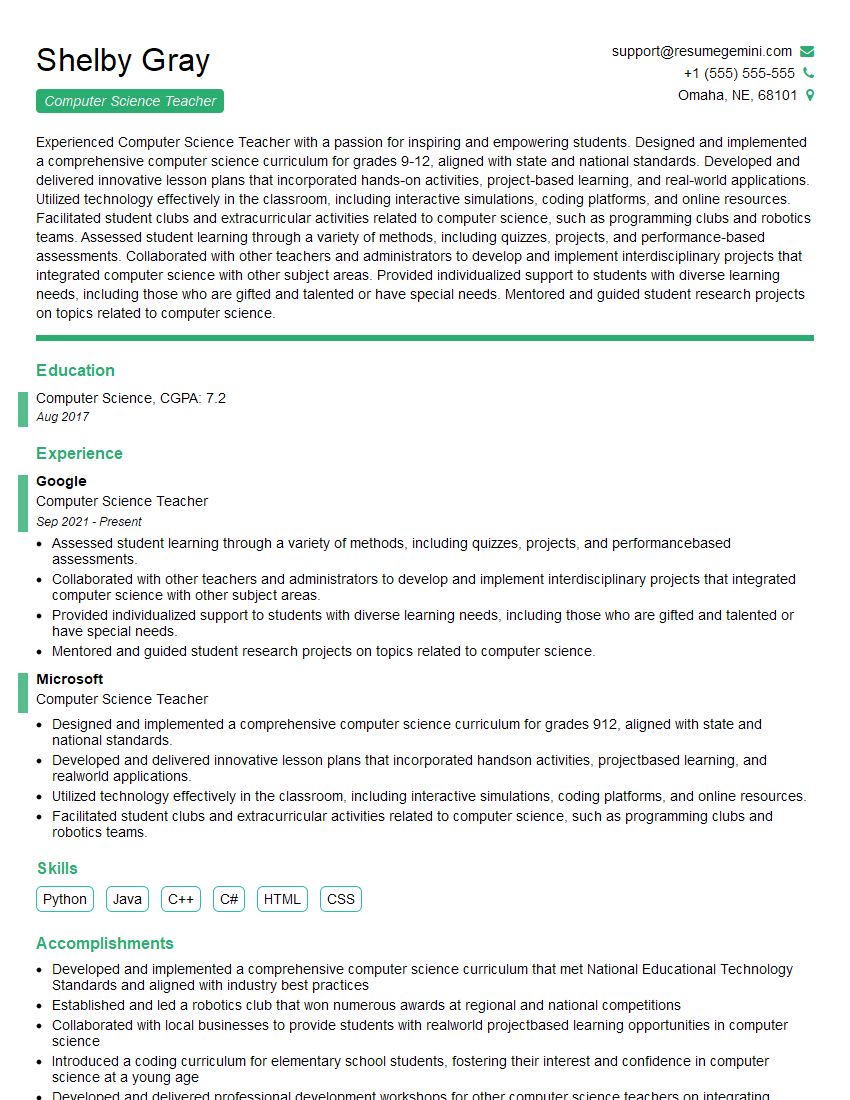
Acing the interview is crucial, but landing one requires a compelling resume that gets you noticed. Crafting a professional document that highlights your skills and experience is the first step toward interview success. ResumeGemini can help you build a standout resume that gets you called in for that dream job.






Essential Interview Questions For Computer Science Teacher
1. What are the key principles of object-oriented programming?
- Encapsulation: Hiding data and implementation details within an object.
- Abstraction: Representing essential characteristics and behaviours without exposing details.
- Inheritance: Creating new classes that inherit properties and methods from existing ones.
- Polymorphism: Objects of different classes can respond to the same message in different ways.
2. Explain the difference between static and dynamic binding.
Static Binding
- Binding occurs at compile time.
- Determines the method to be called based on the type of the object at compile time.
Dynamic Binding
- Binding occurs at runtime.
- Determines the method to be called based on the actual object’s type at runtime.
3. Describe the purpose and use cases of a data structure called a stack.
- Purpose: A linear data structure that follows the Last-In-First-Out (LIFO) principle.
- Use Cases:
- Undo operations
- Function calls
- Expression evaluation
4. What are the key differences between Python and Java?
- Type System: Python is dynamically typed, while Java is strongly typed.
- Syntax: Python uses indentation and is more concise, while Java uses curly braces.
- Compilation: Python is interpreted, while Java is compiled into bytecode before execution.
- Libraries: Python offers extensive libraries, while Java is known for its security and enterprise support.
5. Explain the concept of time complexity and how it is used to analyze algorithms.
- Time Complexity: A measure of the amount of time required to execute an algorithm.
- How it is used:
- Compare algorithms
- Predict performance
- Identify bottlenecks
6. What are the advantages of using an integrated development environment (IDE) for software development?
- Code Editing: IDEs provide features like syntax highlighting, auto-completion, and error detection.
- Debugging: IDEs offer integrated debugging tools to identify and fix bugs.
- Project Management: IDEs assist in organizing and managing large code projects.
- Collaboration: IDEs facilitate collaboration between developers by providing version control integration.
7. Describe the role of version control systems in software development.
- Track Changes: Version control systems record changes made to files over time.
- Collaboration: They enable multiple developers to work on the same project simultaneously.
- Rollback: Version control allows for reverting to previous versions of the codebase.
- History: It provides a history of changes, making it easier to understand and trace code evolution.
8. What strategies would you use to teach introductory computer science concepts to students with no prior programming experience?
- Real-World Examples: Relate concepts to real-world scenarios to make them relatable.
- Hands-On Activities: Engage students with hands-on labs and projects to provide practical understanding.
- Visual Aids: Use diagrams, flowcharts, and simulations to illustrate concepts visually.
- Gradual Progression: Start with fundamental concepts and gradually build upon them to avoid overwhelming students.
9. How would you differentiate between supervised and unsupervised machine learning algorithms?
- Supervised Learning:
- Uses labeled data to train models.
- Models predict outputs based on known inputs.
- Unsupervised Learning:
- Uses unlabeled data to find patterns and structures.
- Models extract insights from data without explicit guidance.
10. What pedagogical techniques do you employ to promote active learning in the classroom?
- Group Discussions: Encourage students to engage in discussions and share ideas.
- Problem-Based Learning: Present students with real-world problems to solve in teams.
- Project-Based Learning: Challenge students with projects that require them to apply knowledge and skills.
- Flipped Classroom: Deliver lectures as online material and use class time for interactive learning activities.
Interviewers often ask about specific skills and experiences. With ResumeGemini‘s customizable templates, you can tailor your resume to showcase the skills most relevant to the position, making a powerful first impression. Also check out Resume Template specially tailored for Computer Science Teacher.
Career Expert Tips:
- Ace those interviews! Prepare effectively by reviewing the Top 50 Most Common Interview Questions on ResumeGemini.
- Navigate your job search with confidence! Explore a wide range of Career Tips on ResumeGemini. Learn about common challenges and recommendations to overcome them.
- Craft the perfect resume! Master the Art of Resume Writing with ResumeGemini’s guide. Showcase your unique qualifications and achievements effectively.
- Great Savings With New Year Deals and Discounts! In 2025, boost your job search and build your dream resume with ResumeGemini’s ATS optimized templates.
Researching the company and tailoring your answers is essential. Once you have a clear understanding of the Computer Science Teacher‘s requirements, you can use ResumeGemini to adjust your resume to perfectly match the job description.
Key Job Responsibilities
Computer Science Teachers are responsible for planning, implementing, and evaluating computer science education programs for students. They work with students of all ages, from elementary school to college, and teach a variety of computer science topics, including programming, data structures, algorithms, and computer architecture.
1. Develop and implement computer science curriculum
Computer Science Teachers are responsible for developing and implementing computer science curriculum that aligns with state and national standards. They must be able to create lesson plans, design assessments, and select appropriate resources for their students.
- Develop lesson plans that align with state and national standards
- Design assessments to measure student learning
- Select appropriate resources for students, such as textbooks, software, and online materials
2. Teach computer science concepts and skills
Computer Science Teachers teach a variety of computer science concepts and skills to their students. These concepts and skills may include programming, data structures, algorithms, and computer architecture.
- Teach programming concepts and skills, such as variables, loops, and functions
- Teach data structures, such as arrays, linked lists, and trees
- Teach algorithms, such as sorting algorithms and searching algorithms
- Teach computer architecture, such as the components of a computer and how they work together
3. Assess student learning
Computer Science Teachers assess student learning through a variety of methods, such as tests, quizzes, and projects. They must be able to provide students with feedback on their progress and help them to improve their understanding of computer science concepts.
- Administer tests and quizzes to assess student learning
- Grade student projects and assignments
- Provide students with feedback on their progress
4. Collaborate with other teachers and staff
Computer Science Teachers often collaborate with other teachers and staff to provide students with a well-rounded education. They may work with math teachers to integrate computer science concepts into math lessons, or with science teachers to develop projects that involve computer science.
- Collaborate with other teachers to integrate computer science concepts into other subject areas
- Work with staff to develop and implement school-wide technology initiatives
- Attend professional development workshops and conferences
Interview Tips
Preparing for a job interview can be daunting, but by following a few simple tips, you can increase your chances of success. Here are some tips to help you prepare for your computer science teacher interview:
1. Research the school and the position
Before you go on an interview, it is important to do your research. This means learning about the school, the position you are applying for, and the community. This will help you to answer questions intelligently and show that you are interested in the job.
- Visit the school’s website
- Read the job description
- Talk to people who work at the school
2. Practice your answers to common interview questions
There are a few common interview questions that you are likely to be asked, such as “Why do you want to be a computer science teacher?” and “What are your strengths and weaknesses?”. It is helpful to practice your answers to these questions beforehand so that you can deliver them confidently during the interview.
- Why do you want to be a computer science teacher?
- What are your strengths and weaknesses?
- What are your teaching methods and why?
- How do you assess student learning?
- How do you collaborate with other teachers and staff?
3. Dress professionally and arrive on time
First impressions matter, so it is important to dress professionally and arrive on time for your interview. This shows that you are respectful of the interviewer’s time and that you take the job seriously.
- Dress in business attire
- Arrive on time for your interview
- Be polite and respectful to the interviewer
4. Be enthusiastic and positive
Interviewers are looking for candidates who are passionate about teaching and who have a positive attitude. Be enthusiastic about your love of computer science and how you can share that passion with students. Also, be positive about the challenges of teaching and how you can overcome them.
- Be enthusiastic about teaching
- Have a positive attitude
- Be confident in your abilities
5. Follow up after the interview
After the interview, it is important to follow up with the interviewer. This shows that you are interested in the job and that you appreciate their time. You can follow up by sending a thank-you note or email, or by calling the interviewer to check on the status of your application.
- Send a thank-you note to the interviewer
- Call the interviewer to check on the status of your application
Next Step:
Armed with this knowledge, you’re now well-equipped to tackle the Computer Science Teacher interview with confidence. Remember, preparation is key. So, start crafting your resume, highlighting your relevant skills and experiences. Don’t be afraid to tailor your application to each specific job posting. With the right approach and a bit of practice, you’ll be well on your way to landing your dream job. Build your resume now from scratch or optimize your existing resume with ResumeGemini. Wish you luck in your career journey!