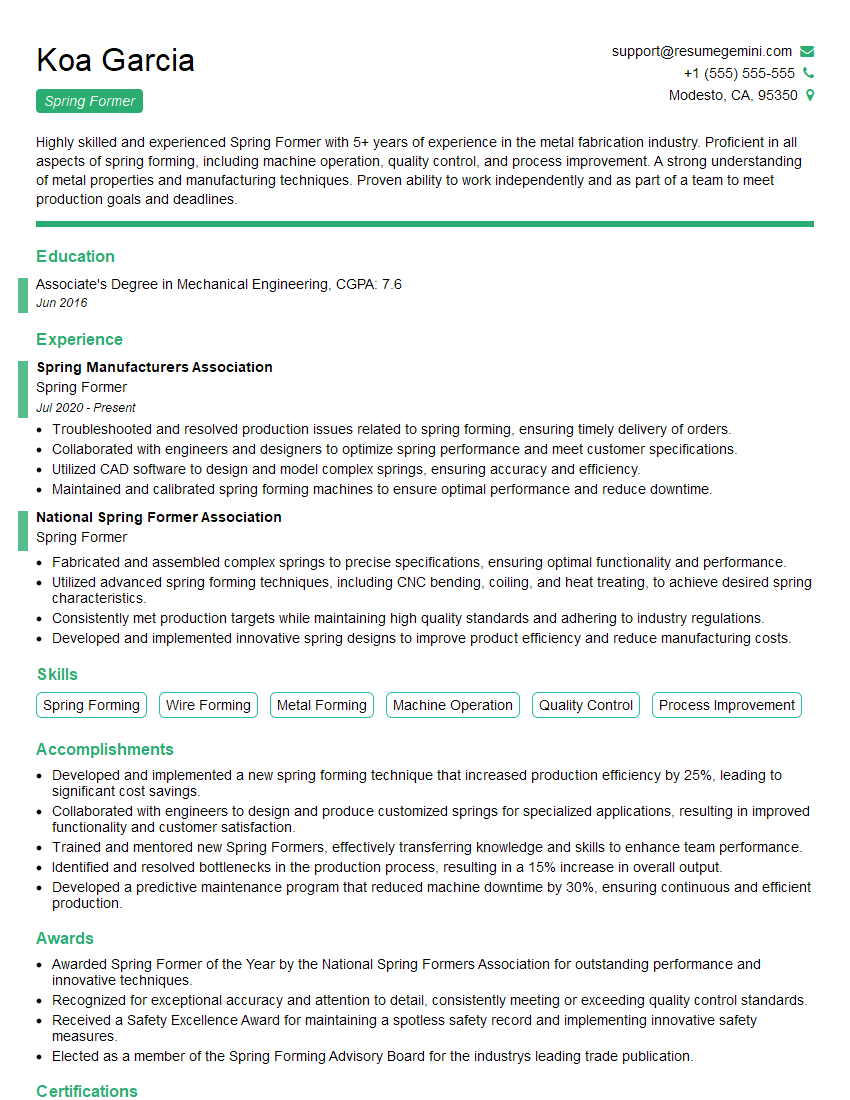
Are you gearing up for a career in Spring Former? Feeling nervous about the interview questions that might come your way? Don’t worry, you’re in the right place. In this blog post, we’ll dive deep into the most common interview questions for Spring Former and provide you with expert-backed answers. We’ll also explore the key responsibilities of this role so you can tailor your responses to showcase your perfect fit.
Acing the interview is crucial, but landing one requires a compelling resume that gets you noticed. Crafting a professional document that highlights your skills and experience is the first step toward interview success. ResumeGemini can help you build a standout resume that gets you called in for that dream job.






Essential Interview Questions For Spring Former
1. Explain the concept of dependency injection in Spring?
Dependency injection is a design pattern that allows the creation of objects without the need to specify their dependencies explicitly. In Spring, dependency injection is achieved through two mechanisms: constructor injection and setter injection. Constructor injection involves passing the dependencies to the object’s constructor, while setter injection involves using setter methods to set the dependencies after the object has been created.
- Constructor injection is the preferred method for dependency injection as it is more concise and less error-prone.
- Setter injection is more flexible as it allows the dependencies to be set after the object has been created.
2. What is the difference between a bean and a component in Spring?
Bean
- A bean is a generic term that refers to any object that is managed by the Spring IoC container.
- Beans can be created manually or by using Spring’s autowiring feature.
Component
- A component is a bean that is automatically discovered by the Spring IoC container.
- Components are typically annotated with the @Component annotation.
3. What is the purpose of the Spring MVC framework?
The Spring MVC framework is a web application framework that is used to build web applications in Java. Spring MVC follows the Model-View-Controller (MVC) design pattern, which separates the application logic (Model), the presentation logic (View), and the request handling logic (Controller).
- Spring MVC is a powerful and flexible framework that provides a number of features out of the box, such as:
- Request handling
- Data binding
- Validation
4. What is the difference between a servlet and a Spring controller?
- Servlets are low-level components that are used to handle HTTP requests and responses.
- Spring controllers are higher-level components that are used to handle HTTP requests and responses in a more object-oriented manner.
- Spring controllers provide a number of benefits over servlets, such as:
- They are more concise and easier to write.
- They are more testable.
- They provide better support for dependency injection.
5. What is the purpose of the Spring Data JPA framework?
The Spring Data JPA framework is a data access framework that is used to access data from a relational database using the Java Persistence API (JPA). Spring Data JPA provides a number of features that make it easier to work with JPA, such as:
- Repository abstraction: Spring Data JPA provides a repository abstraction that makes it easier to perform CRUD operations on entities.
- Query creation: Spring Data JPA provides a number of methods for creating queries, including methods for creating JPQL and native SQL queries.
- Transaction management: Spring Data JPA provides support for transaction management, which makes it easier to ensure that data is consistent.
6. What are the advantages of using Spring Boot?
- Simplicity: Spring Boot makes it easy to create Spring applications. It provides a number of pre-configured defaults that make it possible to get started with Spring development quickly and easily.
- Productivity: Spring Boot provides a number of features that can help to improve developer productivity, such as auto-configuration, starter dependencies, and live reload.
- Flexibility: Spring Boot is flexible and can be used to create a wide variety of applications, from simple web applications to complex enterprise applications.
7. What is the difference between a monolith and a microservice?
- Monolith: A monolith is a single, self-contained application that contains all of the functionality of the system.
- Microservice: A microservice is a small, independently deployable application that performs a specific function. Microservices are often used to build complex systems by combining multiple microservices into a single application.
- Scalability: Microservices can be scaled independently, which makes it easier to scale the system as a whole.
- Fault tolerance: If one microservice fails, the other microservices will continue to function, which makes the system more fault tolerant.
- Flexibility: Microservices can be developed and deployed independently, which makes it easier to update and change the system.
8. What are the benefits of using a continuous integration (CI) and continuous delivery (CD) pipeline?
- Improved code quality: CI/CD pipelines help to ensure that code is of high quality by running automated tests and checks.
- Faster delivery: CI/CD pipelines help to speed up the delivery of new features and fixes by automating the build, test, and deployment process.
- Reduced risk: CI/CD pipelines help to reduce the risk of deploying broken code by providing a safety net that catches errors before they reach production.
9. What is the importance of security in software development?
Security is of paramount importance in software development. Software vulnerabilities can be exploited by attackers to gain unauthorized access to systems and data, or to cause damage to systems. It is important to take security into account throughout the software development lifecycle, from design to deployment.
- Some of the best practices for software security include:
- Use secure coding practices: Secure coding practices help to prevent vulnerabilities from being introduced into code.
- Perform regular security audits: Security audits help to identify vulnerabilities in code and systems.
- Deploy security patches: Security patches fix vulnerabilities in software and systems.
- Use a web application firewall (WAF): A WAF can help to protect web applications from attacks.
10. What are the challenges of working in a team environment?
- Communication: Communication is key in a team environment. It is important to be able to communicate effectively with teammates in order to share ideas, resolve conflicts, and work together towards common goals.
- Coordination: Coordination is another important challenge in a team environment. It is important to be able to coordinate with teammates in order to ensure that everyone is working together efficiently and effectively.
- Conflict resolution: Conflict is inevitable in any team environment. It is important to be able to resolve conflicts in a healthy and productive way in order to maintain a positive and productive work environment.
Interviewers often ask about specific skills and experiences. With ResumeGemini‘s customizable templates, you can tailor your resume to showcase the skills most relevant to the position, making a powerful first impression. Also check out Resume Template specially tailored for Spring Former.
Career Expert Tips:
- Ace those interviews! Prepare effectively by reviewing the Top 50 Most Common Interview Questions on ResumeGemini.
- Navigate your job search with confidence! Explore a wide range of Career Tips on ResumeGemini. Learn about common challenges and recommendations to overcome them.
- Craft the perfect resume! Master the Art of Resume Writing with ResumeGemini’s guide. Showcase your unique qualifications and achievements effectively.
- Great Savings With New Year Deals and Discounts! In 2025, boost your job search and build your dream resume with ResumeGemini’s ATS optimized templates.
Researching the company and tailoring your answers is essential. Once you have a clear understanding of the Spring Former‘s requirements, you can use ResumeGemini to adjust your resume to perfectly match the job description.
Key Job Responsibilities
A Spring Former is responsible for the operation and maintenance of spring-forming machinery, which is used to manufacture various types of springs. Key job responsibilities include:
1. Machine Operation
Operate spring-forming machines to produce springs according to specifications.
- Set up and adjust forming parameters for different types of springs.
- Monitor machine operation and ensure smooth production.
2. Quality Control
Inspect finished springs to ensure they meet quality standards.
- Conduct dimensional checks, tensile strength tests, and fatigue tests.
- Identify and correct any defects or deviations from specifications.
3. Tooling Maintenance
Maintain and repair forming tools, fixtures, and jigs used in spring production.
- Sharpen or replace cutting tools and forming dies.
- Lubricate and adjust tooling to ensure optimal performance.
4. Troubleshooting
Troubleshoot and resolve operational issues related to spring-forming machinery.
- Diagnose and repair electrical, mechanical, or hydraulic faults.
- Identify and address production bottlenecks or inefficiencies.
Interview Tips
To ace an interview for a Spring Former position, it is crucial to prepare thoroughly and showcase your skills and knowledge. Here are some tips:
1. Research the Company and the Position
Learn about the company’s products, processes, and industry reputation. Understand the specific responsibilities and requirements of the Spring Former position.
2. Highlight Your Technical Skills
Emphasize your expertise in operating and maintaining spring-forming machines. Provide specific examples of your experience with different types of machinery and tooling.
3. Demonstrate Quality Control Knowledge
Explain your understanding of spring quality standards and inspection techniques. Highlight your ability to identify and rectify any deviations or defects.
4. Stress Troubleshooting Abilities
Showcase your problem-solving skills by providing examples of how you have successfully diagnosed and resolved operational issues in the past.
5. Be Enthusiastic and Motivated
Convey your passion for manufacturing and your desire to contribute to the company’s success. Show that you are eager to learn and grow in the field.
Next Step:
Armed with this knowledge, you’re now well-equipped to tackle the Spring Former interview with confidence. Remember, a well-crafted resume is your first impression. Take the time to tailor your resume to highlight your relevant skills and experiences. And don’t forget to practice your answers to common interview questions. With a little preparation, you’ll be on your way to landing your dream job. So what are you waiting for? Start building your resume and start applying! Build an amazing resume with ResumeGemini.