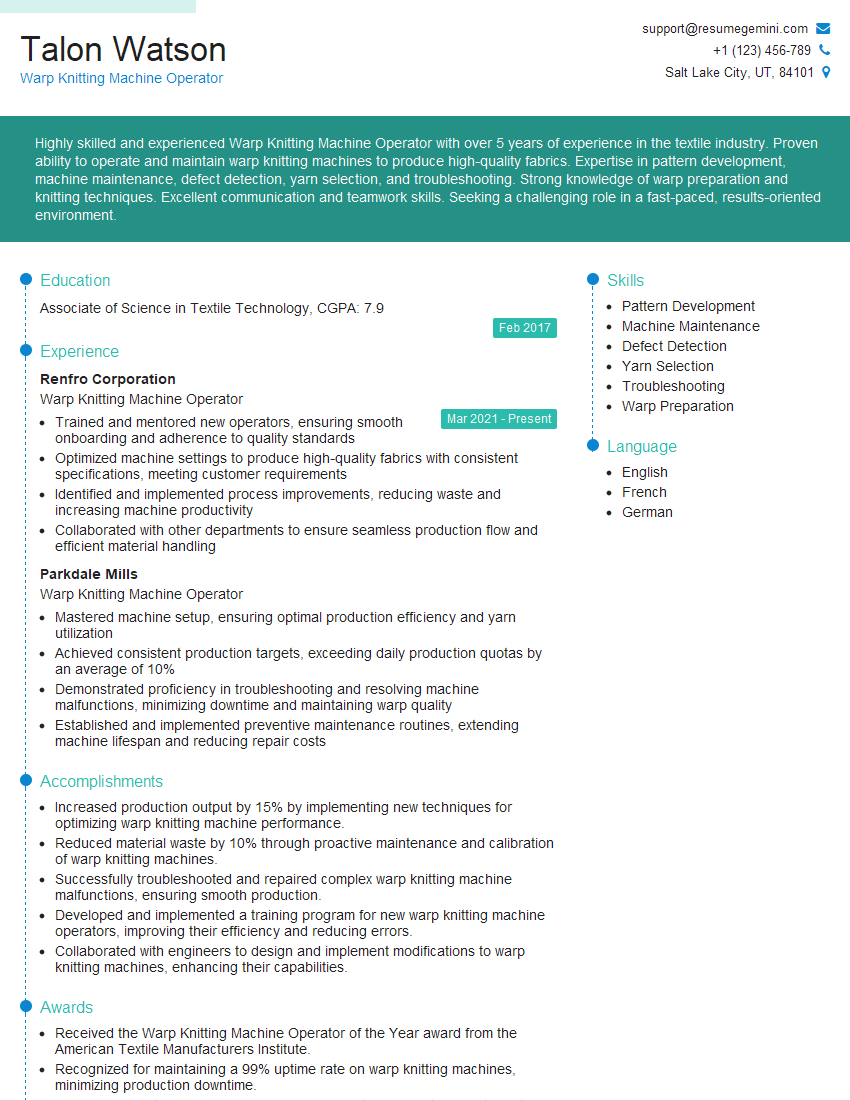
Are you gearing up for an interview for a Warp Knitting Machine Operator position? Whether you’re a seasoned professional or just stepping into the role, understanding what’s expected can make all the difference. In this blog, we dive deep into the essential interview questions for Warp Knitting Machine Operator and break down the key responsibilities of the role. By exploring these insights, you’ll gain a clearer picture of what employers are looking for and how you can stand out. Read on to equip yourself with the knowledge and confidence needed to ace your next interview and land your dream job!
Acing the interview is crucial, but landing one requires a compelling resume that gets you noticed. Crafting a professional document that highlights your skills and experience is the first step toward interview success. ResumeGemini can help you build a standout resume that gets you called in for that dream job.






Essential Interview Questions For Warp Knitting Machine Operator
1. What is the difference between a warp and a weft knitting machine?
A warp knitting machine is a knitting machine that produces fabric by knitting the yarns together in a vertical direction, while a weft knitting machine produces fabric by knitting the yarns together in a horizontal direction. Warp knitting machines are typically used to produce fabrics that are stronger and more stable than weft knitted fabrics, while weft knitting machines are typically used to produce fabrics that are softer and more elastic than warp knitted fabrics.
2. What are the different types of warp knitting machines?
-Tricot machines
- Tricot machines are used to produce fabrics that have a smooth, flat surface. They are typically used to produce fabrics that are used in clothing, such as T-shirts, underwear, and swimwear.
-Raschel machines
- Raschel machines are used to produce fabrics that have a more textured surface. They are typically used to produce fabrics that are used in upholstery, curtains, and blankets.
3. What are the different parts of a warp knitting machine?
- The creel is a frame that holds the yarn cones.
- The yarn guides guide the yarn to the needles.
- The needles form the loops of yarn that create the fabric.
- The sinkers hold the loops of yarn in place until they are knitted together.
- The take-up roller pulls the finished fabric away from the machine.
4. How do you operate a warp knitting machine?
To operate a warp knitting machine, you must first load the yarn onto the creel. Then, you must thread the yarn through the yarn guides and the needles. Once the yarn is threaded, you can start the machine. The machine will automatically knit the fabric according to the pattern that you have programmed into the machine.
5. How do you maintain a warp knitting machine?
To maintain a warp knitting machine, you must regularly clean the machine and oil the moving parts. You must also inspect the machine for any damage and repair any damage that you find. You must also calibrate the machine regularly to ensure that it is producing fabric to the correct specifications.
6. What are the different types of fabrics that can be produced on a warp knitting machine?
A warp knitting machine can produce a wide variety of fabrics, including tricot, raschel, and lace. Tricot fabrics are smooth and flat, while raschel fabrics are more textured. Lace fabrics are delicate and openwork.
7. What are the different applications for warp knitted fabrics?
Warp knitted fabrics are used in a wide variety of applications, including clothing, upholstery, curtains, blankets, and medical textiles.
8. What are the advantages of warp knitting over weft knitting?
Warp knitting offers a number of advantages over weft knitting, including:
- Warp knitted fabrics are stronger and more stable than weft knitted fabrics.
- Warp knitted fabrics are less likely to run or snag than weft knitted fabrics.
- Warp knitted fabrics can be produced in a wider variety of patterns than weft knitted fabrics.
9. What are the disadvantages of warp knitting over weft knitting?
Warp knitting also has some disadvantages over weft knitting, including:
- Warp knitting machines are more expensive than weft knitting machines.
- Warp knitting machines are more difficult to operate than weft knitting machines.
- Warp knitted fabrics are more expensive than weft knitted fabrics.
10. What are the future trends in warp knitting?
The future of warp knitting is bright. Warp knitting technology is constantly evolving, and new and innovative fabrics are being developed all the time. Warp knitted fabrics are becoming increasingly popular in a wide variety of applications, and this trend is expected to continue in the future.
Interviewers often ask about specific skills and experiences. With ResumeGemini‘s customizable templates, you can tailor your resume to showcase the skills most relevant to the position, making a powerful first impression. Also check out Resume Template specially tailored for Warp Knitting Machine Operator.
Career Expert Tips:
- Ace those interviews! Prepare effectively by reviewing the Top 50 Most Common Interview Questions on ResumeGemini.
- Navigate your job search with confidence! Explore a wide range of Career Tips on ResumeGemini. Learn about common challenges and recommendations to overcome them.
- Craft the perfect resume! Master the Art of Resume Writing with ResumeGemini’s guide. Showcase your unique qualifications and achievements effectively.
- Great Savings With New Year Deals and Discounts! In 2025, boost your job search and build your dream resume with ResumeGemini’s ATS optimized templates.
Researching the company and tailoring your answers is essential. Once you have a clear understanding of the Warp Knitting Machine Operator‘s requirements, you can use ResumeGemini to adjust your resume to perfectly match the job description.
Key Job Responsibilities
Warp Knitting Machine Operators are responsible for the operation and maintenance of warp knitting machines, which produce fabrics for a variety of applications. Their key responsibilities include:
1. Setting up and operating warp knitting machines
Warp Knitting Machine Operators must be able to set up and operate warp knitting machines according to specifications. They must be able to prepare the machine for operation, including threading the yarn, setting the knitting pattern, and adjusting the machine settings.
- Operate warp knitting machines to produce knitted fabrics
- Load and unload yarn onto the machine
- Monitor the knitting process and make adjustments as needed
2. Inspecting and correcting fabric defects
Warp Knitting Machine Operators must be able to inspect and correct fabric defects. They must be able to identify defects in the fabric, determine the cause of the defect, and correct the defect.
- Inspect knitted fabrics for defects
- Identify and correct defects in the fabric
- Maintain a clean and safe work area
3. Maintaining warp knitting machines
Warp Knitting Machine Operators must be able to maintain warp knitting machines. They must be able to lubricate the machine, change parts, and perform other maintenance tasks.
- Lubricate and adjust the machine
- Replace worn or damaged parts
- Perform other maintenance tasks as needed
4. Working with other staff
Warp Knitting Machine Operators must be able to work with other staff. They must be able to communicate with supervisors and other workers, and work as part of a team.
- Work with other staff members to ensure efficient production
- Communicate with supervisors and other workers
- Work as part of a team
Interview Tips
To prepare for an interview for a Warp Knitting Machine Operator position, candidates should:
1. Research the company and the position
Candidates should research the company and the position to which they are applying. This will help them to understand the company’s culture and the requirements of the position.
- Visit the company’s website
- Read about the company in industry publications
- Talk to people who work for the company
2. Practice answering common interview questions
Candidates should practice answering common interview questions. This will help them to be prepared for the interview and to make a good impression on the interviewer.
- What are your strengths and weaknesses?
- Why are you interested in this position?
- What are your salary expectations?
3. Dress appropriately
Candidates should dress appropriately for the interview. This means wearing business attire, such as a suit or dress. They should also be well-groomed and punctual.
- Wear business attire
- Be well-groomed
- Be punctual
4. Be confident
Candidates should be confident in their abilities and their ability to do the job. They should be able to articulate their skills and experience, and they should be able to answer the interviewer’s questions clearly and concisely.
- Be confident in your abilities
- Articulate your skills and experience
- Answer the interviewer’s questions clearly and concisely
Next Step:
Now that you’re armed with interview-winning answers and a deeper understanding of the Warp Knitting Machine Operator role, it’s time to take action! Does your resume accurately reflect your skills and experience for this position? If not, head over to ResumeGemini. Here, you’ll find all the tools and tips to craft a resume that gets noticed. Don’t let a weak resume hold you back from landing your dream job. Polish your resume, hit the “Build Your Resume” button, and watch your career take off! Remember, preparation is key, and ResumeGemini is your partner in interview success.