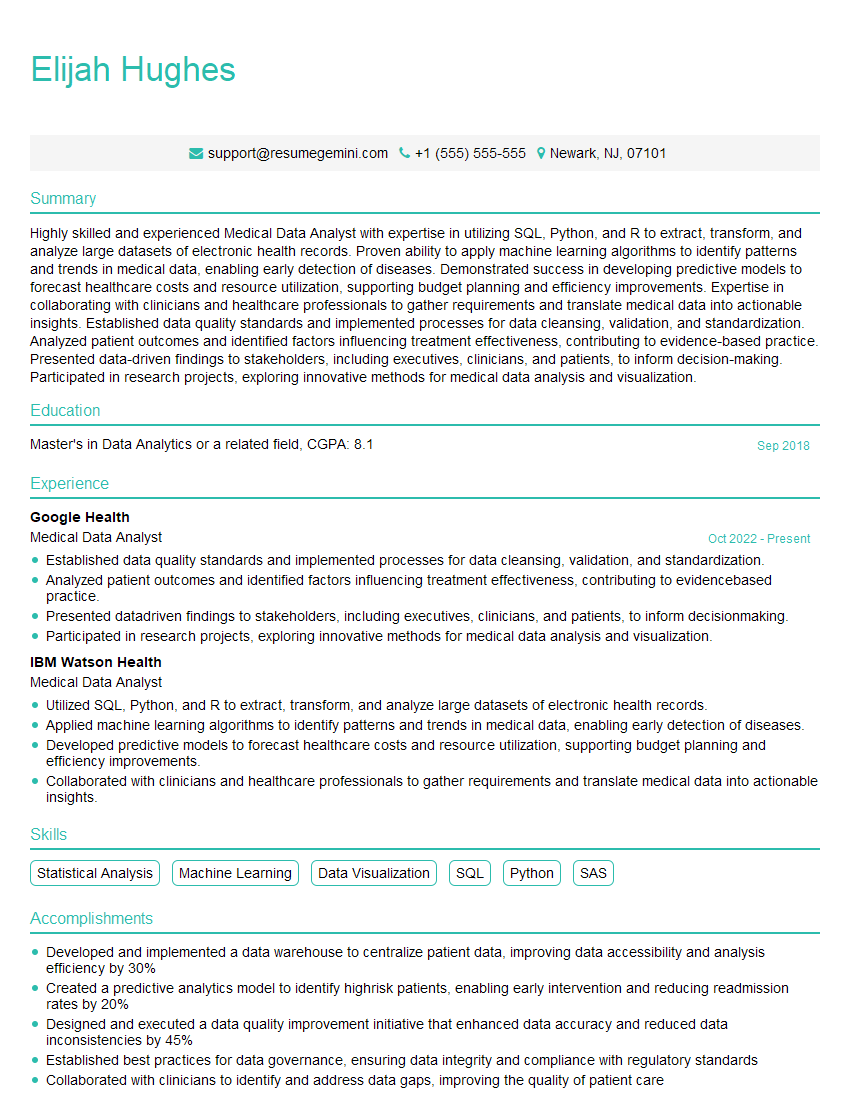
Feeling lost in a sea of interview questions? Landed that dream interview for Medical Data Analyst but worried you might not have the answers? You’re not alone! This blog is your guide for interview success. We’ll break down the most common Medical Data Analyst interview questions, providing insightful answers and tips to leave a lasting impression. Plus, we’ll delve into the key responsibilities of this exciting role, so you can walk into your interview feeling confident and prepared.
Acing the interview is crucial, but landing one requires a compelling resume that gets you noticed. Crafting a professional document that highlights your skills and experience is the first step toward interview success. ResumeGemini can help you build a standout resume that gets you called in for that dream job.






Essential Interview Questions For Medical Data Analyst
1. What is the role of a Medical Data Analyst?
As a Medical Data Analyst, I am responsible for collecting, analyzing, and interpreting healthcare data to identify patterns, trends, and insights. I collaborate with clinicians, researchers, and administrators to improve patient care, optimize healthcare operations, and support decision-making.
2. Describe your experience in using statistical software and data visualization tools.
- I am proficient in using statistical software such as SAS, SPSS, and R for data analysis, modeling, and hypothesis testing.
- I am skilled in using data visualization tools like Tableau and Power BI to create clear and compelling visualizations that communicate insights effectively.
3. How do you handle large and complex datasets?
I leverage data management techniques to handle large and complex datasets. I use data cleaning and transformation tools to ensure the data is accurate and consistent. I also employ sampling methods and statistical techniques to analyze large datasets efficiently and draw meaningful conclusions.
4. Describe your experience in applying machine learning techniques to healthcare data.
- I have experience in applying various machine learning algorithms, such as regression, classification, and clustering, to healthcare data.
- I have used these techniques to develop predictive models for disease risk assessment, patient segmentation, and treatment optimization.
5. How do you ensure the quality and accuracy of your data analysis results?
- I follow rigorous data quality checks and validation procedures to ensure the accuracy and reliability of my analysis results.
- I employ data verification and validation techniques to identify and correct errors or inconsistencies in the data.
6. Describe your communication and presentation skills.
- I am an effective communicator and can clearly convey complex data analysis results to both technical and non-technical audiences.
- I am proficient in presenting my findings through presentations, reports, and dashboards that are visually appealing and easy to understand.
7. How do you stay up-to-date with the latest advancements in healthcare data analysis?
- I regularly attend conferences, workshops, and webinars to stay abreast of the latest trends and innovations in healthcare data analysis.
- I subscribe to industry publications and research journals to keep myself informed about emerging techniques and best practices.
8. Describe a challenging project you worked on and how you overcame the challenges.
I worked on a project to develop a predictive model to identify high-risk patients for a rare disease. The challenge was that the data was limited and imbalanced, making it difficult to train the model effectively. I used sampling techniques and ensemble learning methods to overcome these challenges and develop a model that achieved high accuracy and specificity.
9. How do you handle ethical considerations in healthcare data analysis?
- I am aware of the ethical considerations and privacy concerns associated with handling healthcare data.
- I follow industry best practices and comply with regulations to protect patient confidentiality and ensure the ethical use of data.
10. How do you see the role of Medical Data Analysts evolving in the future?
- I believe that the role of Medical Data Analysts will become increasingly important in the future as healthcare data continues to grow and become more complex.
- Data analysts will play a crucial role in driving data-driven decision-making, improving patient care, and transforming the healthcare industry.
Interviewers often ask about specific skills and experiences. With ResumeGemini‘s customizable templates, you can tailor your resume to showcase the skills most relevant to the position, making a powerful first impression. Also check out Resume Template specially tailored for Medical Data Analyst.
Career Expert Tips:
- Ace those interviews! Prepare effectively by reviewing the Top 50 Most Common Interview Questions on ResumeGemini.
- Navigate your job search with confidence! Explore a wide range of Career Tips on ResumeGemini. Learn about common challenges and recommendations to overcome them.
- Craft the perfect resume! Master the Art of Resume Writing with ResumeGemini’s guide. Showcase your unique qualifications and achievements effectively.
- Great Savings With New Year Deals and Discounts! In 2025, boost your job search and build your dream resume with ResumeGemini’s ATS optimized templates.
Researching the company and tailoring your answers is essential. Once you have a clear understanding of the Medical Data Analyst‘s requirements, you can use ResumeGemini to adjust your resume to perfectly match the job description.
Key Job Responsibilities
Medical Data Analysts mine, process, and analyze vast amounts of health-related data to extract actionable insights that drive decision-making within healthcare organizations.
1. Data Management and Analysis
Collects, organizes, and processes medical data from various sources, including electronic health records, claims data, and clinical research studies.
- Ensures data integrity, accuracy, and completeness by implementing data validation and cleaning techniques.
- Applies statistical and analytical methods to identify patterns, trends, and correlations in the data.
2. Data Visualization and Reporting
Develops dashboards, reports, and presentations to visualize and communicate complex data findings.
- Selects appropriate data visualization techniques to effectively convey insights to stakeholders.
- Writes clear and concise reports that highlight key findings and provide actionable recommendations.
3. Clinical Support
Collaborates with clinicians to understand their data needs and provide insights that inform patient care decisions.
- Identifies opportunities for improving patient outcomes, care delivery, and resource utilization.
- Assists in the development and evaluation of clinical interventions based on data analysis results.
4. Business Intelligence
Uses data analysis techniques to identify opportunities for operational improvements and cost optimization.
- Supports financial planning, budgeting, and strategic decision-making by providing data-driven insights.
- Monitors key performance indicators and develops predictive models to forecast trends and predict outcomes.
Interview Tips
Preparing for an interview for a Medical Data Analyst position requires careful research and a strategic approach.
1. Research the Company and Position
Thoroughly review the company website, LinkedIn profile, and any available materials about the specific job opening.
- Identify the company’s mission, values, and key industry initiatives.
- Understand the specific responsibilities and expectations of the Medical Data Analyst role.
2. Quantify Your Experience
Use specific metrics and examples to demonstrate the impact of your data analysis efforts.
- Quantify the financial savings or operational improvements resulting from your insights.
- Provide examples of how you have used data to identify trends, predict outcomes, and solve problems.
3. Showcase Your Skills
Highlight your proficiency in data management, analysis, and visualization tools.
- Discuss your experience with specific software packages such as SQL, Python, and Tableau.
- Present case studies or projects that demonstrate your ability to extract insights from complex datasets.
4. Prepare for Technical Questions
Expect technical questions about data analysis techniques, data modeling, and statistical methods.
- Review fundamental statistical concepts such as hypothesis testing, regression analysis, and probability distributions.
- Practice solving data manipulation problems using SQL or Python.
5. Emphasize Communication and Collaboration
Medical Data Analysts must be able to effectively communicate their findings to both technical and non-technical audiences.
- Highlight your ability to write clear and concise reports, deliver presentations, and collaborate with stakeholders from different backgrounds.
- Share examples of how you have successfully influenced decision-making through effective communication.
Next Step:
Now that you’re armed with a solid understanding of what it takes to succeed as a Medical Data Analyst, it’s time to turn that knowledge into action. Take a moment to revisit your resume, ensuring it highlights your relevant skills and experiences. Tailor it to reflect the insights you’ve gained from this blog and make it shine with your unique qualifications. Don’t wait for opportunities to come to you—start applying for Medical Data Analyst positions today and take the first step towards your next career milestone. Your dream job is within reach, and with a polished resume and targeted applications, you’ll be well on your way to achieving your career goals! Build your resume now with ResumeGemini.