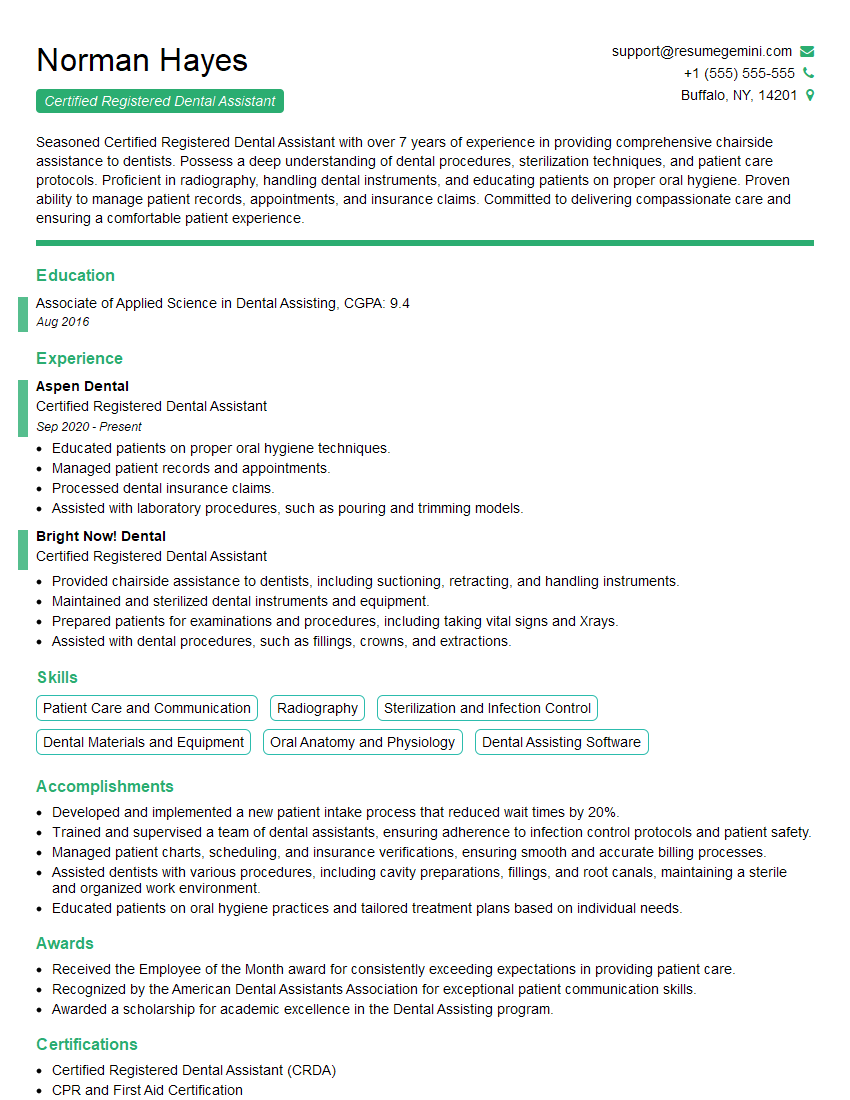
Feeling lost in a sea of interview questions? Landed that dream interview for Certified Registered Dental Assistant but worried you might not have the answers? You’re not alone! This blog is your guide for interview success. We’ll break down the most common Certified Registered Dental Assistant interview questions, providing insightful answers and tips to leave a lasting impression. Plus, we’ll delve into the key responsibilities of this exciting role, so you can walk into your interview feeling confident and prepared.
Acing the interview is crucial, but landing one requires a compelling resume that gets you noticed. Crafting a professional document that highlights your skills and experience is the first step toward interview success. ResumeGemini can help you build a standout resume that gets you called in for that dream job.






Essential Interview Questions For Certified Registered Dental Assistant
1. Describe the procedure for taking dental impressions using different materials?
The procedure for taking dental impressions using different materials may vary depending on the specific material being used, but here is a general overview.
- Prepare the patient by explaining the procedure, rinsing their mouth with water, and placing a protective barrier (e.g., rubber dam) over the teeth to isolate them from saliva.
- Select the appropriate impression material and mix it according to the manufacturer’s instructions.
- Load the impression material into an impression tray and position it over the teeth.
- Instruct the patient to bite down gently and hold the tray in place for the specified time.
- Once the impression material has set, remove the tray from the mouth and inspect the impression for accuracy.
- Trim any excess material and pour the impression into a mold to create a stone model of the teeth.
2. Explain how to properly sterilize dental instruments using an autoclave?
Sterilization of dental instruments using an autoclave is crucial to prevent the transmission of infection.
- Clean the instruments thoroughly to remove any visible debris or contaminants.
- Wrap the instruments in a sterilization pouch or container.
- Place the instruments in the autoclave chamber and secure the door.
- Select the appropriate sterilization cycle (e.g., temperature and duration) based on the manufacturer’s recommendations.
- Start the sterilization cycle and monitor the temperature and pressure throughout the process.
- Once the cycle is complete, allow the instruments to cool before handling them.
3. How do you assist the dentist in performing a root canal treatment?
Assisting the dentist in performing a root canal treatment involves various responsibilities.
- Prepare the patient by explaining the procedure and obtaining consent.
- Set up the dental unit and equipment, including the dental dam and root canal instruments.
- Provide suction and ensure a clear operating field by removing saliva and debris.
- Mix and prepare root canal sealants and medications as directed by the dentist.
- Assist with the placement of rubber dams, clamps, and other isolation materials.
- Hand instruments to the dentist and operate the dental dam suction.
- Take X-rays as needed to assess the progress of the treatment.
4. Discuss the importance of maintaining a clean and organized dental operatory?
Maintaining a clean and organized dental operatory is essential for several reasons.
- Infection control: A clean environment helps prevent the spread of bacteria and viruses, protecting both patients and staff.
- Patient comfort: A clean and organized operatory creates a more pleasant and comfortable experience for patients.
- Efficiency: Having everything in its proper place allows for a smooth workflow and increased productivity.
- Professionalism: A well-maintained operatory reflects well on the dental practice and its staff.
- Compliance: Maintaining a clean and organized operatory is often a requirement for compliance with regulatory standards.
5. Describe the different types of dental materials used in restorative dentistry and their properties?
There are various types of dental materials used in restorative dentistry, each with its unique properties:
- Amalgam: A mixture of silver, mercury, tin, and copper, amalgam is a durable and affordable material used for fillings.
- Composite resin: A tooth-colored material that is used for fillings, crowns, and veneers. It is strong and aesthetically pleasing.
- Glass ionomer cement: A tooth-colored material that releases fluoride and is used for fillings and liners.
- Porcelain: A strong and aesthetically pleasing material used for crowns, veneers, and bridges.
- Zirconia: A strong and biocompatible material used for crowns, bridges, and implants.
6. Explain the role of a Certified Registered Dental Assistant in patient education?
As a Certified Registered Dental Assistant, patient education is an important aspect of my role.
- Provide oral hygiene instructions: I demonstrate proper brushing and flossing techniques to help patients maintain good oral hygiene.
- Explain dental procedures: I clearly explain dental procedures to patients, addressing their concerns and answering their questions.
- Discuss treatment options: I present different treatment options to patients, explaining the benefits and limitations of each.
- Promote preventive care: I emphasize the importance of regular dental checkups, cleanings, and preventive measures to maintain oral health.
- Create educational materials: I develop educational materials, such as brochures and handouts, to reinforce oral health information for patients.
7. Describe the steps involved in taking and developing dental radiographs?
- Position the patient: I position the patient correctly in the dental chair and adjust the X-ray machine.
- Place the film: I place the X-ray film in the patient’s mouth and hold it securely.
- Expose the film: I expose the film to X-rays by pressing the exposure button.
- Develop the film: I develop the film in a darkroom using chemicals to create a visible image.
- Mount the film: I mount the developed film on a viewbox for interpretation by the dentist.
8. Explain how to manage dental emergencies, such as a knocked-out tooth?
- Remain calm: It is important to remain calm and reassure the patient.
- Locate the tooth: Find the knocked-out tooth and gently rinse it with water (do not scrub).
- Preserve the tooth: If possible, place the tooth back into the socket immediately. If this is not possible, store the tooth in milk or saliva.
- Seek immediate dental attention: Contact a dentist immediately, as it is crucial to get the tooth replanted as soon as possible.
9. Describe the ethical considerations and legal responsibilities of a Certified Registered Dental Assistant?
- Confidentiality: Maintain patient confidentiality by protecting their personal and medical information.
- Informed consent: Obtain informed consent from patients before performing any procedures.
- Competence: Perform duties within the scope of my training and experience.
- Reporting: Report any suspected abuse or neglect of patients to the appropriate authorities.
- Compliance: Adhere to all applicable laws and regulations governing dental assisting.
10. Discuss the importance of continuing education for a Certified Registered Dental Assistant?
- Advance knowledge and skills: Continuing education provides opportunities to stay up-to-date with the latest advancements in dental technology and techniques.
- Meet certification requirements: Many states and organizations require dental assistants to complete continuing education hours to maintain their certification.
- Enhance patient care: By acquiring new knowledge and skills, I can provide better and more comprehensive care to patients.
- Stay informed about industry trends: Continuing education helps me stay informed about industry trends and best practices.
- Personal and professional growth: Continuing education fosters personal and professional growth by challenging me to learn and expand my capabilities.
Interviewers often ask about specific skills and experiences. With ResumeGemini‘s customizable templates, you can tailor your resume to showcase the skills most relevant to the position, making a powerful first impression. Also check out Resume Template specially tailored for Certified Registered Dental Assistant.
Career Expert Tips:
- Ace those interviews! Prepare effectively by reviewing the Top 50 Most Common Interview Questions on ResumeGemini.
- Navigate your job search with confidence! Explore a wide range of Career Tips on ResumeGemini. Learn about common challenges and recommendations to overcome them.
- Craft the perfect resume! Master the Art of Resume Writing with ResumeGemini’s guide. Showcase your unique qualifications and achievements effectively.
- Great Savings With New Year Deals and Discounts! In 2025, boost your job search and build your dream resume with ResumeGemini’s ATS optimized templates.
Researching the company and tailoring your answers is essential. Once you have a clear understanding of the Certified Registered Dental Assistant‘s requirements, you can use ResumeGemini to adjust your resume to perfectly match the job description.
Key Job Responsibilities
Certified Registered Dental Assistants (CRDAs) are integral members of the dental team, providing essential support to dentists in delivering quality dental care. Their key responsibilities encompass a wide range of tasks that contribute to the efficient operation of the dental practice and the well-being of patients.
1. Patient Care and Assistance
CRDAs play a crucial role in assisting dentists with patient care. They interact directly with patients, providing comfort, reassurance, and instructions. Their responsibilities in this area include:
- Preparing patients for dental procedures, including taking X-rays and vital signs
- Assisting dentists during examinations, treatments, and surgeries
- Providing oral hygiene instructions and educating patients on proper dental care techniques
2. Administrative and Office Management
CRDAs are also responsible for various administrative and office management tasks that ensure the smooth functioning of the practice. Their duties in this area include:
- Scheduling appointments, maintaining patient records, and managing insurance claims
- Processing payments, ordering supplies, and maintaining equipment
- Assisting with marketing and outreach initiatives to attract new patients
3. Sterilization and Infection Control
CRDAs are responsible for maintaining a sterile and hygienic work environment to prevent the spread of infections. Their duties in this area include:
- Sterilizing instruments and equipment using approved methods
- Disinfecting surfaces and maintaining a clean work area
- Following safety protocols and adhering to infection control guidelines
4. Continuing Education
CRDAs are required to maintain their certification by completing continuing education credits. This ensures that they stay up-to-date with the latest advancements in dental technology and best practices.
- Attending conferences, workshops, and online courses
- Staying informed about new dental materials and techniques
- Participating in peer-reviewed studies and research to enhance the field of dentistry
Interview Tips
Preparing for an interview for a Certified Registered Dental Assistant position requires careful planning and research. Here are some tips and hacks to help you ace the interview:
1. Research the Practice
Before the interview, take the time to research the dental practice you’re applying to. Visit their website, read online reviews, and learn about their services and specialties. This will give you a better understanding of the practice’s culture and mission, and allow you to tailor your answers to the specific needs of the practice.
2. Practice Common Interview Questions
Prepare for the most common interview questions asked for dental assistant positions. Practice answering questions related to your skills, experience, and qualifications. Use the STAR method (Situation, Task, Action, Result) to structure your answers and provide specific examples of your work.
3. Highlight Your Passion for Dentistry
Emphasize your interest in dentistry and how it aligns with your career goals. Share any volunteer or shadowing experiences you have in the field, and discuss how you stay up-to-date with the latest dental trends and techniques. Your passion for dentistry will set you apart from other candidates.
4. Showcase Your Interpersonal Skills
Dental assistants interact with patients and colleagues on a daily basis, so it’s essential to demonstrate your strong interpersonal skills. Highlight your ability to communicate effectively, build rapport with patients, and work well in a team environment.
5. Dress Professionally and Arrive on Time
First impressions matter, so dress professionally for your interview. Arrive on time and be prepared to show your enthusiasm and professionalism. Your punctuality and appearance will reflect your respect for the hiring manager and the practice.
Next Step:
Now that you’re armed with a solid understanding of what it takes to succeed as a Certified Registered Dental Assistant, it’s time to turn that knowledge into action. Take a moment to revisit your resume, ensuring it highlights your relevant skills and experiences. Tailor it to reflect the insights you’ve gained from this blog and make it shine with your unique qualifications. Don’t wait for opportunities to come to you—start applying for Certified Registered Dental Assistant positions today and take the first step towards your next career milestone. Your dream job is within reach, and with a polished resume and targeted applications, you’ll be well on your way to achieving your career goals! Build your resume now with ResumeGemini.