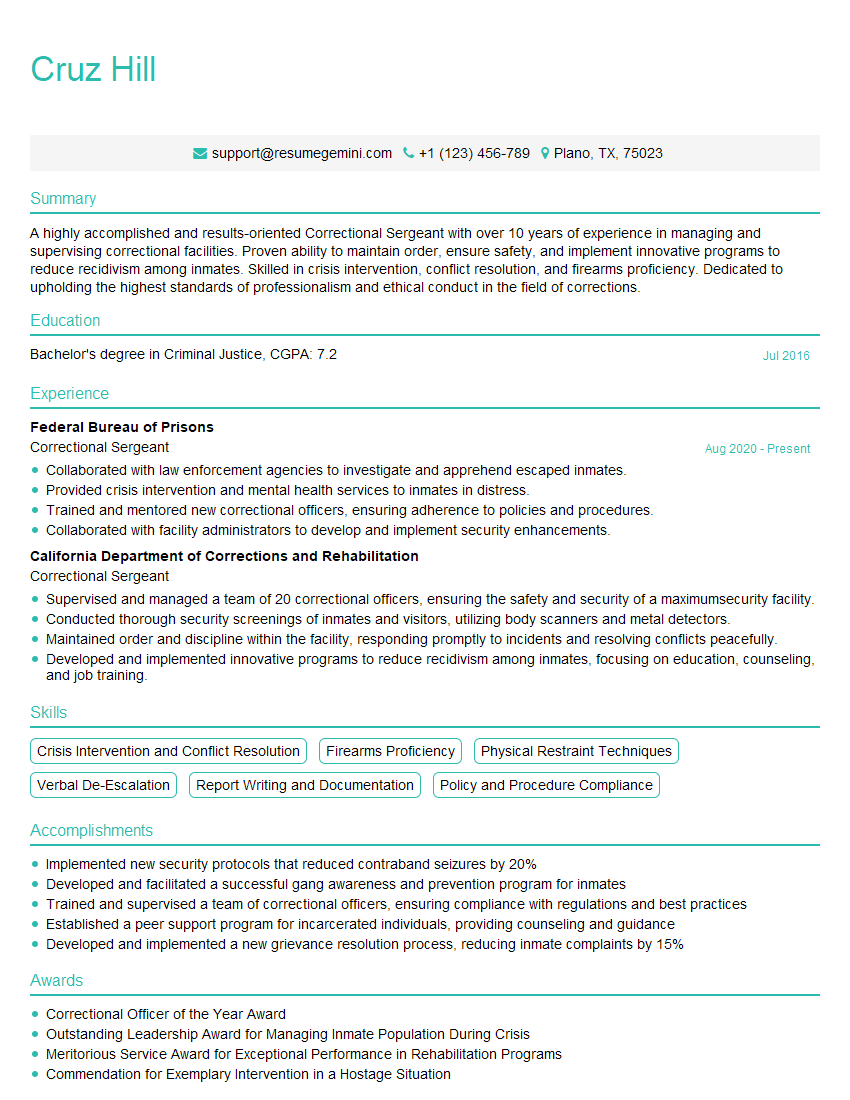
Feeling lost in a sea of interview questions? Landed that dream interview for Correctional Sergeant but worried you might not have the answers? You’re not alone! This blog is your guide for interview success. We’ll break down the most common Correctional Sergeant interview questions, providing insightful answers and tips to leave a lasting impression. Plus, we’ll delve into the key responsibilities of this exciting role, so you can walk into your interview feeling confident and prepared.
Acing the interview is crucial, but landing one requires a compelling resume that gets you noticed. Crafting a professional document that highlights your skills and experience is the first step toward interview success. ResumeGemini can help you build a standout resume that gets you called in for that dream job.






Essential Interview Questions For Correctional Sergeant
1. What are the key responsibilities of a Correctional Sergeant?
The key responsibilities of a Correctional Sergeant include:
- Supervising and training correctional officers
- Maintaining order and safety within the correctional facility
- Enforcing departmental policies and procedures
- Investigating incidents and conducting disciplinary proceedings
- Providing support and guidance to inmates
2. What are the most important qualities and skills for a Correctional Sergeant?
- Leadership
- Communication
- Problem-solving
- Decision-making
- Physical fitness
3. How would you handle a situation in which an inmate is being disruptive or violent?
I would first attempt to de-escalate the situation by speaking calmly and asking the inmate to comply. If the inmate does not comply, I would call for backup and use force if necessary to restrain the inmate and restore order.
4. How would you motivate a team of correctional officers?
I would motivate a team of correctional officers by setting clear expectations, providing regular feedback, and recognizing their accomplishments. I would also create a positive and supportive work environment where they feel valued and respected.
5. What are some of the challenges that you have faced as a Correctional Sergeant?
Some of the challenges that I have faced as a Correctional Sergeant include dealing with violent or disruptive inmates, managing a large and diverse staff, and maintaining order and safety in a high-stress environment.
6. What are your career goals?
My career goal is to become a Correctional Lieutenant. I believe that my experience and skills as a Correctional Sergeant have prepared me for this role, and I am confident that I can be an effective leader and manager in a higher-level position.
7. Why do you want to work for our correctional facility?
I am interested in working for your correctional facility because I am impressed by your commitment to rehabilitation and your focus on providing a safe and humane environment for inmates. I believe that my skills and experience would be a valuable asset to your team, and I am excited about the opportunity to contribute to your mission.
8. What are your thoughts on the use of solitary confinement?
I believe that solitary confinement should only be used as a last resort, and only for a limited period of time. I believe that it is important to provide inmates with opportunities for rehabilitation and reintegration into society, and solitary confinement can be detrimental to this process.
9. What are your thoughts on the use of force?
I believe that the use of force should only be used as a last resort, and only when necessary to maintain order and safety. I believe that it is important to use the least amount of force necessary, and to de-escalate situations whenever possible.
10. What are your thoughts on the role of correctional officers in the community?
I believe that correctional officers play an important role in the community by helping to keep it safe and by providing support and guidance to inmates. I believe that it is important for correctional officers to be involved in community outreach programs and to work with other agencies to address the root causes of crime.
Interviewers often ask about specific skills and experiences. With ResumeGemini‘s customizable templates, you can tailor your resume to showcase the skills most relevant to the position, making a powerful first impression. Also check out Resume Template specially tailored for Correctional Sergeant.
Career Expert Tips:
- Ace those interviews! Prepare effectively by reviewing the Top 50 Most Common Interview Questions on ResumeGemini.
- Navigate your job search with confidence! Explore a wide range of Career Tips on ResumeGemini. Learn about common challenges and recommendations to overcome them.
- Craft the perfect resume! Master the Art of Resume Writing with ResumeGemini’s guide. Showcase your unique qualifications and achievements effectively.
- Great Savings With New Year Deals and Discounts! In 2025, boost your job search and build your dream resume with ResumeGemini’s ATS optimized templates.
Researching the company and tailoring your answers is essential. Once you have a clear understanding of the Correctional Sergeant‘s requirements, you can use ResumeGemini to adjust your resume to perfectly match the job description.
Key Job Responsibilities
Correctional Sergeants play a crucial role in maintaining order, safety, and security within correctional facilities. Their responsibilities encompass a wide range of tasks, including:
1. Supervision of Inmates
Correctional Sergeants are responsible for the supervision and care of inmates within their assigned areas. They ensure that inmates follow facility rules and regulations, maintain order, and adhere to safety protocols.
- Monitor inmate behavior and activities
- Enforce facility policies and procedures
- Respond to incidents and emergencies
2. Security and Safety
Correctional Sergeants are tasked with maintaining the security and safety of the facility and its occupants. They conduct security checks, monitor surveillance systems, and respond to security breaches.
- Conduct regular security checks and inspections
- Monitor surveillance cameras and other security systems
- Respond to security breaches and disturbances
3. Inmate Management
Correctional Sergeants are involved in various aspects of inmate management, including intake processing, classification, and rehabilitation programs. They assist with inmate counseling, provide support to inmates, and facilitate communication between inmates and staff.
- Process new inmates and conduct intake interviews
- Classify inmates according to their security level and needs
- Facilitate inmate counseling and rehabilitation programs
4. Staff Supervision and Training
Correctional Sergeants often supervise and train other correctional staff, including officers and non-sworn personnel. They provide guidance, support, and training to ensure that staff members are well-equipped to handle their duties.
- Supervise and train correctional officers
- Provide guidance and support to non-sworn staff
- Conduct training sessions on facility policies and procedures
Interview Tips
Preparing thoroughly for a Correctional Sergeant interview is essential to increase your chances of success. Here are some tips to help you ace the interview:
1. Research the Facility
Familiarize yourself with the correctional facility you are applying to. Learn about its history, mission, and the population it serves. This knowledge will demonstrate your interest and commitment to the facility.
- Visit the facility’s website and read about its history and programs
- Read news articles and other publications about the facility
- Talk to people who have worked or are currently working at the facility
2. Practice Answering Common Interview Questions
Research common interview questions for Correctional Sergeant positions and prepare your answers in advance. Anticipating the questions and preparing thoughtful responses will boost your confidence and enable you to articulate your qualifications effectively.
- Why are you interested in working as a Correctional Sergeant?
- What experience and skills do you have that make you a good fit for this role?
- How do you handle conflict and maintain order in a challenging environment?
3. Be Prepared to Discuss Your Experience and Skills
Highlight your relevant experience and skills during the interview. Emphasize your leadership abilities, problem-solving skills, and ability to work effectively with a diverse population. Provide specific examples to demonstrate your qualifications.
- Discuss your experience supervising and managing staff
- Share examples of how you have handled difficult inmates or situations
- Explain your understanding of correctional facility policies and procedures
4. Dress Professionally and Behave Respectfully
First impressions matter. Dress professionally for the interview and arrive on time. Be polite and respectful to the interviewer and all other individuals you encounter during the interview process.
- Wear a suit or business casual attire
- Be on time for your interview
- Make eye contact and speak clearly
Next Step:
Now that you’re armed with a solid understanding of what it takes to succeed as a Correctional Sergeant, it’s time to turn that knowledge into action. Take a moment to revisit your resume, ensuring it highlights your relevant skills and experiences. Tailor it to reflect the insights you’ve gained from this blog and make it shine with your unique qualifications. Don’t wait for opportunities to come to you—start applying for Correctional Sergeant positions today and take the first step towards your next career milestone. Your dream job is within reach, and with a polished resume and targeted applications, you’ll be well on your way to achieving your career goals! Build your resume now with ResumeGemini.