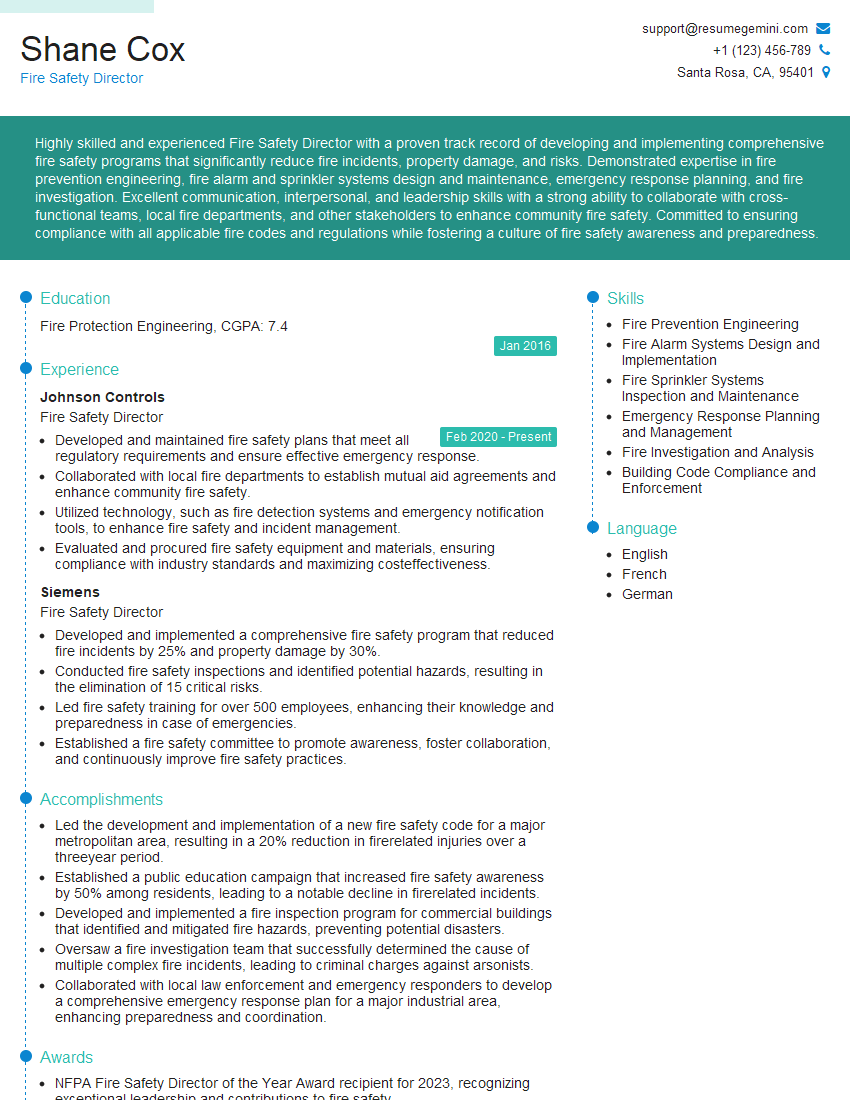
Are you gearing up for a career in Fire Safety Director? Feeling nervous about the interview questions that might come your way? Don’t worry, you’re in the right place. In this blog post, we’ll dive deep into the most common interview questions for Fire Safety Director and provide you with expert-backed answers. We’ll also explore the key responsibilities of this role so you can tailor your responses to showcase your perfect fit.
Acing the interview is crucial, but landing one requires a compelling resume that gets you noticed. Crafting a professional document that highlights your skills and experience is the first step toward interview success. ResumeGemini can help you build a standout resume that gets you called in for that dream job.






Essential Interview Questions For Fire Safety Director
1. How would you establish and maintain a comprehensive fire safety program for our facility?
- Conduct a thorough risk assessment to identify potential hazards and develop appropriate mitigation strategies.
- Establish clear guidelines and procedures for fire prevention, suppression, and evacuation.
- Provide regular training and drills for employees to ensure their understanding and preparedness.
- Inspect and maintain fire safety systems, including sprinklers, detectors, and alarms, to ensure their reliability.
- Collaborate with local fire authorities to stay up-to-date on best practices and regulations.
2. What are the key elements of an effective fire safety plan, and how would you ensure compliance within the organization?
subheading of the answer
- Hazard identification and risk assessment: Identify and evaluate potential fire hazards to prioritize mitigation efforts.
- Prevention and control measures: Implement measures such as fire barriers, sprinklers, and early detection systems to minimize the likelihood and spread of fires.
- Emergency response plan: Establish clear evacuation procedures, assign roles and responsibilities, and provide training to all occupants to ensure a coordinated response.
subheading of the answer
- Compliance monitoring and enforcement: Regularly inspect facilities, review records, and conduct audits to ensure adherence to established fire safety standards.
- Communication and training: Communicate fire safety regulations and procedures to all stakeholders, and provide ongoing training to enhance awareness and preparedness.
- Continuous improvement: Regularly review and update the fire safety plan based on lessons learned from incidents, changes in regulations, and best practices.
3. How would you conduct a fire safety risk assessment for a new building or facility?
- Review building plans and specifications to identify potential fire hazards.
- Conduct a site visit to observe building layout, materials used, and occupancy.
- Identify potential ignition sources and fuel sources, and assess the likelihood of fire occurrence.
- Evaluate the adequacy of existing fire safety systems, such as sprinklers, detectors, and alarms.
- Consider the potential impact of a fire on occupants, the environment, and the surrounding community.
- Develop mitigation strategies to address identified risks, including fire prevention measures, evacuation plans, and emergency response procedures.
4. What are the key differences between active and passive fire protection systems, and how do you determine which is appropriate for a particular application?
- Active fire protection systems: Detect and suppress fires using water, foam, or other extinguishing agents. Examples include sprinklers, fire alarms, and smoke detectors.
- Passive fire protection systems: Prevent the spread of fire and protect structural integrity. Examples include fire-rated walls, doors, and sealants.
- Determination of appropriateness: The choice between active and passive systems depends on factors such as the type of occupancy, fire hazards present, and the desired level of protection.
5. How would you manage a fire safety team and ensure their ongoing professional development?
- Team management: Establish clear roles and responsibilities, provide regular training and guidance, and foster a culture of open communication and teamwork.
- Professional development: Identify and support opportunities for team members to enhance their skills and knowledge through seminars, workshops, and certifications.
- Performance evaluation: Regularly assess team members’ performance, provide feedback, and set goals for continuous improvement.
6. What are your strategies for maintaining compliance with all applicable fire safety codes and regulations?
- Stay informed about current fire safety codes and regulations through industry publications and updates.
- Conduct regular inspections and audits to identify potential non-compliances.
- Work closely with local fire authorities to obtain guidance and ensure alignment with local requirements.
- Provide ongoing training to staff on fire safety regulations and compliance best practices.
7. How would you implement a fire safety training program for employees and ensure its effectiveness?
- Needs assessment: Identify the specific fire safety knowledge and skills required for different job roles.
- Program development: Design training modules that cover essential topics such as fire prevention, evacuation procedures, and emergency response.
- Delivery: Utilize various training methods, such as classroom presentations, simulations, and hands-on exercises.
- Evaluation: Conduct regular assessments to measure training effectiveness and identify areas for improvement.
8. What are your thoughts on the use of artificial intelligence (AI) in fire safety, and how do you see it impacting the industry in the future?
- AI applications in fire safety: AI technologies can be used for early fire detection, predicting fire spread, and optimizing evacuation plans.
- Benefits of AI: Enhanced accuracy, faster response times, and improved decision-making during emergencies.
- Future impact: AI is expected to revolutionize fire safety by enabling more proactive and data-driven approaches to prevention and response.
9. Describe a time when you successfully managed a fire safety crisis. What were the key challenges you faced, and what was your strategy for resolving the situation effectively?
- Challenges: Evacuating occupants safely, coordinating with emergency responders, and minimizing property damage.
- Strategy: Clear communication, effective decision-making, and collaboration with all stakeholders.
- Outcome: Successful evacuation, containment of fire damage, and efficient recovery process.
10. What are your key areas of expertise in fire safety, and how do you stay up-to-date with the latest developments in the field?
- Expertise: Fire prevention, suppression, emergency response, codes and regulations, risk assessment.
- Staying up-to-date: Industry conferences, webinars, publications, and professional development courses.
- Value: Staying abreast of best practices and technological advancements to enhance fire safety measures.
Interviewers often ask about specific skills and experiences. With ResumeGemini‘s customizable templates, you can tailor your resume to showcase the skills most relevant to the position, making a powerful first impression. Also check out Resume Template specially tailored for Fire Safety Director.
Career Expert Tips:
- Ace those interviews! Prepare effectively by reviewing the Top 50 Most Common Interview Questions on ResumeGemini.
- Navigate your job search with confidence! Explore a wide range of Career Tips on ResumeGemini. Learn about common challenges and recommendations to overcome them.
- Craft the perfect resume! Master the Art of Resume Writing with ResumeGemini’s guide. Showcase your unique qualifications and achievements effectively.
- Great Savings With New Year Deals and Discounts! In 2025, boost your job search and build your dream resume with ResumeGemini’s ATS optimized templates.
Researching the company and tailoring your answers is essential. Once you have a clear understanding of the Fire Safety Director‘s requirements, you can use ResumeGemini to adjust your resume to perfectly match the job description.
Key Job Responsibilities
The Fire Safety Director is responsible for developing, implementing, and maintaining a comprehensive fire safety program to ensure the protection of life and property.
1. Develop and implement fire safety policies and procedures
The Fire Safety Director is responsible for developing and implementing fire safety policies and procedures that comply with all applicable codes and regulations. These policies and procedures should cover a wide range of topics, including:
- Fire prevention
- Fire detection and alarm systems
- Fire suppression systems
- Fire evacuation plans
- Fire drills
2. Conduct fire safety inspections
The Fire Safety Director is responsible for conducting regular fire safety inspections of all buildings and facilities under their jurisdiction. These inspections should identify any potential fire hazards and ensure that all fire safety systems are functioning properly.
- Inspect buildings for compliance with fire codes
- Identify and correct fire hazards
- Test fire alarm and sprinkler systems
3. Train employees on fire safety
The Fire Safety Director is responsible for training employees on fire safety procedures. This training should cover a wide range of topics, including:
- Fire prevention
- Fire detection and alarm systems
- Fire suppression systems
- Fire evacuation plans
- Fire drills
4. Investigate fire incidents
The Fire Safety Director is responsible for investigating all fire incidents that occur within their jurisdiction. These investigations should determine the cause of the fire, identify any contributing factors, and recommend corrective actions to prevent future fires.
- Determine the cause of the fire
- Identify contributing factors
- Recommend corrective actions
Interview Tips
Preparing for an interview for the position of Fire Safety Director requires a comprehensive approach that includes researching the organization, understanding the key responsibilities of the role, and practicing answering common interview questions.
1. Research the organization
Before the interview, it is crucial to research the organization to understand its mission, values, and goals. This knowledge will help you tailor your answers to demonstrate how your skills and experience align with the organization’s needs.
- Visit the organization’s website to learn about its history, services, and recent news.
- Read industry publications and articles to gain insights into the organization’s reputation and standing within the fire safety field.
- If possible, connect with current or former employees of the organization to gather additional information about the work environment and culture.
2. Understand the key responsibilities of the role
The job description for the Fire Safety Director should provide a clear outline of the key responsibilities for the role. Carefully review this document and identify the skills and experiences that are most relevant to the position. During the interview, highlight your strengths in these areas and provide specific examples of how you have successfully fulfilled similar responsibilities in previous roles.
- Be prepared to discuss your experience in developing and implementing fire safety policies and procedures.
- Describe your expertise in conducting fire safety inspections and identifying potential hazards.
- Emphasize your ability to train employees on fire safety procedures and ensure their understanding of emergency protocols.
3. Practice answering common interview questions
There are many common interview questions that you are likely to encounter during an interview for the position of Fire Safety Director. Practicing your answers to these questions will help you feel more confident and prepared during the actual interview. Some common questions include:
- Tell me about your experience in developing and implementing fire safety programs.
- What are the most important factors to consider when conducting a fire safety inspection?
- How would you train employees on fire safety procedures?
- What are the key elements of an effective fire evacuation plan?
4. Prepare questions for the interviewer
Asking well-thought-out questions at the end of the interview demonstrates your interest in the position and your understanding of the organization. Prepare a few questions that you can ask the interviewer to learn more about the role, the organization, and the company culture.
- What are the organization’s biggest fire safety challenges?
- What are the organization’s goals for improving fire safety?
- What opportunities are there for professional development and advancement within the organization?
Next Step:
Armed with this knowledge, you’re now well-equipped to tackle the Fire Safety Director interview with confidence. Remember, a well-crafted resume is your first impression. Take the time to tailor your resume to highlight your relevant skills and experiences. And don’t forget to practice your answers to common interview questions. With a little preparation, you’ll be on your way to landing your dream job. So what are you waiting for? Start building your resume and start applying! Build an amazing resume with ResumeGemini.