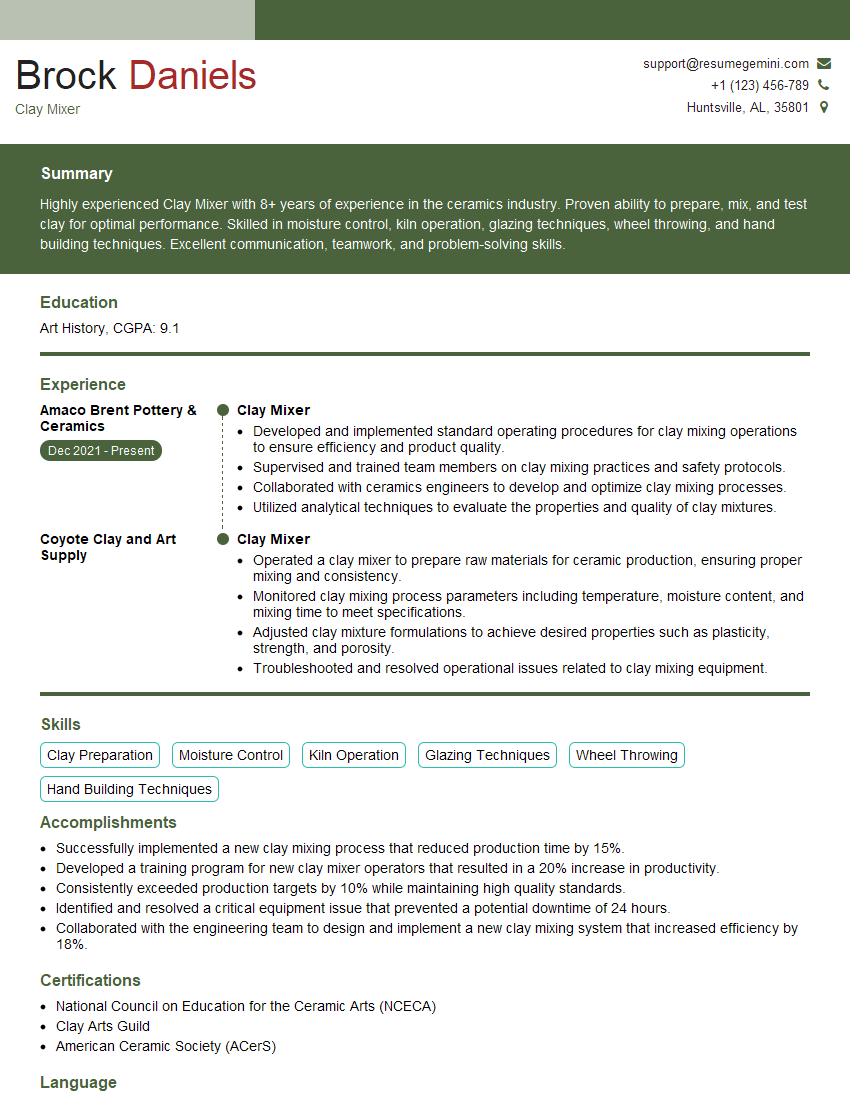
Feeling lost in a sea of interview questions? Landed that dream interview for Clay Mixer but worried you might not have the answers? You’re not alone! This blog is your guide for interview success. We’ll break down the most common Clay Mixer interview questions, providing insightful answers and tips to leave a lasting impression. Plus, we’ll delve into the key responsibilities of this exciting role, so you can walk into your interview feeling confident and prepared.
Acing the interview is crucial, but landing one requires a compelling resume that gets you noticed. Crafting a professional document that highlights your skills and experience is the first step toward interview success. ResumeGemini can help you build a standout resume that gets you called in for that dream job.






Essential Interview Questions For Clay Mixer
1. What is the difference between a batch mixer and a continuous mixer, and what are the advantages and disadvantages of each?
- Batch mixer:
- Mixes a specific amount of ingredients for a fixed period of time.
- Suitable for small-scale production and when high accuracy is required.
- Disadvantages: long mixing time, limited capacity, and intermittent operation.
- Continuous mixer:
- Continuously feeds ingredients and discharges the mixed product at a steady rate.
- Higher productivity and capacity compared to batch mixers.
- Disadvantages: less control over mixing quality, potential for uneven mixing, and continuous operation.
2. What are the key factors to consider when selecting a clay mixer for a specific application?
Raw material properties:
- Clay type and composition
- Particle size and moisture content
Mixing requirements:
- Desired level of mixing homogeneity
- Mixing time and energy requirements
Production scale and capacity:
- Batch or continuous operation
- Throughput and productivity
3. What are the main types of blades used in clay mixers, and how do their designs affect the mixing process?
- Paddle blades: Provide gentle mixing and are suitable for wet clays.
- Ribbon blades: Create a shearing action, promoting uniform mixing and deagglomeration.
- Spiral blades: Offer a combination of shearing and lifting, resulting in high mixing efficiency.
- Intermeshing blades: Two sets of blades rotate in opposite directions, providing intense mixing.
4. How do you optimize the performance of a clay mixer to achieve the desired mixing quality?
- Blade design and configuration: Select blades that match the material properties and mixing requirements.
- Mixing speed and time: Determine the optimal speed and mixing time to achieve the desired homogeneity.
- Ingredient order and feeding: Optimize the sequence and rate of ingredient addition to minimize segregation.
- Moisture content control: Ensure that the moisture content of the clay is within the optimal range for effective mixing.
5. How do you troubleshoot common problems encountered in clay mixing, such as agglomeration, uneven mixing, and poor discharge?
- Agglomeration: Increase mixing speed, optimize blade design, or add dispersing agents.
- Uneven mixing: Adjust mixing time, change blade configuration, or check for material segregation.
- Poor discharge: Ensure proper blade clearance, check for obstructions in the discharge chute, or modify the clay’s moisture content.
6. What are the safety considerations for operating a clay mixer, and what procedures should be followed to ensure the operator’s safety?
- Proper guarding: Ensure that all moving parts are adequately guarded.
- Electrical safety: Follow electrical safety protocols, including grounding and regular inspections.
- Lockout/tagout procedures: Implement proper lockout/tagout procedures before performing maintenance or cleaning.
- Operator training: Train operators on safe operating procedures and emergency response plans.
7. How do you maintain a clay mixer to ensure its longevity and optimal performance?
- Regular cleaning: Remove clay buildup from blades, mixing chamber, and discharge chute.
- Blade inspection and replacement: Check blades for wear and replace or sharpen as needed.
- Mechanical maintenance: Lubricate bearings, check belts, and ensure proper alignment of moving parts.
- Electrical system maintenance: Inspect and test electrical components, including motors and switches.
8. What are the different types of sensors used in clay mixing processes, and how do they contribute to process control and monitoring?
- Moisture sensors: Measure the moisture content of the clay, enabling adjustments to achieve optimal mixing conditions.
- Temperature sensors: Monitor the temperature of the mixing chamber, preventing overheating and ensuring proper mixing parameters.
- Torque sensors: Detect changes in mixing torque, indicating variations in clay consistency or agglomeration.
- Vibration sensors: Monitor vibration levels to detect potential mechanical issues or imbalance in the mixer.
9. How do you integrate process control systems into clay mixing operations, and what benefits do they provide?
- Automated mixing programs: Implement pre-defined mixing recipes to ensure consistent product quality.
- Data logging and analysis: Collect and analyze process data to identify areas for improvement and optimize mixing parameters.
- Alarm and monitoring systems: Set alarms to alert operators to deviations in process conditions, preventing potential problems.
- Remote monitoring and control: Enable remote access and control of the mixing process, facilitating troubleshooting and optimization.
10. What emerging technologies are available for clay mixing, and how are they transforming the industry?
- Advanced sensor technologies: IoT-enabled sensors provide real-time data on process conditions, enabling predictive maintenance and early detection of issues.
- Artificial intelligence (AI): AI algorithms analyze process data to optimize mixing parameters, improve quality, and reduce production costs.
- Microwave heating: Microwave technology accelerates the mixing process by heating the clay uniformly, reducing energy consumption.
- Smart mixing equipment: Connected mixers integrate sensors and AI, providing advanced control, data analysis, and remote monitoring capabilities.
Interviewers often ask about specific skills and experiences. With ResumeGemini‘s customizable templates, you can tailor your resume to showcase the skills most relevant to the position, making a powerful first impression. Also check out Resume Template specially tailored for Clay Mixer.
Career Expert Tips:
- Ace those interviews! Prepare effectively by reviewing the Top 50 Most Common Interview Questions on ResumeGemini.
- Navigate your job search with confidence! Explore a wide range of Career Tips on ResumeGemini. Learn about common challenges and recommendations to overcome them.
- Craft the perfect resume! Master the Art of Resume Writing with ResumeGemini’s guide. Showcase your unique qualifications and achievements effectively.
- Great Savings With New Year Deals and Discounts! In 2025, boost your job search and build your dream resume with ResumeGemini’s ATS optimized templates.
Researching the company and tailoring your answers is essential. Once you have a clear understanding of the Clay Mixer‘s requirements, you can use ResumeGemini to adjust your resume to perfectly match the job description.
Key Job Responsibilities
Clay Mixers are responsible for operating and maintaining clay mixing equipment used in the production of bricks, tiles, and other clay products. Their key responsibilities include:
1. Mixing and Blending Clay
Clay Mixers operate clay mixers to blend different types of clay and other materials, such as sand, water, and chemicals, according to specified proportions to create a homogenous mixture.
- Measure and weigh ingredients accurately.
- Monitor mixing process to ensure proper consistency and moisture content.
2. Equipment Operation and Maintenance
Clay Mixers are responsible for the operation and maintenance of clay mixing equipment, including mixers, conveyors, and pumps. They perform regular maintenance checks, lubricate and clean equipment, and troubleshoot and repair minor issues.
- Follow established operating procedures.
- Identify and resolve equipment malfunctions promptly.
3. Quality Control
Clay Mixers play a crucial role in ensuring the quality of clay products by monitoring the mixing process and conducting quality checks. They perform tests on clay samples to verify its consistency, moisture content, and other properties.
- Conduct regular quality checks to ensure adherence to specifications.
- Identify and correct deviations in clay properties.
4. Safety Compliance
Clay Mixers prioritize safety in the workplace by adhering to established safety regulations and protocols. They wear appropriate safety gear, follow lockout/tagout procedures, and report any safety concerns promptly.
- Comply with established safety policies and guidelines.
- Maintain a clean and organized work area.
Interview Tips
To prepare for a Clay Mixer interview, candidates should focus on demonstrating their technical skills, experience in clay mixing operations, and commitment to safety. Here are some tips to help candidates ace the interview:
1. Research the Company and Position
Before the interview, thoroughly research the company and the specific Clay Mixer position. Familiarize yourself with the company’s products, processes, and culture to demonstrate your interest and understanding of the role.
- Visit the company website.
- Review industry publications and news.
2. Practice Answering Common Interview Questions
Prepare answers to common interview questions related to clay mixing operations, equipment maintenance, and safety procedures. Use the STAR method (Situation, Task, Action, Result) to structure your responses and provide specific examples.
- Describe your experience operating and maintaining clay mixing equipment.
- Share an example of how you identified and resolved a clay mixing issue.
3. Highlight Safety Awareness and Compliance
Emphasize your commitment to safety and your understanding of industry regulations and best practices. Provide examples of your safety practices and how you ensure compliance in the workplace.
- Discuss your knowledge of lockout/tagout procedures.
- Explain your approach to maintaining a clean and organized work area.
4. Showcase Problem-Solving and Analytical Skills
Clay Mixers often encounter challenges in their work. During the interview, highlight your problem-solving skills and ability to analyze situations and find solutions. Use examples from your experience to demonstrate your critical thinking and decision-making abilities.
- Describe a situation where you had to troubleshoot and repair a clay mixer.
- Explain how you optimized clay mixing processes to improve product quality.
5. Be Prepared to Discuss Your Career Goals
The interviewer may ask about your career goals and aspirations. Be prepared to articulate your professional ambitions and how the Clay Mixer position aligns with them. Explain how your skills and experience can contribute to the company’s goals.
- State your interest in the clay mixing industry and your desire to grow within the field.
- Explain how your qualifications make you a suitable candidate for the position.
Next Step:
Armed with this knowledge, you’re now well-equipped to tackle the Clay Mixer interview with confidence. Remember, a well-crafted resume is your first impression. Take the time to tailor your resume to highlight your relevant skills and experiences. And don’t forget to practice your answers to common interview questions. With a little preparation, you’ll be on your way to landing your dream job. So what are you waiting for? Start building your resume and start applying! Build an amazing resume with ResumeGemini.