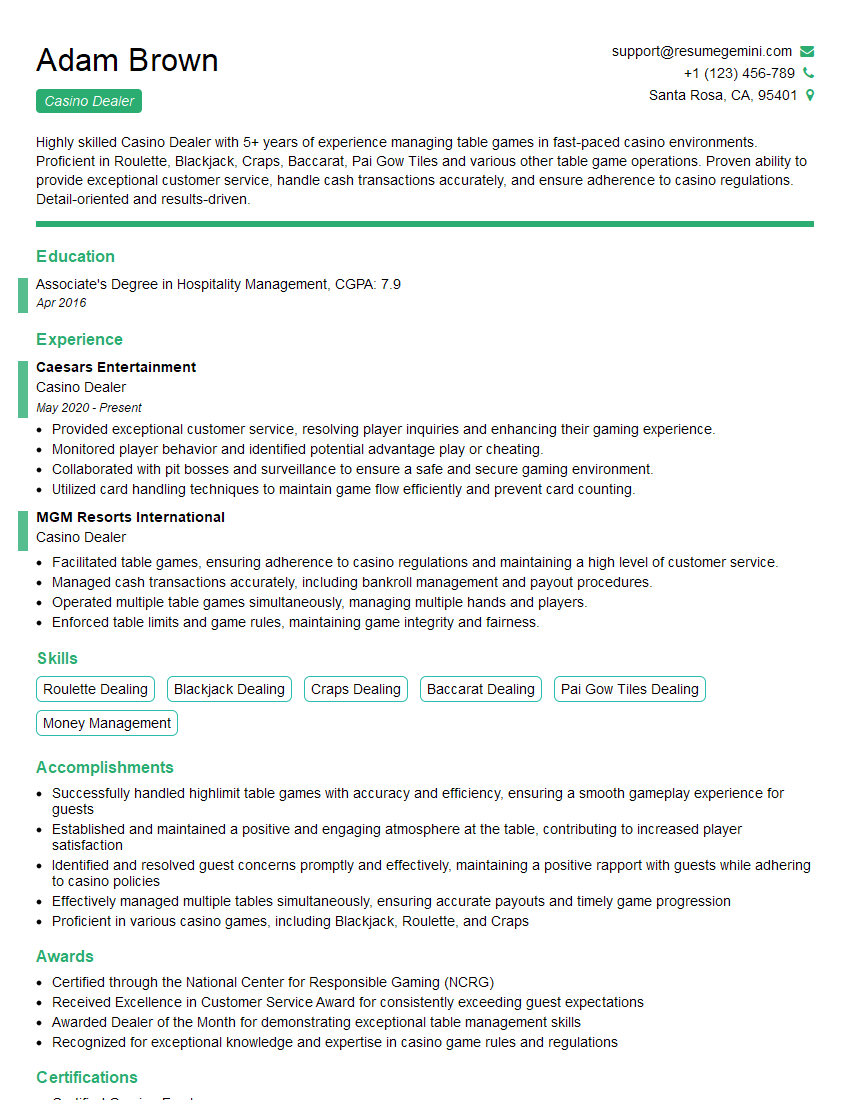
Are you gearing up for a career in Casino Dealer? Feeling nervous about the interview questions that might come your way? Don’t worry, you’re in the right place. In this blog post, we’ll dive deep into the most common interview questions for Casino Dealer and provide you with expert-backed answers. We’ll also explore the key responsibilities of this role so you can tailor your responses to showcase your perfect fit.
Acing the interview is crucial, but landing one requires a compelling resume that gets you noticed. Crafting a professional document that highlights your skills and experience is the first step toward interview success. ResumeGemini can help you build a standout resume that gets you called in for that dream job.






Essential Interview Questions For Casino Dealer
1. What are the different types of bets that can be placed in a casino?
There are many different types of bets that can be placed in a casino, including:
- Straight bets: These bets are placed on a single number, and pay out at 35 to 1.
- Split bets: These bets are placed on two adjacent numbers, and pay out at 17 to 1.
- Street bets: These bets are placed on three consecutive numbers, and pay out at 11 to 1.
- Corner bets: These bets are placed on four adjacent numbers, and pay out at 8 to 1.
- Line bets: These bets are placed on six consecutive numbers, and pay out at 5 to 1.
- Dozen bets: These bets are placed on 12 consecutive numbers, and pay out at 2 to 1.
- Column bets: These bets are placed on 12 numbers in a single column, and pay out at 2 to 1.
- Odd/even bets: These bets are placed on whether the winning number will be odd or even, and pay out at 1 to 1.
- Red/black bets: These bets are placed on whether the winning number will be red or black, and pay out at 1 to 1.
- High/low bets: These bets are placed on whether the winning number will be high (13-24) or low (1-12), and pay out at 1 to 1.
2. What are the house edges for the different types of bets?
- Straight bets: 5.26%
- Split bets: 2.63%
- Street bets: 1.39%
- Corner bets: 0.89%
- Line bets: 0.62%
- Dozen bets: 2.70%
- Column bets: 2.70%
- Odd/even bets: 1.05%
- Red/black bets: 1.05%
- High/low bets: 1.05%
3. What are the different ways to deal a deck of cards?
- From the shoe: This is the most common way to deal a deck of cards in a casino. The shoe is a plastic or wooden device that holds the deck of cards and dispenses them one at a time.
- From the hand: This method is used less often, but it is still common in some casinos. The dealer holds the deck of cards in their hand and deals them out one at a time.
- From the pitch: This method is used in some casinos for games such as blackjack and baccarat. The dealer takes the deck of cards and throws it into the air, then deals the cards out one at a time as they fall.
4. What are the different shuffles that can be used to randomize a deck of cards?
- The overhand shuffle: This is the most common shuffle used in casinos. The dealer holds the deck of cards in one hand and uses their other hand to shuffle the cards by repeatedly cutting the deck and placing the cards on top of each other.
- The riffle shuffle: This shuffle is less common than the overhand shuffle, but it is considered to be more random. The dealer holds the deck of cards in both hands and uses their thumbs to riffle the cards together.
- The wash shuffle: This shuffle is used to randomize a deck of cards that has been stacked or counted. The dealer holds the deck of cards in one hand and uses their other hand to wash the cards back and forth, creating a random order.
5. What are the different ways to cut a deck of cards?
- The standard cut: This is the most common way to cut a deck of cards. The dealer takes the top portion of the deck and places it on the bottom of the deck.
- The riffle cut: This cut is used to randomize a deck of cards that has been stacked or counted. The dealer holds the deck of cards in both hands and uses their thumbs to riffle the cards together, then cuts the deck in half.
- The slide cut: This cut is used to create a specific order of cards. The dealer holds the deck of cards in one hand and uses their other hand to slide the top portion of the deck to the side, then cuts the deck in half.
6. What are the different types of chips that are used in a casino?
- Cash chips: These chips are used to represent cash and can be redeemed for cash at any time.
- Tournament chips: These chips are used in tournament play and cannot be redeemed for cash.
- Promo chips: These chips are given away by casinos as promotions and can be redeemed for cash or other prizes.
7. What are the different types of games that are played in a casino?
- Table games: These games are played on a table, such as blackjack, roulette, and craps.
- Slot machines: These games are played on a machine that spins reels and pays out based on the symbols that line up.
- Video poker: These games are played on a machine that simulates a poker game.
- Sports betting: This type of gambling involves betting on the outcome of sporting events.
- Lottery: This type of gambling involves buying a ticket and hoping that the numbers on the ticket match the numbers drawn.
8. What are the different types of customers that you can expect to encounter in a casino?
- Recreational players: These players are gambling for fun and entertainment.
- Advantage players: These players are gambling in a way that gives them an advantage over the casino.
- Professional players: These players make a living by gambling.
- Addicted players: These players are unable to control their gambling and it is causing problems in their lives.
9. What are the different ways to handle difficult customers in a casino?
- Stay calm and professional.
- Listen to the customer’s complaint.
- Try to resolve the issue in a way that is fair to both the customer and the casino.
- If the customer is still not satisfied, escalate the issue to a supervisor.
10. What are the different ways to prevent cheating in a casino?
- Use surveillance cameras to monitor the tables.
- Use RFID chips to track the cards.
- Use random shufflers to randomize the deck of cards.
- Train dealers to detect cheating.
- Establish clear rules and procedures for gambling.
Interviewers often ask about specific skills and experiences. With ResumeGemini‘s customizable templates, you can tailor your resume to showcase the skills most relevant to the position, making a powerful first impression. Also check out Resume Template specially tailored for Casino Dealer.
Career Expert Tips:
- Ace those interviews! Prepare effectively by reviewing the Top 50 Most Common Interview Questions on ResumeGemini.
- Navigate your job search with confidence! Explore a wide range of Career Tips on ResumeGemini. Learn about common challenges and recommendations to overcome them.
- Craft the perfect resume! Master the Art of Resume Writing with ResumeGemini’s guide. Showcase your unique qualifications and achievements effectively.
- Great Savings With New Year Deals and Discounts! In 2025, boost your job search and build your dream resume with ResumeGemini’s ATS optimized templates.
Researching the company and tailoring your answers is essential. Once you have a clear understanding of the Casino Dealer‘s requirements, you can use ResumeGemini to adjust your resume to perfectly match the job description.
Key Job Responsibilities
Casino dealers are responsible for running table games in a casino, ensuring that guests have a positive experience while adhering to all gaming regulations. Key tasks include:
1. Dealing Cards or Chips
Dealers conduct various card or dice games, such as blackjack, poker, baccarat, roulette, and craps, by dealing cards or chips to players according to established rules.
2. Enforcing Game Rules
Dealers maintain fair gameplay by enforcing the rules of the game, resolving disputes, and making rulings based on their knowledge of gaming regulations.
3. Operating Gaming Equipment
They are proficient in operating gaming equipment, including card shufflers, roulette wheels, and dice tables, to ensure the accuracy and integrity of the games.
4. Handling Money
Dealers handle large sums of money daily, including chips, cash, and player winnings. They must count and verify transactions accurately and maintain proper accounting records.
5. Providing Customer Service
Dealers interact with guests to provide excellent customer service, answering questions, resolving complaints, and creating a welcoming atmosphere.
6. Monitoring Players
They observe players for any suspicious behavior that may indicate cheating or illegal activities, ensuring the safety and integrity of the casino environment.
Interview Tips
To ace a casino dealer interview, consider the following preparation tips:
1. Research the Casino and Industry
Familiarize yourself with the specific casino you are applying to, its reputation, and the gaming industry in general. Show your knowledge and interest in the casino’s operations.
2. Practice Dealing
Practice dealing cards or chips to demonstrate your dexterity and accuracy. You can use a deck of cards or chips at home or find online simulators.
3. Learn Basic Math and Card Counting
Most casino games involve basic math and card counting. Brush up on your mental arithmetic and practice converting chips into cash values.
4. Prepare for Game-Specific Questions
Research the specific games you will be dealing and familiarize yourself with their rules, betting strategies, and payouts. Anticipate questions about your knowledge and ability to handle different game situations.
5. Emphasize Attention to Detail and Customer Service
Highlight your ability to pay attention to multiple details simultaneously and provide excellent customer service in a high-pressure environment.
6. Pass a Background Check
Casinos conduct thorough background checks, so ensure your criminal and credit history is clear. Any discrepancies can impact your chances of getting hired.
Next Step:
Armed with this knowledge, you’re now well-equipped to tackle the Casino Dealer interview with confidence. Remember, preparation is key. So, start crafting your resume, highlighting your relevant skills and experiences. Don’t be afraid to tailor your application to each specific job posting. With the right approach and a bit of practice, you’ll be well on your way to landing your dream job. Build your resume now from scratch or optimize your existing resume with ResumeGemini. Wish you luck in your career journey!