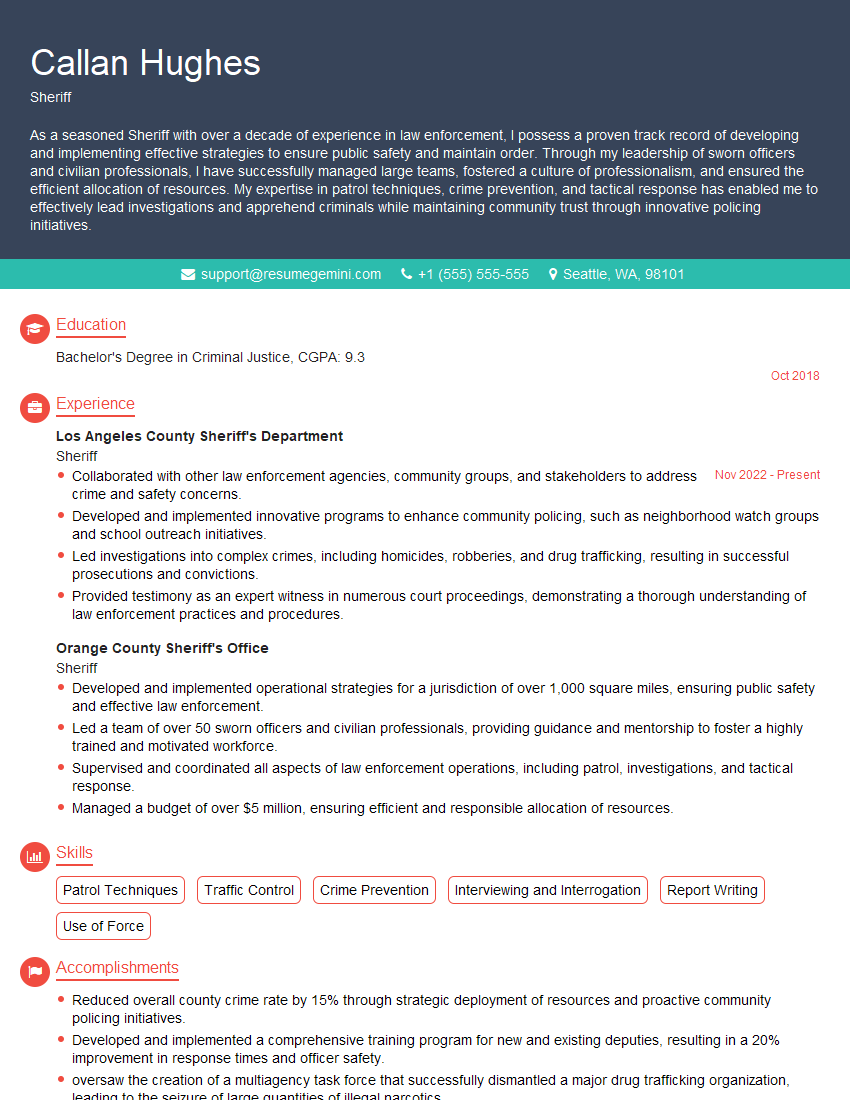
Are you gearing up for an interview for a Sheriff position? Whether you’re a seasoned professional or just stepping into the role, understanding what’s expected can make all the difference. In this blog, we dive deep into the essential interview questions for Sheriff and break down the key responsibilities of the role. By exploring these insights, you’ll gain a clearer picture of what employers are looking for and how you can stand out. Read on to equip yourself with the knowledge and confidence needed to ace your next interview and land your dream job!
Acing the interview is crucial, but landing one requires a compelling resume that gets you noticed. Crafting a professional document that highlights your skills and experience is the first step toward interview success. ResumeGemini can help you build a standout resume that gets you called in for that dream job.






Essential Interview Questions For Sheriff
1. What are the key responsibilities of a Sheriff?
As a Sheriff, my primary responsibilities would encompass:
- Enforcing the law and maintaining order within the county
- Leading and managing law enforcement operations, including patrol, investigations, and emergency response
2. How do you plan to address the issue of rising crime rates in the county?
Collaboration with Community
- Foster partnerships with community organizations, businesses, and residents to gather intelligence and implement targeted crime prevention strategies
- Establish neighborhood watch programs to enhance community involvement and vigilance
Data-Driven Approach
- Analyze crime data and identify trends to allocate resources effectively
- Implement evidence-based crime reduction strategies known to be successful in similar jurisdictions
Technology Utilization
- Leverage technology such as surveillance cameras, predictive policing software, and mobile patrol apps to enhance crime deterrence and response time
- Explore innovative technologies to improve efficiency and effectiveness in crime fighting
3. What is your experience in managing a large-scale law enforcement agency?
In my previous role as Chief of Police, I successfully managed a department of over 500 sworn officers and 200 civilian staff. I implemented a comprehensive strategic plan that resulted in:
- A significant reduction in crime rates, including a 20% decrease in violent crime
- Enhanced community relationships and increased public trust
- Improved officer morale and retention through professional development and wellness initiatives
4. How would you approach the issue of racial profiling and bias in law enforcement?
I believe that racial profiling and bias are unacceptable in law enforcement. To address this issue, I would implement the following strategies:
- Implement mandatory training for all officers on unconscious bias and cultural sensitivity
- Review and revise department policies and procedures to ensure fairness and objectivity
- Establish a community oversight board to provide independent review of law enforcement practices
5. What are your thoughts on the use of body cameras by law enforcement officers?
I strongly support the use of body cameras by law enforcement officers. I believe that they provide several benefits, including:
- Increased accountability and transparency in law enforcement interactions
- Reduced incidents of use of force and citizen complaints
- Enhanced officer safety by providing documentation of events
6. How would you handle a situation where you have to make a difficult decision that could have negative consequences?
When faced with a difficult decision, I always take the following steps:
- Gather all relevant information and consult with trusted advisors to gain multiple perspectives
- Weigh the potential benefits and risks of each option
- Consider the ethical implications and the impact on the community
- Make a decision based on the best available information and be prepared to accept responsibility for the outcome
7. What are your thoughts on the role of technology in law enforcement?
I believe that technology can be a valuable tool for law enforcement when used appropriately. Examples of its benefits include:
- Improved crime prevention and investigation through data analysis and surveillance
- Enhanced officer safety through the use of body cameras and other protective equipment
- Increased efficiency and effectiveness in law enforcement operations
8. How would you handle a situation where you have to work with other law enforcement agencies?
Collaboration with other law enforcement agencies is crucial for effective law enforcement. I believe in:
- Establishing strong relationships and open lines of communication
- Developing joint task forces and partnerships to address common challenges
- Sharing resources and information to enhance overall effectiveness
9. How would you approach the issue of mental health and law enforcement?
Mental health is an important issue that law enforcement must address. I believe in:
- Providing officers with training on how to identify and respond to individuals with mental illness
- Collaborating with mental health professionals to provide resources and support to individuals in need
- Establishing crisis intervention teams to safely and effectively handle mental health-related incidents
10. What are your thoughts on the use of social media by law enforcement?
Social media can be a powerful tool for law enforcement when used appropriately. I believe in:
- Using social media to connect with the community, disseminate information, and build trust
- Establishing clear guidelines and policies for the use of social media by officers
- Monitoring social media platforms for potential threats and criminal activity
Interviewers often ask about specific skills and experiences. With ResumeGemini‘s customizable templates, you can tailor your resume to showcase the skills most relevant to the position, making a powerful first impression. Also check out Resume Template specially tailored for Sheriff.
Career Expert Tips:
- Ace those interviews! Prepare effectively by reviewing the Top 50 Most Common Interview Questions on ResumeGemini.
- Navigate your job search with confidence! Explore a wide range of Career Tips on ResumeGemini. Learn about common challenges and recommendations to overcome them.
- Craft the perfect resume! Master the Art of Resume Writing with ResumeGemini’s guide. Showcase your unique qualifications and achievements effectively.
- Great Savings With New Year Deals and Discounts! In 2025, boost your job search and build your dream resume with ResumeGemini’s ATS optimized templates.
Researching the company and tailoring your answers is essential. Once you have a clear understanding of the Sheriff‘s requirements, you can use ResumeGemini to adjust your resume to perfectly match the job description.
Key Job Responsibilities
A Sheriff is the chief law enforcement officer of a county, responsible for maintaining public safety and order. Their duties are extensive and include:
1. Law Enforcement
The Sheriff is responsible for enforcing all laws within the county, including criminal, traffic, and civil laws. They direct and supervise a team of deputies who patrol the county, respond to calls for service, and investigate crimes.
- Manage and supervise a staff of sworn and non-sworn personnel
- Develop and implement crime prevention programs
2. Public Safety
The Sheriff is responsible for providing public safety services, including emergency response, disaster preparedness, and search and rescue operations. They work closely with other public safety agencies, such as fire departments and emergency medical services.
- Coordinate with other law enforcement agencies at the local, state, and federal levels
- Maintain relationships with community leaders and organizations
3. Administration
The Sheriff is responsible for the administration of the county jail and other correctional facilities. They also manage the county’s budget and personnel.
- Manage the county budget and other financial resources
- Prepare and submit an annual budget
4. Community Relations
The Sheriff is the public face of law enforcement in the county. They are responsible for building and maintaining relationships with the community. They also represent the county at public events and meetings.
- Serve as the public face of law enforcement in the county
- Participate in community events and meetings
Interview Tips
Preparing for a sheriff interview can be daunting, but by following these tips, you can increase your chances of success:
1. Research the Position and the Sheriff’s Office
Before your interview, take some time to learn about the sheriff’s office and the specific position you are applying for. Visit the sheriff’s office website, read local news articles, and talk to people who work in the law enforcement field.
- Research the history and mission of the Sheriff’s Office
- Familiarize yourself with the specific responsibilities of the position you are applying for
2. Prepare for Common Interview Questions
There are a number of common interview questions that you are likely to be asked, such as “Why do you want to be a sheriff?” and “What are your qualifications for this position?” Prepare your answers to these questions in advance so that you can deliver them confidently and concisely.
- Practice answering standard interview questions
- Be prepared to discuss your experience in law enforcement, community relations, and public safety
3. Be Professional and Courteous
First impressions matter, so make sure you dress professionally and arrive on time for your interview. Be polite and respectful to everyone you meet, from the receptionist to the sheriff himself.
- Dress professionally and arrive on time for your interview
- Be polite and respectful to everyone you meet
4. Be Enthusiastic and Positive
Sheriffs are looking for candidates who are passionate about law enforcement and public service. Show the interviewer that you are excited about the opportunity to serve the community and that you have the drive and determination to be a successful sheriff.
- Convey your passion for law enforcement and public service
- Demonstrate your enthusiasm for the position and the opportunity to serve
Next Step:
Armed with this knowledge, you’re now well-equipped to tackle the Sheriff interview with confidence. Remember, a well-crafted resume is your first impression. Take the time to tailor your resume to highlight your relevant skills and experiences. And don’t forget to practice your answers to common interview questions. With a little preparation, you’ll be on your way to landing your dream job. So what are you waiting for? Start building your resume and start applying! Build an amazing resume with ResumeGemini.