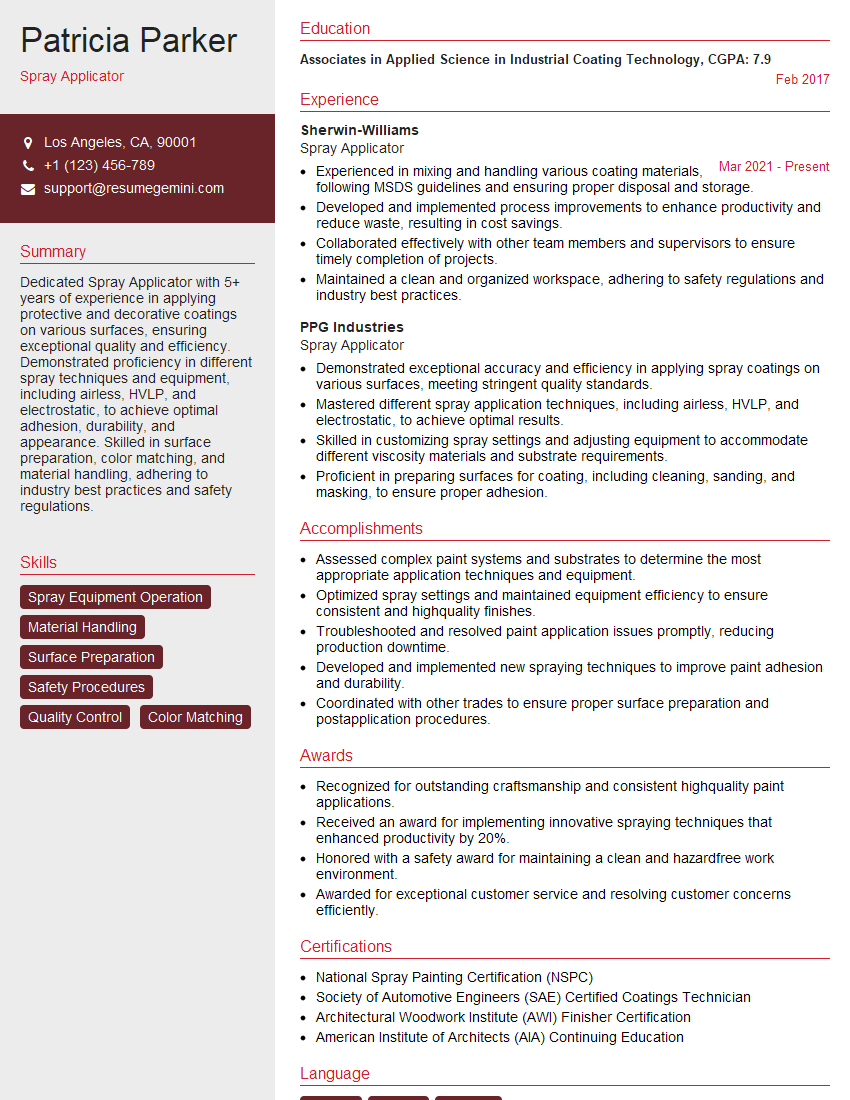
Are you gearing up for a career in Spray Applicator? Feeling nervous about the interview questions that might come your way? Don’t worry, you’re in the right place. In this blog post, we’ll dive deep into the most common interview questions for Spray Applicator and provide you with expert-backed answers. We’ll also explore the key responsibilities of this role so you can tailor your responses to showcase your perfect fit.
Acing the interview is crucial, but landing one requires a compelling resume that gets you noticed. Crafting a professional document that highlights your skills and experience is the first step toward interview success. ResumeGemini can help you build a standout resume that gets you called in for that dream job.






Essential Interview Questions For Spray Applicator
1. What are the different types of spray applicators and their uses?
- Airless sprayers: These sprayers use high-pressure air to atomize the paint, resulting in a fine and even finish. They are commonly used for larger projects, such as painting houses or commercial buildings.
- Air-assisted sprayers: These sprayers use a combination of air and pressure to atomize the paint. They offer more control over the spray pattern and are suitable for both small and large projects.
- HVLP (High Volume Low Pressure) sprayers: These sprayers use a high volume of air at low pressure to atomize the paint. They produce less overspray and are ideal for smaller projects or areas with limited ventilation.
- LVLP (Low Volume Low Pressure) sprayers: These sprayers use a low volume of air at low pressure to atomize the paint. They offer the highest level of control and are suitable for delicate or precision painting tasks.
2. How do you prepare a surface for spray application?
- Clean the surface: Remove any dirt, debris, or contaminants from the surface using a degreaser or cleaner.
- Sand the surface: Lightly sand the surface to create a smooth and even surface for the paint to adhere to.
- Prime the surface: Apply a primer to the surface to improve adhesion and provide a base for the paint.
- Mask off areas: Cover any areas that should not be painted using masking tape or plastic sheeting.
3. What are the safety precautions that should be taken when using a spray applicator?
- Wear appropriate personal protective equipment (PPE), including a respirator, gloves, and eye protection.
- Ensure proper ventilation in the work area to prevent the accumulation of fumes and overspray.
- Follow the manufacturer’s instructions for the specific spray applicator being used.
- Never point the spray gun at yourself or others.
- Keep the spray gun clean and maintained to prevent malfunctions.
4. How do you troubleshoot common problems that may occur when using a spray applicator?
- Clogged nozzle: Clean the nozzle using a solvent or brush.
- Uneven spray pattern: Adjust the air pressure, fluid pressure, or nozzle size.
- Overspray: Reduce the air pressure or use a smaller nozzle.
- Runs or sags: Apply thinner coats or use a slower drying paint.
- Fish eyes: Ensure the surface is clean of contaminants and the paint is properly mixed.
5. What are the different types of paints that can be applied using a spray applicator?
- Latex paint: A water-based paint that is commonly used for interior walls and ceilings.
- Oil-based paint: A solvent-based paint that is more durable and resistant to wear and tear.
- Acrylic paint: A versatile paint that can be used for both interior and exterior applications.
- Enamel paint: A glossy paint that is often used for trim, furniture, and other surfaces that require a hard finish.
- Lacquer: A fast-drying paint that provides a high-gloss finish.
6. What are the advantages and disadvantages of using a spray applicator compared to other painting methods?
Advantages
- Faster and more efficient.
- Provides a smoother and more even finish.
- Can be used to paint large areas quickly and easily.
- Suitable for a variety of paints and coatings.
Disadvantages
- Requires more preparation and cleanup.
- Can create overspray and fumes.
- May be more expensive than other painting methods.
- Requires specialized equipment and training.
7. How do you maintain a spray applicator to ensure optimal performance?
- Clean the spray gun thoroughly after each use to prevent clogging and buildup.
- Check the air filter and replace it regularly to maintain airflow.
- Lubricate moving parts as recommended by the manufacturer.
- Store the spray gun in a dry and clean environment.
- Have the spray gun serviced by a qualified technician on a regular basis.
8. Describe a situation where you had to troubleshoot a problem with a spray applicator and how you resolved it.
- During a painting project, I encountered a problem where the spray gun was not atomizing the paint properly, resulting in a rough and uneven finish.
- I checked the nozzle for clogs and found that it was partially blocked.
- I removed the nozzle and cleaned it using a solvent and a brush.
- I reattached the nozzle and tested the spray gun, which was now atomizing the paint correctly.
- I continued painting and the finish was smooth and even.
9. What are the latest trends and advancements in spray applicator technology?
- Development of high-efficiency airless (HEA) sprayers that reduce overspray and improve transfer efficiency.
- Introduction of electrostatic sprayers that charge paint particles for better adhesion and reduced overspray.
- Advancements in robotic spray applicators for automated and precise painting processes.
- Integration of IoT (Internet of Things) technology for remote monitoring and control of spray applicators.
10. How do you stay up-to-date with the latest developments in spray applicator technology?
- Attend industry conferences and exhibitions.
- Read trade publications and technical journals.
- Participate in online forums and discussion groups.
- Collaborate with other professionals in the field.
- Stay informed about manufacturer updates and new product releases.
Interviewers often ask about specific skills and experiences. With ResumeGemini‘s customizable templates, you can tailor your resume to showcase the skills most relevant to the position, making a powerful first impression. Also check out Resume Template specially tailored for Spray Applicator.
Career Expert Tips:
- Ace those interviews! Prepare effectively by reviewing the Top 50 Most Common Interview Questions on ResumeGemini.
- Navigate your job search with confidence! Explore a wide range of Career Tips on ResumeGemini. Learn about common challenges and recommendations to overcome them.
- Craft the perfect resume! Master the Art of Resume Writing with ResumeGemini’s guide. Showcase your unique qualifications and achievements effectively.
- Great Savings With New Year Deals and Discounts! In 2025, boost your job search and build your dream resume with ResumeGemini’s ATS optimized templates.
Researching the company and tailoring your answers is essential. Once you have a clear understanding of the Spray Applicator‘s requirements, you can use ResumeGemini to adjust your resume to perfectly match the job description.
Key Job Responsibilities
Spray Applicators play a crucial role in applying protective and decorative coatings to various surfaces using specialized spray equipment. Their key responsibilities include:
1. Surface Preparation
Prior to spraying, Spray Applicators thoroughly clean and prepare surfaces to ensure proper adhesion and a flawless finish. This involves removing dirt, debris, rust, and other impurities.
2. Equipment Setup and Maintenance
Spray Applicators are responsible for setting up, calibrating, and maintaining spray equipment, including spray guns, hoses, and compressors. They ensure that the equipment is functioning properly to achieve optimal results.
3. Material Selection and Mixing
Based on the project requirements, Spray Applicators select and mix appropriate coatings, such as paints, stains, and sealants. They carefully follow manufacturer instructions to achieve the desired consistency and performance.
4. Spraying Techniques
Spray Applicators use specialized spraying techniques to apply coatings evenly and effectively. They control spray pressure, flow rate, and distance to achieve uniform coverage and avoid runs or drips.
5. Quality Control and Inspection
Spray Applicators continuously monitor the spraying process and inspect the finished surface for defects. They make necessary adjustments to ensure that the coating meets quality standards and client specifications.
Interview Tips
To ace your Spray Applicator interview, follow these preparation tips:
1. Research the Company and Position
Thoroughly research the company’s background, industry, and the specific requirements of the Spray Applicator position. This will demonstrate your interest and understanding of the role.
- Visit the company website and read industry publications.
- Identify the key responsibilities and skills required for the position.
2. Highlight Relevant Experience and Skills
Emphasize your relevant experience and skills that align with the job responsibilities. Quantify your accomplishments and provide specific examples to showcase your abilities.
- Describe your involvement in surface preparation, equipment maintenance, and spray application.
- Provide examples of successful projects where you achieved exceptional results.
3. Display Technical Knowledge
Demonstrate your in-depth knowledge of spray equipment, coatings, and spraying techniques. This will highlight your competency and professionalism.
- Discuss different types of spray guns and their applications.
- Explain the properties and uses of various coating materials.
4. Emphasize Attention to Detail
Stress your meticulous attention to detail and commitment to quality. Spray Applicators must be able to produce flawless results and ensure customer satisfaction.
- Describe your quality control procedures and how you handle errors or defects.
- Provide examples of projects where you exceeded client expectations.
5. Prepare for Common Interview Questions
Anticipate common interview questions and prepare thoughtful responses. Practice answering questions related to your experience, skills, and motivation.
- Why are you interested in this Spray Applicator position?
- Describe your experience with spray equipment and different coating materials.
- What are your strengths and weaknesses as a Spray Applicator?
Next Step:
Armed with this knowledge, you’re now well-equipped to tackle the Spray Applicator interview with confidence. Remember, a well-crafted resume is your first impression. Take the time to tailor your resume to highlight your relevant skills and experiences. And don’t forget to practice your answers to common interview questions. With a little preparation, you’ll be on your way to landing your dream job. So what are you waiting for? Start building your resume and start applying! Build an amazing resume with ResumeGemini.