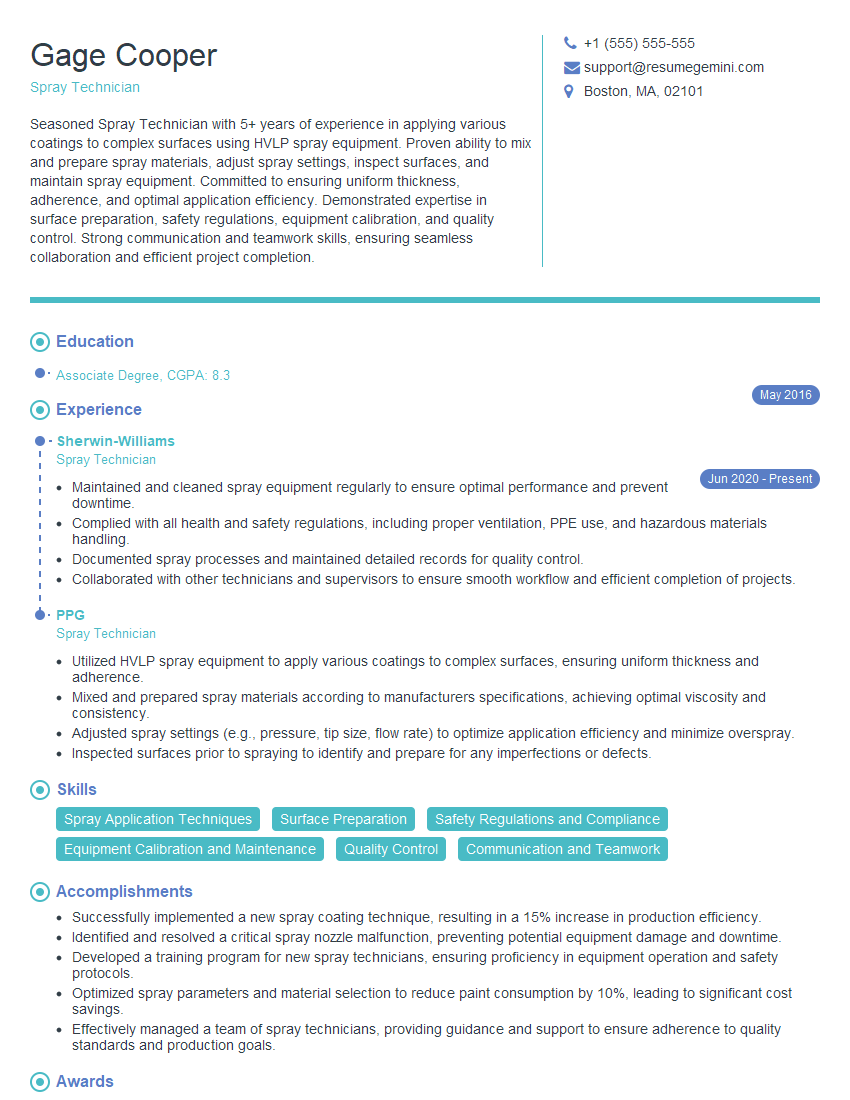
Feeling lost in a sea of interview questions? Landed that dream interview for Spray Technician but worried you might not have the answers? You’re not alone! This blog is your guide for interview success. We’ll break down the most common Spray Technician interview questions, providing insightful answers and tips to leave a lasting impression. Plus, we’ll delve into the key responsibilities of this exciting role, so you can walk into your interview feeling confident and prepared.
Acing the interview is crucial, but landing one requires a compelling resume that gets you noticed. Crafting a professional document that highlights your skills and experience is the first step toward interview success. ResumeGemini can help you build a standout resume that gets you called in for that dream job.






Essential Interview Questions For Spray Technician
1. What are the different types of spray booths and which one is the most effective?
- Cross-draft spray booth: Air is drawn across the work area and exhausted outside.
- Downdraft spray booth: Air is drawn down through the work area and exhausted below.
- Side-draft spray booth: Air is drawn from one side of the work area and exhausted from the other side.
- Semi-downdraft spray booth: A combination of downdraft and cross-draft booth.
Most effective: Downdraft spray booth because it provides the best containment of overspray and fumes.
2. What are the main types of spray guns and what are their advantages and disadvantages?
HVLP (High Volume Low Pressure) Spray Gun
- Advantages: Low overspray, reduced paint consumption, improved finish quality.
- Disadvantages: Slower application speed, may require more coats.
LVLP (Low Volume Low Pressure) Spray Gun
- Advantages: Similar advantages to HVLP, but with increased application speed.
- Disadvantages: Slightly higher overspray than HVLP.
Conventional Spray Gun
- Advantages: High application speed, low cost.
- Disadvantages: High overspray, poor finish quality.
3. What are the key factors that affect the quality of a spray finish?
- Surface preparation: The surface must be clean, dry, and free of contaminants.
- Paint selection: The paint must be compatible with the surface and the desired finish.
- Spray gun setup: The spray gun must be properly set up and adjusted.
- Spray technique: The spray technician must use proper technique to apply the paint evenly.
- Environmental conditions: Temperature, humidity, and air flow can affect the quality of the finish.
4. What are the common defects that can occur in a spray finish and how can they be prevented?
- Runs: Paint that flows too heavily and forms drips.
- Sags: Paint that settles and forms uneven areas.
- Orange peel: A rough, textured surface caused by incomplete atomization.
- Fish eyes: Small craters in the finish caused by contaminants in the paint or surface.
- Blushing: A milky appearance caused by moisture in the finish.
5. What are the safety precautions that must be taken when spray painting?
- Wear appropriate PPE (respirator, gloves, eye protection, coveralls).
- Ensure proper ventilation to prevent inhalation of fumes.
- Handle and store paint materials safely.
- Follow manufacturer’s instructions for use and disposal of paint and equipment.
- Maintain a clean and organized work area.
6. What are the techniques for troubleshooting common spray painting problems?
- Runs and sags: Check spray gun settings, adjust paint viscosity, ensure proper trigger control.
- Orange peel: Check spray gun settings, use proper paint thinning, adjust air pressure.
- Fish eyes: Clean the surface and equipment, ensure paint compatibility.
- Blushing: Allow for proper drying time, check environmental conditions.
7. What are the different types of paint finishes and how are they achieved?
- Gloss: Highly reflective, provides a shiny finish; achieved by using a high-gloss paint with a smooth surface.
- Semi-gloss: Moderate reflectivity, provides a subtle shine; achieved by using a semi-gloss paint with a slightly textured surface.
- Satin: Low reflectivity, provides a velvety appearance; achieved by using a satin paint with a fine-textured surface.
- Matte: No reflectivity, provides a flat finish; achieved by using a matte paint with a rough surface texture.
8. What are the different methods for preparing a surface for spray painting?
- Sanding: Removes old paint, dirt, and imperfections.
- Priming: Creates a smooth, uniform surface for paint adhesion.
- Cleaning: Removes contaminants such as oil, grease, and dust.
- Masking: Protects areas that should not be painted.
9. What are the different types of spray painting equipment and what are their uses?
- Spray guns: Apply paint in a controlled manner.
- Air compressors: Provide the compressed air needed to operate spray guns.
- Spray booths: Enclose the spray area to contain overspray and fumes.
- Personal protective equipment: Protects the spray technician from paint and fumes.
10. What are the maintenance and cleaning procedures for spray painting equipment?
- Regular cleaning: Remove paint buildup and debris from spray guns, air compressors, and spray booths.
- Periodic maintenance: Lubricate moving parts, check for leaks, and replace worn or damaged components.
- Storage: Store equipment in a clean, dry place to prevent corrosion and damage.
Interviewers often ask about specific skills and experiences. With ResumeGemini‘s customizable templates, you can tailor your resume to showcase the skills most relevant to the position, making a powerful first impression. Also check out Resume Template specially tailored for Spray Technician.
Career Expert Tips:
- Ace those interviews! Prepare effectively by reviewing the Top 50 Most Common Interview Questions on ResumeGemini.
- Navigate your job search with confidence! Explore a wide range of Career Tips on ResumeGemini. Learn about common challenges and recommendations to overcome them.
- Craft the perfect resume! Master the Art of Resume Writing with ResumeGemini’s guide. Showcase your unique qualifications and achievements effectively.
- Great Savings With New Year Deals and Discounts! In 2025, boost your job search and build your dream resume with ResumeGemini’s ATS optimized templates.
Researching the company and tailoring your answers is essential. Once you have a clear understanding of the Spray Technician‘s requirements, you can use ResumeGemini to adjust your resume to perfectly match the job description.
Key Job Responsibilities
As a Spray Technician, your main objective is to conduct meticulous spraying operations, adhering to established safety measures and quality standards. Your responsibilities encompass a wide range of tasks, ensuring efficient and precise execution of spraying processes:
1. Spraying Operations
• Carry out spraying operations utilizing various types of spraying equipment, including spray guns, pumps, and nozzles
• Maintain optimum spraying conditions by adjusting spray parameters such as pressure, flow rate, and nozzle size
• Accurately apply protective coatings, paints, sealants, and other materials onto designated surfaces
2. Surface Preparation
• Prepare surfaces for spraying by cleaning, degreasing, and abrading to ensure proper adhesion of applied materials
• Inspect surfaces for defects, repairs, or inconsistencies that may affect the spraying process
• Mask off areas to prevent overspray and protect sensitive components
3. Equipment Maintenance
• Perform routine maintenance and calibration of spraying equipment to ensure optimal performance
• Clean and inspect spray guns, hoses, pumps, and other components to prevent clogs and malfunctions
• Troubleshoot and resolve equipment issues to minimize downtime and maintain productivity
4. Quality Control
• Monitor the spraying process to ensure consistent application and adherence to specified coating thickness
• Conduct visual inspections and use quality control tools to evaluate the quality of the sprayed finish
• Document and report any deviations from quality standards or non-conformances
Interview Tips
To ace your interview for a Spray Technician position, here are some valuable preparation tips and interview hacks:
1. Research the Company and Position
• Thoroughly research the company’s website, industry reputation, and recent projects
• Review the job description carefully to identify the essential qualifications and responsibilities
• Prepare questions to ask the interviewer that demonstrate your interest and knowledge of the company and role
2. Highlight Your Technical Expertise
• Showcase your proficiency in spraying techniques, equipment operation, and surface preparation
• Emphasize your ability to interpret technical specifications and apply them in practical settings
• Provide specific examples of projects where you successfully applied your technical skills to achieve exceptional results
3. Demonstrate Your Safety Awareness
• Stress your commitment to adhering to safety regulations and following proper handling procedures
• Discuss your understanding of the potential hazards associated with spraying operations and the precautions you take to mitigate risks
• Explain how you ensure the safe disposal of hazardous materials and maintain a clean and organized work environment
4. Practice Your Communication Skills
• Be prepared to clearly articulate your technical knowledge and explain complex concepts to non-technical individuals
• Practice active listening and demonstrate your ability to ask clarifying questions
• Prepare concise and informative answers that highlight your strengths and qualifications
Example Outline:
• “Tell me about your experience in surface preparation and how you ensure proper adhesion of coatings.”
• “Describe a situation where you successfully troubleshooted and resolved a spraying equipment issue.”
• “How do you prioritize quality control and ensure compliance with coating thickness specifications?”
Next Step:
Armed with this knowledge, you’re now well-equipped to tackle the Spray Technician interview with confidence. Remember, a well-crafted resume is your first impression. Take the time to tailor your resume to highlight your relevant skills and experiences. And don’t forget to practice your answers to common interview questions. With a little preparation, you’ll be on your way to landing your dream job. So what are you waiting for? Start building your resume and start applying! Build an amazing resume with ResumeGemini.