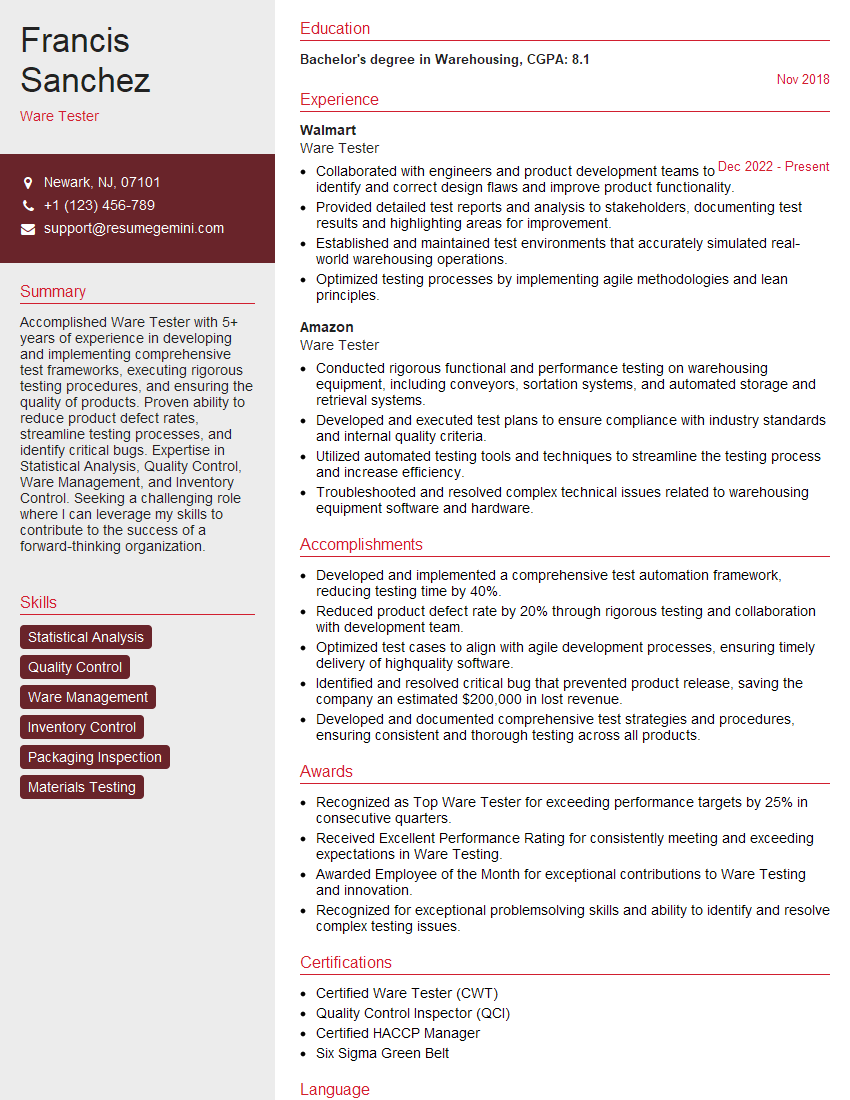
Ever felt underprepared for that crucial job interview? Or perhaps you’ve landed the interview but struggled to articulate your skills and experiences effectively? Fear not! We’ve got you covered. In this blog post, we’re diving deep into the Ware Tester interview questions that you’re most likely to encounter. But that’s not all. We’ll also provide expert insights into the key responsibilities of a Ware Tester so you can tailor your answers to impress potential employers.
Acing the interview is crucial, but landing one requires a compelling resume that gets you noticed. Crafting a professional document that highlights your skills and experience is the first step toward interview success. ResumeGemini can help you build a standout resume that gets you called in for that dream job.






Essential Interview Questions For Ware Tester
1. What are the key responsibilities of a Software Tester?
As a Software Tester, my key responsibilities include:
- Planning and executing test cases to identify defects and ensure software quality.
- Analyzing requirements, designing test plans, and developing test scripts.
- Evaluating test results, reporting defects, and collaborating with developers to resolve issues.
- Performing functional, performance, and regression testing.
- Automating test processes using tools and techniques.
- Adhering to testing methodologies (e.g., Agile, Waterfall) and industry standards.
- Providing feedback on software design, usability, and maintainability.
- Keeping up-to-date with industry best practices and emerging technologies.
2. How do you prioritize and manage multiple testing projects simultaneously?
Prioritization:
- Analyze project requirements, risk, and impact to determine critical tests.
- Use prioritization techniques (e.g., MoSCoW, Risk-Based Testing) to assign priority levels.
- Consult with stakeholders to understand business objectives and user needs.
Management:
- Create test plans and schedules, allocate resources, and monitor progress.
- Use project management tools to track tasks, timelines, and dependencies.
- Communicate regularly with team members and stakeholders to ensure alignment.
3. What is Defect Life Cycle and how do you manage defects efficiently?
Defect Life Cycle:
- New: Defect is identified and reported.
- Assigned: Defect is assigned to a developer for resolution.
- Fixed: Developer resolves the defect and provides a fix.
- Retest: Tester verifies the fix and confirms the defect resolution.
- Closed: Defect is closed upon successful retesting and confirmation.
Defect Management:
- Use a defect tracking system to capture, track, and manage defects.
- Classify defects based on severity, priority, and type.
- Monitor defect status and notify stakeholders of progress.
- Conduct root cause analysis to identify underlying issues and prevent recurrence.
4. How do you approach functional testing and what techniques do you employ?
Approach:
- Review requirements and specifications to understand the intended functionality.
- Design test cases that cover all functional areas and scenarios.
- Execute test cases manually or using automation tools.
- Document test results and report any deviations from expected behavior.
Techniques:
- Black Box Testing: Testing without knowledge of internal code structure.
- White Box Testing: Testing with knowledge of internal code structure.
- Equivalence Partitioning: Dividing input values into equivalence classes to cover a range of conditions.
- Boundary Value Analysis: Testing extreme values and boundaries to ensure correct behavior.
- State Transition Testing: Verifying transitions between different states of the software.
5. How do you handle performance testing and what metrics do you consider?
Approach:
- Define performance goals and criteria based on business requirements.
- Use performance testing tools to simulate user load and measure key metrics.
- Analyze test results to identify performance bottlenecks and areas for improvement.
Metrics:
- Response Time: Time taken for the system to respond to a request.
- Throughput: Number of requests processed per unit time.
- Load Capacity: Maximum number of concurrent users the system can handle without performance degradation.
- Resource Utilization: CPU, memory, and network usage.
- Error Rate: Percentage of requests that fail due to performance issues.
6. How do you approach regression testing and ensure that changes do not introduce new defects?
Approach:
- Identify critical test cases that are likely to be affected by changes.
- Prioritize and execute regression test cases to verify that existing functionality is not compromised.
- Monitor test results and report any new defects or regression issues.
Techniques:
- Risk-Based Regression: Focus on testing areas where changes have a high risk of introducing defects.
- Requirement-Based Regression: Testing based on specific requirements that may be impacted by changes.
- Automated Regression: Using automation tools to speed up and improve the efficiency of regression testing.
7. What is the role of automation in software testing and how do you approach test automation?
Role of Automation:
- Reduces manual effort and increases test coverage.
- Improves test execution speed and consistency.
- Enables continuous testing and regression testing.
- Frees up testers to focus on exploratory testing and high-value tasks.
Approach to Test Automation:
- Identify suitable test cases for automation.
- Select appropriate automation tools and frameworks.
- Design and develop automated test scripts.
- Maintain and update automated tests over time.
8. How do you stay up-to-date with advancements in software testing tools and techniques?
Methods:
- Attend industry conferences and webinars.
- Read technical articles, whitepapers, and blogs.
- Participate in online forums and communities.
- Explore new testing tools and frameworks.
- Collaborate with other testers and software engineers.
9. How do you adapt to changing software development methodologies and processes, such as Agile?
Approaches:
- Embrace continuous testing and integrate testing into the development cycle.
- Collaborate closely with developers to understand their perspectives and needs.
- Use agile testing techniques (e.g., exploratory testing, test-driven development).
- Automate tests to support faster feedback loops.
- Stay flexible and adapt to changing requirements and priorities.
10. What are some of your strengths and weaknesses as a Software Tester?
Strengths:
- Strong analytical and problem-solving skills.
- Excellent communication and collaboration abilities.
- Experience in various testing methodologies and tools.
- Passion for software quality and continuous improvement.
Weaknesses:
- Limited experience in specific industry domains.
- Still developing expertise in advanced test automation frameworks.
- I am actively working on addressing these weaknesses through training and self-directed learning.
Interviewers often ask about specific skills and experiences. With ResumeGemini‘s customizable templates, you can tailor your resume to showcase the skills most relevant to the position, making a powerful first impression. Also check out Resume Template specially tailored for Ware Tester.
Career Expert Tips:
- Ace those interviews! Prepare effectively by reviewing the Top 50 Most Common Interview Questions on ResumeGemini.
- Navigate your job search with confidence! Explore a wide range of Career Tips on ResumeGemini. Learn about common challenges and recommendations to overcome them.
- Craft the perfect resume! Master the Art of Resume Writing with ResumeGemini’s guide. Showcase your unique qualifications and achievements effectively.
- Great Savings With New Year Deals and Discounts! In 2025, boost your job search and build your dream resume with ResumeGemini’s ATS optimized templates.
Researching the company and tailoring your answers is essential. Once you have a clear understanding of the Ware Tester‘s requirements, you can use ResumeGemini to adjust your resume to perfectly match the job description.
Key Job Responsibilities
Ware testers are responsible for ensuring the quality of goods received by a company. They inspect incoming products for defects, damage, and compliance with specifications. Ware testers also conduct tests to evaluate the performance and durability of products.
1. Inspect incoming products
Ware testers visually inspect incoming products for defects such as scratches, dents, or broken parts. They also check the products against packing slips to ensure that all items have been received. For example, a ware tester might inspect a shipment of electronic components for any signs of damage that could have occurred during transit.
2. Conduct performance and durability tests
Ware testers conduct a variety of tests to evaluate the performance and durability of products. These tests may include:
- Functional testing
- Stress testing
- Environmental testing
For example, a ware tester might perform a stress test on a new type of luggage to see how it holds up to being repeatedly dropped or overloaded.
3. Maintain records
Ware testers maintain records of all inspections and tests conducted. These records include the date and time of the inspection, the name of the inspector, the product inspected, and the results of the inspection. For example: A ware tester might keep a log of all products inspected, noting any defects found and the action taken.
4. Report defects and non-conformances
Ware testers report any defects or non-conformances found during inspections or testing to the appropriate personnel. They may also make recommendations for corrective action. For example, a ware tester might report a defect in a product to the supplier and recommend that the product be recalled.
5. Work with other departments
Ware testers often work with other departments, such as quality control, purchasing, and manufacturing, to ensure that products meet specifications and are fit for use. For example, a ware tester might work with the quality control department to develop inspection procedures or with the manufacturing department to improve product quality.
Interview Tips
Preparing for an interview for a Ware Tester position can help you make a great impression on the hiring manager and increase your chances of getting the job. Here are some tips to help you prepare:
1. Research the company
Before your interview, take some time to research the company you’re applying to. This will help you understand the company’s culture, values, and products. You can also learn about the company’s competitors and industry trends. For example, you might read the company’s website, annual report, and press releases.
2. Practice your answers to common interview questions
There are a number of common interview questions that you’re likely to be asked, such as “Tell me about yourself” and “Why are you interested in this job?” It’s helpful to practice your answers to these questions in advance so that you can deliver them confidently and clearly. For example, you might practice answering the question “Tell me about yourself” by highlighting your skills and experience that are relevant to the job.
3. Be prepared to talk about your experience
The interviewer will likely ask you about your experience in the field. Be prepared to talk about your skills and experience in detail, and be sure to highlight any accomplishments that are relevant to the job. For example, you might mention a time when you successfully identified a defect in a product that could have caused a safety hazard.
4. Ask questions
Asking questions at the end of the interview shows that you’re interested in the job and the company. It also gives you an opportunity to learn more about the position and the company culture. For example, you might ask about the company’s training programs or about the company’s plans for future growth.
5. Follow up
After the interview, be sure to send a thank-you note to the interviewer. This is a simple way to show your appreciation for their time and to reiterate your interest in the position. For example, you might write a thank-you note that expresses your enthusiasm for the job and reiterates your qualifications.
Next Step:
Now that you’re armed with a solid understanding of what it takes to succeed as a Ware Tester, it’s time to turn that knowledge into action. Take a moment to revisit your resume, ensuring it highlights your relevant skills and experiences. Tailor it to reflect the insights you’ve gained from this blog and make it shine with your unique qualifications. Don’t wait for opportunities to come to you—start applying for Ware Tester positions today and take the first step towards your next career milestone. Your dream job is within reach, and with a polished resume and targeted applications, you’ll be well on your way to achieving your career goals! Build your resume now with ResumeGemini.