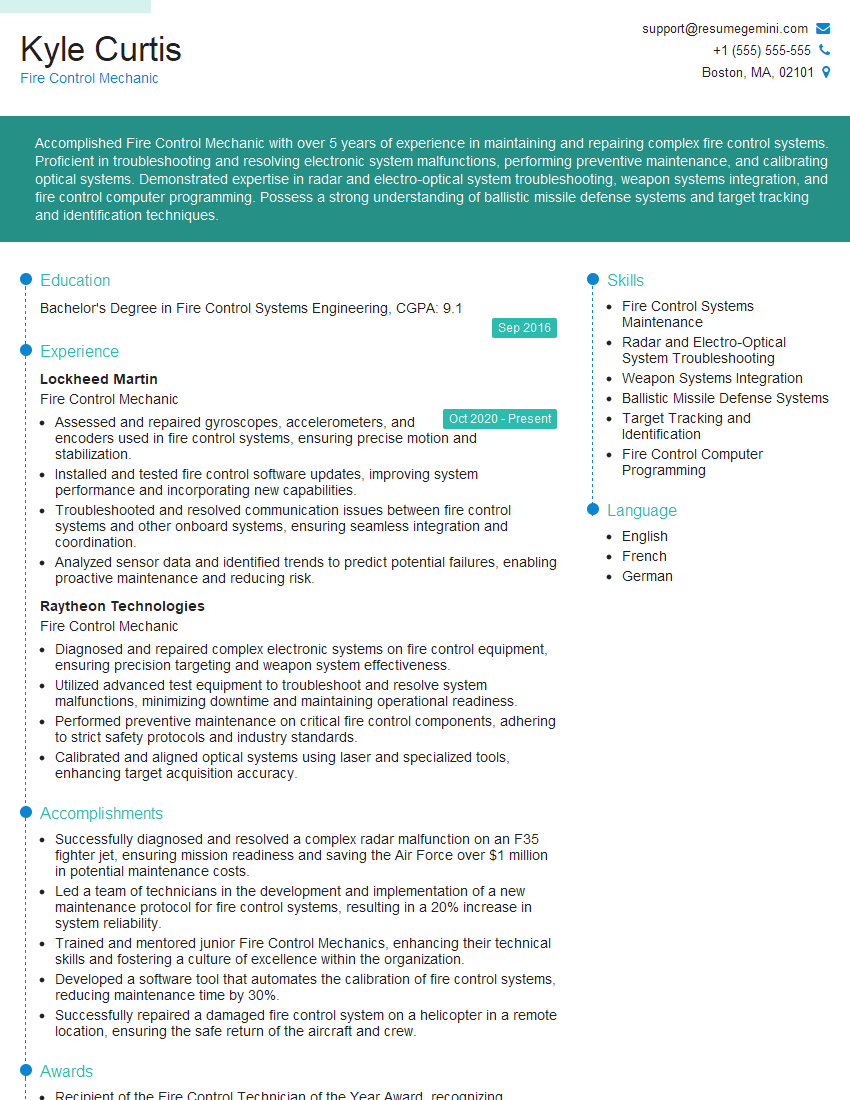
Ever felt underprepared for that crucial job interview? Or perhaps you’ve landed the interview but struggled to articulate your skills and experiences effectively? Fear not! We’ve got you covered. In this blog post, we’re diving deep into the Fire Control Mechanic interview questions that you’re most likely to encounter. But that’s not all. We’ll also provide expert insights into the key responsibilities of a Fire Control Mechanic so you can tailor your answers to impress potential employers.
Acing the interview is crucial, but landing one requires a compelling resume that gets you noticed. Crafting a professional document that highlights your skills and experience is the first step toward interview success. ResumeGemini can help you build a standout resume that gets you called in for that dream job.






Essential Interview Questions For Fire Control Mechanic
1. Describe the primary responsibilities of a Fire Control Mechanic?
As a Fire Control Mechanic, my primary duties entail:
- Maintaining and repairing fire control systems, including radars, computers, and sensors
- Installing, calibrating, and troubleshooting fire control equipment
- Inspecting and testing fire control systems to ensure optimal performance
- Diagnosing and resolving malfunctions in fire control systems
- Complying with safety regulations and maintaining a safe work environment
2. Explain the difference between open-loop and closed-loop fire control systems.
Open-Loop Systems
- Do not rely on feedback to adjust system behavior
- Receive input commands and generate output without considering the actual outcome
- Suitable for applications where high accuracy is not critical
Closed-Loop Systems
- Utilize feedback to adjust system behavior
- Continuously monitor system output and compare it to desired output
- Adjust system input based on deviations from the desired output
- Offer greater accuracy and stability
3. Discuss the role of radar in a fire control system.
Radar plays a crucial role in fire control systems by:
- Detecting and tracking targets
- Determining target range, speed, and altitude
- Providing data for fire control computers to calculate firing solutions
- Guiding weapons to their intended targets
- Enhanced situational awareness for operators
4. Describe the maintenance procedures you would perform on a fire control radar system.
My maintenance procedures for a fire control radar system include:
- Regular visual inspections to identify any physical damage or deterioration
- Testing of radar functionality, including range, azimuth, and elevation accuracy
- Calibration and alignment of radar components to ensure optimal performance
- Replacement of worn or damaged parts, such as waveguides, antennas, and power supplies
- Lubrication and cleaning of moving parts to prevent wear and tear
- Maintenance of a logbook to document all maintenance activities and observations
5. How do you ensure the safety of personnel when working on fire control systems?
I prioritize the safety of personnel by adhering to established protocols and taking the following measures:
- Wearing appropriate personal protective equipment (PPE), such as safety glasses, gloves, and ear protection
- De-energizing the system before performing any maintenance or repairs
- Grounding and discharging capacitors to prevent electrical shocks
- Using insulated tools and equipment to minimize the risk of electrical accidents
- Following proper lockout/tagout procedures to prevent accidental activation of the system
- Working in pairs or with a spotter to provide assistance and ensure safety
6. Explain the importance of troubleshooting in maintaining fire control systems.
Troubleshooting is essential for identifying and resolving malfunctions in fire control systems because it enables me to:
- Quickly diagnose the root cause of a system failure
- Implement effective repair strategies to restore system functionality
- Prevent minor issues from escalating into more significant problems
- Minimize downtime and maintain the operational readiness of fire control systems
- Enhance my understanding of system components and their interrelationships
7. Describe a challenging troubleshooting experience you faced as a Fire Control Mechanic.
In a recent troubleshooting instance, I encountered a complex issue with a fire control radar system. The radar was experiencing intermittent failures, and the initial diagnostics did not reveal any obvious causes. By systematically isolating different system components and performing detailed testing, I was able to identify a faulty power supply as the root cause. Replacing the power supply resolved the issue and restored the system to full functionality.
8. How do you stay updated with the latest advancements in fire control technology?
To remain current with the latest advancements in fire control technology, I engage in continuous learning and development activities. These include:
- Attending industry conferences and workshops
- Reading technical journals and industry publications
- Participating in online courses and webinars
- Seeking mentorship from experienced engineers
- Networking with professionals in the field
9. Explain the importance of teamwork in the role of a Fire Control Mechanic.
Teamwork is critical for a Fire Control Mechanic as it enables me to:
- Collaborate with other technicians and engineers to resolve complex issues
- Share knowledge and expertise with colleagues
- Support my team by assisting with tasks and providing technical guidance
- Maintain a positive and productive work environment
- Meet deadlines and achieve project objectives efficiently
10. How would you approach a project to upgrade a fire control system?
To approach a project to upgrade a fire control system, I would follow a structured process:
- Conduct a thorough assessment of the existing system to identify areas for improvement
- Research and evaluate potential upgrade options, considering factors such as cost, performance, and reliability
- Develop a detailed plan for the upgrade, including timelines, resource allocation, and risk management strategies
- Coordinate with stakeholders to ensure alignment and support throughout the project
- Execute the upgrade plan, ensuring proper installation, testing, and documentation
- Evaluate the upgraded system to ensure it meets the desired performance and functional requirements
Interviewers often ask about specific skills and experiences. With ResumeGemini‘s customizable templates, you can tailor your resume to showcase the skills most relevant to the position, making a powerful first impression. Also check out Resume Template specially tailored for Fire Control Mechanic.
Career Expert Tips:
- Ace those interviews! Prepare effectively by reviewing the Top 50 Most Common Interview Questions on ResumeGemini.
- Navigate your job search with confidence! Explore a wide range of Career Tips on ResumeGemini. Learn about common challenges and recommendations to overcome them.
- Craft the perfect resume! Master the Art of Resume Writing with ResumeGemini’s guide. Showcase your unique qualifications and achievements effectively.
- Great Savings With New Year Deals and Discounts! In 2025, boost your job search and build your dream resume with ResumeGemini’s ATS optimized templates.
Researching the company and tailoring your answers is essential. Once you have a clear understanding of the Fire Control Mechanic‘s requirements, you can use ResumeGemini to adjust your resume to perfectly match the job description.
Key Job Responsibilities
Fire Control Mechanics, also known as Fire Control Systems Technicians, are highly skilled professionals responsible for ensuring the proper functioning of fire control systems in various military platforms such as ships, aircraft, and land-based systems. These systems are critical for accurate targeting and engagement of enemy targets.
1. System Installation and Maintenance
Install, maintain, and repair fire control systems, including radars, electro-optical sensors, and fire control computers.
- Troubleshoot and diagnose system malfunctions and perform repairs to ensure operational readiness.
- Calibrate and align system components to meet performance specifications.
2. System Testing and Evaluation
Conduct system testing and evaluation to ensure proper performance and compliance with specifications.
- Perform live-fire tests and collect data to assess system accuracy and effectiveness.
- Analyze test results and make recommendations for system improvements.
3. Technical Documentation and Training
Prepare and maintain technical documentation for fire control systems.
- Create training materials and provide instruction to operators and maintainers on system operation and maintenance procedures.
- Stay updated on technical advancements in fire control technology.
4. Teamwork and Collaboration
Work as part of a team with engineers, technicians, and operators to ensure the smooth functioning of fire control systems.
- Coordinate with other departments and stakeholders to resolve technical issues and ensure interoperability.
- Participate in equipment evaluations and procurement processes.
Interview Tips
Preparing for a job interview as a Fire Control Mechanic requires a combination of technical knowledge, research, and practice. Here are some tips to help you ace the interview:
1. Research the Company and Position
Thoroughly research the company, its mission, and its products or services. This will demonstrate your interest and knowledge of the organization.
- Review the job description carefully and identify the key skills and qualifications required for the position.
- Visit the company’s website and social media pages to gather additional information.
2. Highlight Your Technical Expertise
Emphasize your technical skills and experience in fire control systems. Use specific examples to demonstrate your abilities in system installation, maintenance, testing, and evaluation.
- Quantify your accomplishments whenever possible, using metrics such as percentage improvements or time savings.
- Be prepared to discuss your understanding of fire control principles, radar systems, and electro-optical sensors.
3. Showcase Your Problem-Solving Abilities
Interviewers will be interested in your ability to troubleshoot and solve technical problems efficiently. Share examples from your previous work experience where you successfully diagnosed and resolved system malfunctions.
- Explain your approach to problem-solving and how you prioritize tasks in a demanding environment.
- Discuss any specialized tools or techniques you have used to troubleshoot and repair complex systems.
4. Prepare for Behavioral Questions
Behavioral questions are commonly used in interviews to assess your soft skills and personality traits. Practice answering questions related to teamwork, collaboration, and conflict resolution.
- Use the STAR method (Situation, Task, Action, Result) to structure your responses and provide specific examples.
- Demonstrate your ability to work effectively in a team environment and communicate clearly with colleagues.
Next Step:
Armed with this knowledge, you’re now well-equipped to tackle the Fire Control Mechanic interview with confidence. Remember, preparation is key. So, start crafting your resume, highlighting your relevant skills and experiences. Don’t be afraid to tailor your application to each specific job posting. With the right approach and a bit of practice, you’ll be well on your way to landing your dream job. Build your resume now from scratch or optimize your existing resume with ResumeGemini. Wish you luck in your career journey!