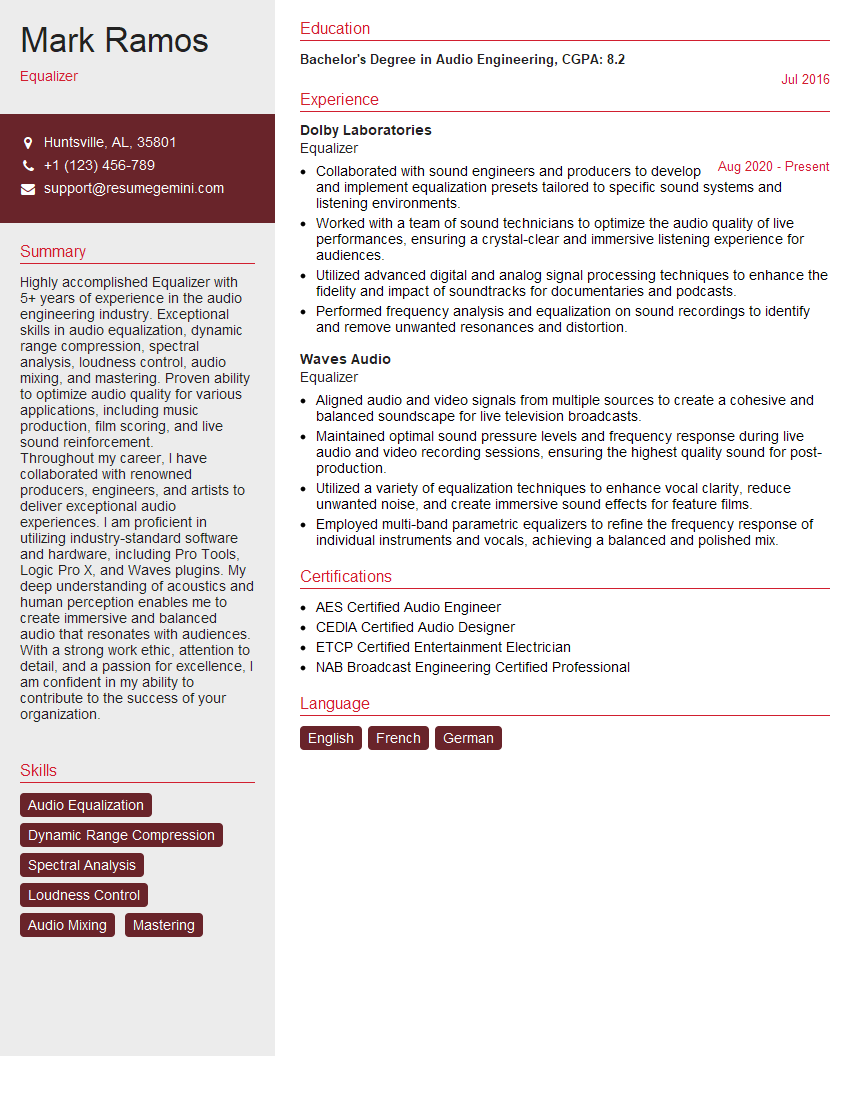
Are you gearing up for an interview for a Equalizer position? Whether you’re a seasoned professional or just stepping into the role, understanding what’s expected can make all the difference. In this blog, we dive deep into the essential interview questions for Equalizer and break down the key responsibilities of the role. By exploring these insights, you’ll gain a clearer picture of what employers are looking for and how you can stand out. Read on to equip yourself with the knowledge and confidence needed to ace your next interview and land your dream job!
Acing the interview is crucial, but landing one requires a compelling resume that gets you noticed. Crafting a professional document that highlights your skills and experience is the first step toward interview success. ResumeGemini can help you build a standout resume that gets you called in for that dream job.






Essential Interview Questions For Equalizer
1. Explain the concept of equalization and its applications in audio engineering.
Equalization is the process of adjusting the balance of different frequencies within an audio signal. It is used to improve the sound quality of recordings, live performances, and broadcasts, and to create specific sonic effects.
- Tonal balance: Equalization can be used to adjust the overall tonal balance of a signal, making it brighter, darker, warmer, or cooler.
- Frequency response correction: Equalization can be used to correct for imbalances in the frequency response of a system, such as a loudspeaker or room.
- Masking and unmasking: Equalization can be used to mask unwanted sounds or to unmask desired sounds. This can be useful in live sound reinforcement or in recording and mixing.
- Special effects: Equalization can be used to create special effects, such as distortion, flanging, and phasing.
2. Describe the different types of equalizers and their characteristics.
Parametric equalizers
- Parametric equalizers allow you to control three parameters for each band: frequency, gain, and Q-factor (bandwidth).
- Parametric equalizers are the most versatile type of equalizer, and they can be used to achieve a wide range of tonal adjustments.
Graphic equalizers
- Graphic equalizers have a series of fixed frequency bands, each with its own gain control.
- Graphic equalizers are easier to use than parametric equalizers, but they are less versatile.
3. How do you use an equalizer to shape the frequency response of a sound system?
To use an equalizer to shape the frequency response of a sound system, you need to:
- Identify the problem: You need to identify the frequencies that are causing the problem. This can be done by listening to the system and identifying the frequencies that are too loud, too soft, or missing.
- Make adjustments: Once you have identified the problem frequencies, you can use the equalizer to make adjustments. You can boost or cut the gain of specific frequencies, or you can adjust the Q-factor to narrow or widen the bandwidth of the affected frequencies.
- Listen and adjust: After you have made adjustments, you need to listen to the system and make further adjustments as needed. It is important to take your time and make small adjustments until you achieve the desired sound.
4. What is the difference between a passive and an active equalizer?
- Passive equalizers do not require power to operate. They are typically used in fixed installations, such as home stereo systems and recording studios.
- Active equalizers require power to operate. They are typically used in live sound reinforcement systems and in recording and mixing consoles.
5. What are some of the challenges of using equalization?
- Finding the right balance: Equalization can be a powerful tool, but it is important to use it with restraint. Over-equalization can lead to a thin, harsh sound.
- Avoiding feedback: Equalization can increase the gain of certain frequencies, which can lead to feedback. It is important to be aware of the potential for feedback when using equalization.
- Interference with other instruments: Equalization can affect the sound of other instruments in a mix. It is important to consider the overall mix when using equalization.
6. What are some of the common mistakes that people make when using equalization?
- Using too much equalization: It is important to use equalization with restraint. Over-equalization can lead to a thin, harsh sound.
- Not understanding the frequency response of the system: It is important to understand the frequency response of the system you are using before you start making adjustments. This will help you to avoid making mistakes.
- Not considering the overall mix: Equalization can affect the sound of other instruments in a mix. It is important to consider the overall mix when using equalization.
7. What are some of the advanced techniques for using equalization?
- Multi-band equalization: Multi-band equalization allows you to apply different equalization settings to different frequency ranges.
- Dynamic equalization: Dynamic equalization adjusts the equalization settings based on the input signal.
- Mid/side equalization: Mid/side equalization allows you to apply different equalization settings to the mid and side channels of a stereo signal.
8. What are some of the best resources for learning about equalization?
- Books: There are many books available on the subject of equalization. Some of the most popular books include “The EQ Cookbook” by George Massenburg, “The Art of Mixing” by David Gibson, and “Mixing Audio: Concepts, Practices and Tools” by Roey Izhaki.
- Online resources: There are many online resources available on the subject of equalization. Some of the most popular websites include the Bob Katz forums, the Pro Sound Web forums, and the Gearslutz forums.
- Workshops and seminars: There are many workshops and seminars available on the subject of equalization. These workshops can be a great way to learn about equalization from experienced professionals.
9. What is the difference between a subtractive and an additive EQ?
- Subtractive EQ: Subtractive EQ removes or attenuates certain frequencies from the signal, creating a “cut” or “notch”. It is typically used to reduce unwanted resonances or harshness, or to make space for other elements in the mix.
- Additive EQ: Additive EQ boosts or amplifies certain frequencies, creating a “boost” or “peak”. It is typically used to enhance specific elements of the signal, such as adding warmth, or to compensate for deficiencies in the source material.
10. What are the different types of EQ curves?
- Bell curve: A bell curve is the most common type of EQ curve. It has a peak in the center, and it rolls off gradually on either side. Bell curves can be used to boost or cut specific frequencies.
- Shelf curve: A shelf curve is a flat line that slopes up or down at a certain frequency. Shelf curves can be used to boost or cut all frequencies above or below a certain point.
- High-pass curve: A high-pass curve rolls off all frequencies below a certain point. High-pass curves can be used to remove low-frequency noise or to make a sound brighter.
- Low-pass curve: A low-pass curve rolls off all frequencies above a certain point. Low-pass curves can be used to remove high-frequency noise or to make a sound darker.
Interviewers often ask about specific skills and experiences. With ResumeGemini‘s customizable templates, you can tailor your resume to showcase the skills most relevant to the position, making a powerful first impression. Also check out Resume Template specially tailored for Equalizer.
Career Expert Tips:
- Ace those interviews! Prepare effectively by reviewing the Top 50 Most Common Interview Questions on ResumeGemini.
- Navigate your job search with confidence! Explore a wide range of Career Tips on ResumeGemini. Learn about common challenges and recommendations to overcome them.
- Craft the perfect resume! Master the Art of Resume Writing with ResumeGemini’s guide. Showcase your unique qualifications and achievements effectively.
- Great Savings With New Year Deals and Discounts! In 2025, boost your job search and build your dream resume with ResumeGemini’s ATS optimized templates.
Researching the company and tailoring your answers is essential. Once you have a clear understanding of the Equalizer‘s requirements, you can use ResumeGemini to adjust your resume to perfectly match the job description.
Key Job Responsibilities
An Equalizer is responsible for calibrating and maintaining audio equipment to ensure optimal sound quality across various applications.
1. Audio Equipment Calibration
Calibrate and maintain audio equipment including mixers, amplifiers, speakers, headphones, and microphones to meet industry standards and client specifications.
- Perform frequency response testing and adjustments to optimize sound output.
- Troubleshoot and resolve audio issues to ensure seamless performance.
2. Room Acoustics Analysis
Analyze the acoustics of listening environments and identify areas for improvement.
- Identify and mitigate acoustic problems such as reflections, reverberation, and standing waves.
- Recommend and implement acoustic treatments to enhance sound quality.
3. System Design and Integration
Design and integrate audio systems to meet specific requirements and constraints.
- Select and configure equipment based on project specifications and budgets.
- Install and commission audio systems to ensure optimal performance.
4. Technical Support and Training
Provide technical support and training to users of audio systems.
- Troubleshoot and resolve technical issues with audio equipment.
- Train users on proper equipment operation and maintenance.
Interview Tips
Interview preparation is crucial for standing out in an Equalizer interview. Here are some essential tips.
1. Research the Industry and Company
Stay up-to-date with the latest audio technology trends and the company’s portfolio. This will demonstrate your passion for the field and your interest in the specific role.
- Attend industry conferences or read trade publications to gather knowledge.
- Review the company’s website, social media, and news articles to understand their values and projects.
2. Showcase Your Skills and Experience
Highlight your technical proficiency in audio equipment calibration, room acoustics analysis, and system design. Quantify your accomplishments with specific examples.
- Mention projects where you successfully calibrated and maintained audio systems to meet stringent standards.
- Describe how you analyzed room acoustics and implemented treatments to improve sound quality.
- Explain your experience in designing and integrating audio systems within budget constraints.
3. Emphasize Your Problem-Solving Abilities
Interviewers will be looking for candidates who can effectively troubleshoot and resolve audio issues. Demonstrate your analytical thinking and problem-solving skills.
- Share an example of a complex audio problem you encountered and how you systematically identified and resolved it.
- Explain your approach to analyzing audio signals and identifying sound quality issues.
4. Highlight Your Communication and Interpersonal Skills
Equalizers often collaborate with engineers, musicians, and clients. Highlight your ability to communicate technical concepts clearly and effectively.
- Provide examples of how you effectively communicated technical information to non-technical stakeholders.
- Explain how you build strong relationships with clients and maintain customer satisfaction.
Next Step:
Armed with this knowledge, you’re now well-equipped to tackle the Equalizer interview with confidence. Remember, preparation is key. So, start crafting your resume, highlighting your relevant skills and experiences. Don’t be afraid to tailor your application to each specific job posting. With the right approach and a bit of practice, you’ll be well on your way to landing your dream job. Build your resume now from scratch or optimize your existing resume with ResumeGemini. Wish you luck in your career journey!