





In today’s competitive job market, it’s more important than ever to have a resume that stands out from the crowd. Recruiters are inundated with resumes, so you need to make sure yours is one that they’ll want to read. Here are seven secrets to writing a resume in 2026 that recruiters will love:
The Art of Resume Storytelling: Captivating Recruiters
Your resume is not just a list of your skills and experience. It’s a story about you and your career journey. When you’re writing your resume, think about what you want to communicate to recruiters. What are your unique strengths? What are your accomplishments? What are your goals? Once you know what you want to say, you can start to craft a narrative that will capture their attention.
- Use strong action verbs. When describing your accomplishments, use strong action verbs that convey your skills and abilities. For example, instead of saying “I managed a team of engineers,” say “I led a team of engineers to develop a new product that increased sales by 20%.”
- Quantify your accomplishments. Whenever possible, quantify your accomplishments to demonstrate the impact of your work. For example, instead of saying “I improved customer satisfaction,” say “I improved customer satisfaction by 15% through a new customer service initiative.”
Leveraging Keywords for Maximum Impact: The ATS Advantage
Most companies use Applicant Tracking Systems (ATS) to screen resumes. ATSs are designed to scan resumes for specific keywords. If your resume doesn’t include the right keywords, it’s likely to be rejected. The best way to find the right keywords is to read the job description carefully. Make a list of the skills and experience that the employer is looking for, and then incorporate those keywords into your resume.
- Don’t overdo it. While you want to include the right keywords in your resume, you don’t want to overdo it. A resume that is stuffed with keywords will be difficult to read and understand.
- Use keywords naturally. The best way to incorporate keywords into your resume is to use them naturally. Don’t force them into your resume in a way that sounds awkward.
Quantifying Your Accomplishments: Metrics Matter
Recruiters want to see evidence of your accomplishments. The best way to do this is to quantify your results. For example, instead of saying “I managed a team of engineers,” say “I led a team of engineers to develop a new product that increased sales by 20%.”
- Use specific numbers. When quantifying your accomplishments, be specific. Don’t just say “I increased sales.” Say “I increased sales by 20%.”
- Use percentages. Percentages are a great way to show the impact of your work. For example, instead of saying “I improved customer satisfaction,” say “I improved customer satisfaction by 15%.”
Crafting a Powerful Summary: Hook Them from the Start
Your resume summary is your chance to make a great first impression on recruiters. This is the section where you should highlight your key skills, experience, and accomplishments. Your resume summary should be concise and to the point, and it should be tailored to the specific job you’re applying for.
- Keep it short. Your resume summary should be no more than three to four sentences long.
- Highlight your most relevant skills and experience. When writing your resume summary, focus on the skills and experience that are most relevant to the job you’re applying for.
Showcasing Your Skills: The Showcase Section Advantage
The showcase section is a great way to highlight your skills and experience in more detail. This section can be used to provide additional information about your skills, such as your proficiency level, or to provide examples of your work. The showcase section is a great way to make your resume stand out from the crowd.
- Use the showcase section to highlight your key skills. The showcase section is a great place to highlight your key skills. For example, if you’re a software engineer, you could use the showcase section to list your programming languages and your experience with different software development tools.
- Provide examples of your work. The showcase section is also a great place to provide examples of your work. For example, if you’re a writer, you could include links to your published articles or blog posts. If you’re a designer, you could include links to your portfolio.
Tailoring Your Resume to the Job Description: The Key to Success
One of the most important things you can do when writing your resume is to tailor it to the specific job you’re applying for. This means reading the job description carefully and making sure that your resume includes the skills and experience that the employer is looking for. The best way to do this is to use the job description as a guide when writing your resume.
- Read the job description carefully. Before you start writing your resume, take some time to read the job description carefully. Make a list of the skills and experience that the employer is looking for.
- Tailor your resume to the job description. Once you have a list of the skills and experience that the employer is looking for, you can start to tailor your resume to the job description. This means including the relevant skills and experience in your resume summary, work history, and skills section.
Proofreading and Editing: The Final Touch for Perfection
Once you’ve finished writing your resume, it’s important to proofread and edit your work. This will help you to catch any errors in grammar or spelling, and it will also help you to make sure that your resume is clear and concise. The best way to proofread your resume is to read it out loud. This will help you to catch any errors that you might have missed when you were reading it silently.
- Proofread your resume carefully. Once you’ve finished writing your resume, it’s important to proofread your work carefully. This will help you to catch any errors in grammar or spelling.
- Ask someone else to proofread your resume. If possible, ask someone else to proofread your resume. This will help you to get a fresh perspective on your resume, and it will also help you to catch any errors that you might have missed.
By following these seven secrets, you can write a resume in 2026 that recruiters will love. Remember, your resume is your chance to make a great first impression, so take the time to write a resume that is well-written, concise, and tailored to the specific job you’re applying for. With a little effort, you can write a resume that will help you to land your dream job.
If you’re looking for an easy way to create a professional resume in minutes, visit ResumeGemini. Our resume builder offers a variety of templates and tools that will help you to create a resume that will impress recruiters.
Career Expert Tips:
- Select the ideal resume template to showcase your professional experience effectively.
- Master the art of resume writing to highlight your unique qualifications and achievements.
- Checkout the resume writing tips for guidance and best practices.
- Make your 2025 brighter with a new job. Build a powerful resume with ResumeGemini and save big, enjoy exclusive discounts on premium templates.
Frequently Asked Questions (FAQ’s)
How do I write a resume that tells a compelling story?
To create a compelling resume, adopt a storytelling approach that engages recruiters and highlights your unique contributions. Begin with a captivating narrative in the resume summary, outlining your career journey, skills, and achievements. Craft a clear and concise professional story throughout the resume, showcasing your progression and impact.
What are the most important keywords to include on my resume?
Identifying and including relevant keywords is crucial for your resume to stand out in ATS systems and reach recruiters. Research the job description and industry-specific terms, incorporating them naturally into your resume content. Utilize keywords in your skills section, job descriptions, and throughout the resume.
How can I quantify my accomplishments to make them more impactful?
To enhance the impact of your accomplishments, quantify them whenever possible. Use specific numbers, metrics, and percentages to demonstrate your contributions and results. Quantifying achievements provides concrete evidence of your impact and highlights your value to potential employers.
What is the best way to write a strong resume summary?
An effective resume summary serves as a captivating introduction to your resume. Keep it concise, typically 2-3 sentences, and highlight your most relevant skills, experience, and accomplishments. Tailor the summary to the specific job you are applying for, emphasizing transferable skills and aligning with the employer’s needs.
How do I tailor my resume to specific job applications?
Tailoring your resume to each job application is essential to demonstrate your interest and qualifications. Carefully review the job description, identify the required skills and experience, and tailor your resume to match those requirements. Highlight relevant projects, accomplishments, and keywords that align with the specific role and company.
Is brevity important in resume writing?
Brevity and conciseness are crucial for effective resume writing. Recruiters and hiring managers typically spend only a few seconds reviewing a resume during the initial screening process. Aim to keep your resume to a maximum of one page, using clear and concise language throughout. Prioritize the most relevant information and tailor it to the specific job application.
Next Step:
Take your resume to the next level with ResumeGemini, your trusted resume-building partner. With ResumeGemini’s expert guidance and customizable templates, you can craft a compelling resume that showcases your skills, experience, and aspirations. Start your journey today and unlock your career potential!
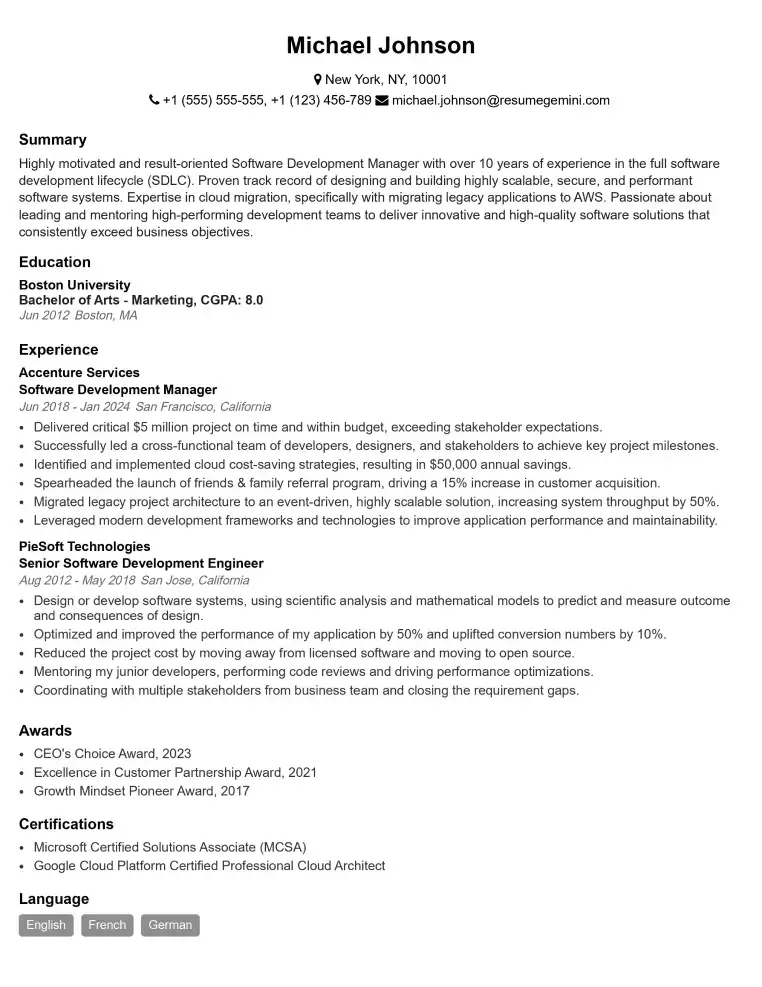
Elevate your job search with our premium resume templates. Here is an amazing resume template that can be used to build a professional and elegant resume. You can build a resume from scratch or revamp your existing resume. Impress hiring managers and secure your next opportunity.
- Top 50 Most Common Interview Questions
- The Psychology of a Great Resume: Hacks to Impress Recruiters
- What Mistakes to Avoid When Writing a Resume: A Comprehensive Guide
- Elevate Your Career with Expert Resume Building: Introducing ResumeGemini
- How to Write a Resume Using Google Gemini: Step-by-Step Guide