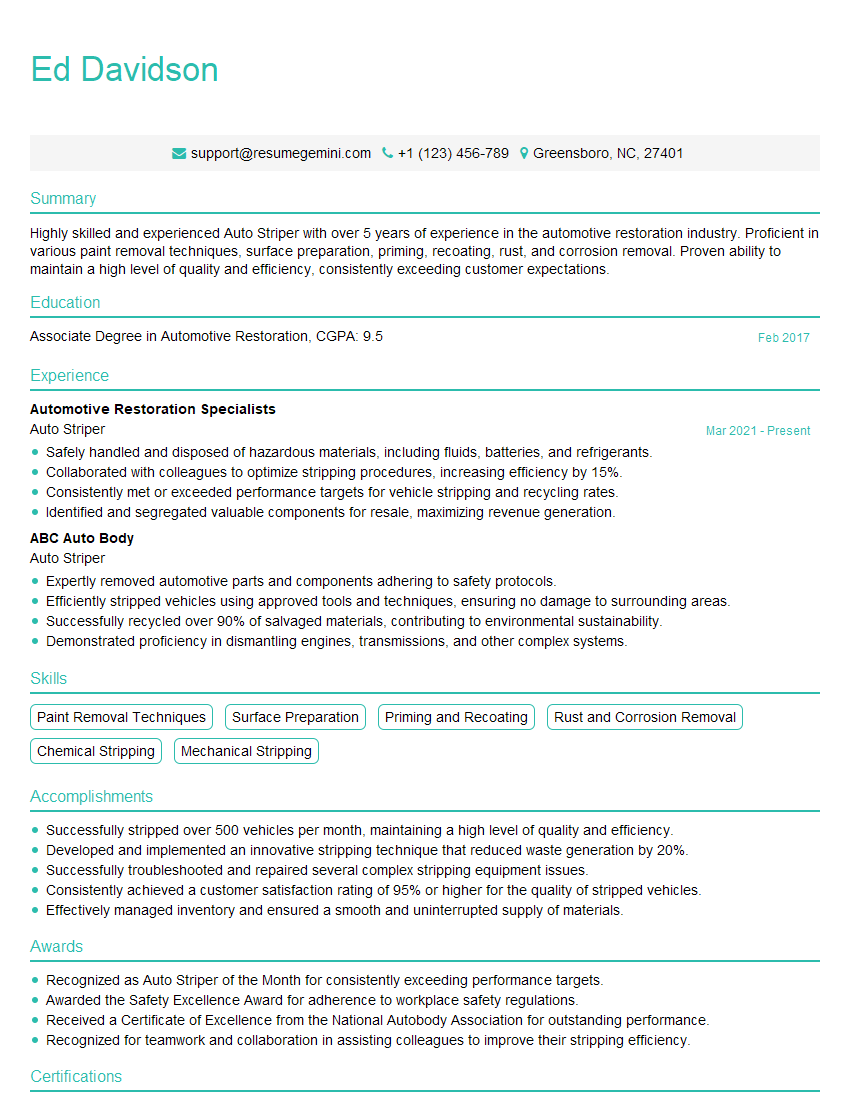
Are you gearing up for a career in Auto Striper? Feeling nervous about the interview questions that might come your way? Don’t worry, you’re in the right place. In this blog post, we’ll dive deep into the most common interview questions for Auto Striper and provide you with expert-backed answers. We’ll also explore the key responsibilities of this role so you can tailor your responses to showcase your perfect fit.
Acing the interview is crucial, but landing one requires a compelling resume that gets you noticed. Crafting a professional document that highlights your skills and experience is the first step toward interview success. ResumeGemini can help you build a standout resume that gets you called in for that dream job.






Essential Interview Questions For Auto Striper
1. What are the different types of auto strippers and their uses?
- Hydraulic Auto Strippers: These strippers use hydraulic pressure to remove insulation from wires. They are powerful and can strip wires of various sizes.
- Pneumatic Auto Strippers: These strippers use compressed air to remove insulation from wires. They are lightweight and easy to use.
- Thermal Auto Strippers: These strippers use heat to soften the insulation before removing it from wires. They are ideal for stripping delicate wires.
- Laser Auto Strippers: These strippers use a laser to vaporize the insulation from wires. They are precise and can strip wires of various sizes and shapes.
2. What are the safety precautions that must be taken while using an auto stripper?
subheading of the answer: Personal Protective Equipment
- Wear safety glasses to protect your eyes from flying debris.
- Wear gloves to protect your hands from sharp edges.
- Wear a dust mask to protect your lungs from inhaling dust.
subheading of the answer: Machine Operation
- Make sure the machine is properly grounded.
- Do not operate the machine if it is damaged.
- Keep the work area clean and free of debris.
3. How do you troubleshoot a common problem with an auto stripper?
- If the stripper is not stripping the insulation properly, check the blade for damage or dullness. If the blade is damaged or dull, replace it.
- If the stripper is not feeding the wire properly, check the tension on the feed rollers. If the tension is too loose, the wire will slip and not be stripped properly. If the tension is too tight, the wire will be damaged.
- If the stripper is not cutting the insulation cleanly, check the blade for damage or dullness. If the blade is damaged or dull, replace it.
4. What are the different types of wire connectors and their uses?
- Butt Connectors: These connectors are used to join two wires together end-to-end.
- Ring Terminals: These connectors are used to connect a wire to a terminal or other electrical component.
- Splice Connectors: These connectors are used to repair a damaged wire.
- Heat Shrink Connectors: These connectors are used to insulate and protect a wire connection.
5. What are the different types of electrical wires and their uses?
- Solid Wire: This type of wire is made of a single, solid strand of metal. It is typically used for low-current applications.
- Stranded Wire: This type of wire is made of multiple, thin strands of metal. It is typically used for high-current applications.
- Coaxial Cable: This type of wire is made of a center conductor surrounded by a layer of insulation and a shield. It is typically used for high-frequency applications.
- Twisted Pair Cable: This type of wire is made of two insulated conductors twisted together. It is typically used for data and telecommunications applications.
6. What are the different types of electrical circuits and their uses?
- Series Circuit: In a series circuit, the current flows through each component in the circuit in turn. The total resistance of the circuit is the sum of the resistances of each component.
- Parallel Circuit: In a parallel circuit, the current can flow through any of the components in the circuit. The total resistance of the circuit is less than the resistance of any of the individual components.
- Mixed Circuit: A mixed circuit is a circuit that contains both series and parallel components.
7. What are the different types of electrical tools and their uses?
- Voltmeter: A voltmeter is used to measure the voltage of an electrical circuit.
- Ammeter: An ammeter is used to measure the current of an electrical circuit.
- Ohmmeter: An ohmmeter is used to measure the resistance of an electrical circuit.
- Multimeter: A multimeter is a device that can measure voltage, current, and resistance.
8. What are the different types of electrical symbols and their meanings?
- Ground Symbol: The ground symbol is a straight line with a horizontal line through it. It is used to indicate a connection to the ground.
- Battery Symbol: The battery symbol is a circle with a plus sign inside it. It is used to indicate a battery.
- Resistor Symbol: The resistor symbol is a zigzag line. It is used to indicate a resistor.
- Capacitor Symbol: The capacitor symbol is two parallel lines with a gap in between them. It is used to indicate a capacitor.
9. What are the different types of electrical hazards and how to avoid them?
- Electrical Shock: Electrical shock is a dangerous condition that can occur when a person comes into contact with an electrical current. To avoid electrical shock, never touch live electrical wires or components.
- Electrical Burns: Electrical burns can occur when a person comes into contact with a hot electrical component. To avoid electrical burns, never touch hot electrical components.
- Electrical Fires: Electrical fires can occur when an electrical circuit overloads or shorts out. To avoid electrical fires, never overload electrical circuits or use damaged electrical equipment.
10. What are the different types of electrical troubleshooting techniques?
- Visual Inspection: The first step in troubleshooting an electrical problem is to visually inspect the circuit for any obvious damage. Look for loose connections, broken wires, or burnt components.
- Voltage and Current Measurements: Once you have visually inspected the circuit, you can use a voltmeter and ammeter to measure the voltage and current at various points in the circuit. This will help you identify any areas where the circuit is not functioning properly.
- Signal Tracing: Signal tracing is a technique used to identify the path of a signal through a circuit. This can be done using a signal tracer or an oscilloscope.
Interviewers often ask about specific skills and experiences. With ResumeGemini‘s customizable templates, you can tailor your resume to showcase the skills most relevant to the position, making a powerful first impression. Also check out Resume Template specially tailored for Auto Striper.
Career Expert Tips:
- Ace those interviews! Prepare effectively by reviewing the Top 50 Most Common Interview Questions on ResumeGemini.
- Navigate your job search with confidence! Explore a wide range of Career Tips on ResumeGemini. Learn about common challenges and recommendations to overcome them.
- Craft the perfect resume! Master the Art of Resume Writing with ResumeGemini’s guide. Showcase your unique qualifications and achievements effectively.
- Great Savings With New Year Deals and Discounts! In 2025, boost your job search and build your dream resume with ResumeGemini’s ATS optimized templates.
Researching the company and tailoring your answers is essential. Once you have a clear understanding of the Auto Striper‘s requirements, you can use ResumeGemini to adjust your resume to perfectly match the job description.
Key Job Responsibilities
An Auto Stripper is a crucial member of an automotive manufacturing team, responsible for meticulously removing various materials and components from scrap vehicles to facilitate the recycling process. The key job responsibilities of an Auto Stripper include:
1. Vehicle Disassembly
Safely dismantle scrap vehicles according to established procedures, utilizing specialized tools and equipment to extract reusable parts and materials.
- Remove doors, hoods, trunks, seats, engines, transmissions, and other major components.
- Disconnect and extract wiring harnesses, hoses, fuel lines, and brake lines.
2. Material Recovery
Separate and recover valuable materials, such as steel, aluminum, copper, and plastics, from the dismantled vehicles.
- Identify different types of materials and metals.
- Operate shredders, balers, and other equipment to process and recycle recovered materials.
3. Fluid Management
Drain and collect fluids, including oil, coolant, fuel, and brake fluid, from the vehicles.
- Follow proper procedures for fluid disposal and recycling.
- Ensure compliance with environmental regulations.
4. Yard Maintenance
Maintain a clean and organized work area by sweeping floors, removing scrap metal, and segregating materials for recycling.
- Operate forklifts and other equipment to move materials.
- Adhere to safety protocols and housekeeping standards.
Interview Tips
To ace the interview for an Auto Stripper position, it’s important to:
1. Understanding of Safety
Emphasize your understanding of safety protocols and your commitment to following them strictly.
- Highlight any previous experience or training related to workplace safety.
- Explain how you would prioritize safety in the Auto Stripper role.
2. Prioritize Physical Capabilities
Demonstrate your physical capabilities and ability to perform the demanding tasks involved in auto stripping.
- Discuss your experience in lifting heavy objects and working in physically demanding environments.
- Emphasize your attention to detail and ability to work efficiently under pressure.
3. Learning Aptitude
Express your willingness to learn about different types of vehicles, materials, and equipment.
- Discuss your experience with machinery or other technical equipment.
- Demonstrate your eagerness to acquire new skills and knowledge.
4. Teamwork and Communication
Highlight your teamwork skills and ability to communicate effectively with colleagues.
- Describe your experience working in a team environment.
- Explain how you would communicate with other team members and supervisors.
Next Step:
Now that you’re armed with the knowledge of Auto Striper interview questions and responsibilities, it’s time to take the next step. Build or refine your resume to highlight your skills and experiences that align with this role. Don’t be afraid to tailor your resume to each specific job application. Finally, start applying for Auto Striper positions with confidence. Remember, preparation is key, and with the right approach, you’ll be well on your way to landing your dream job. Build an amazing resume with ResumeGemini