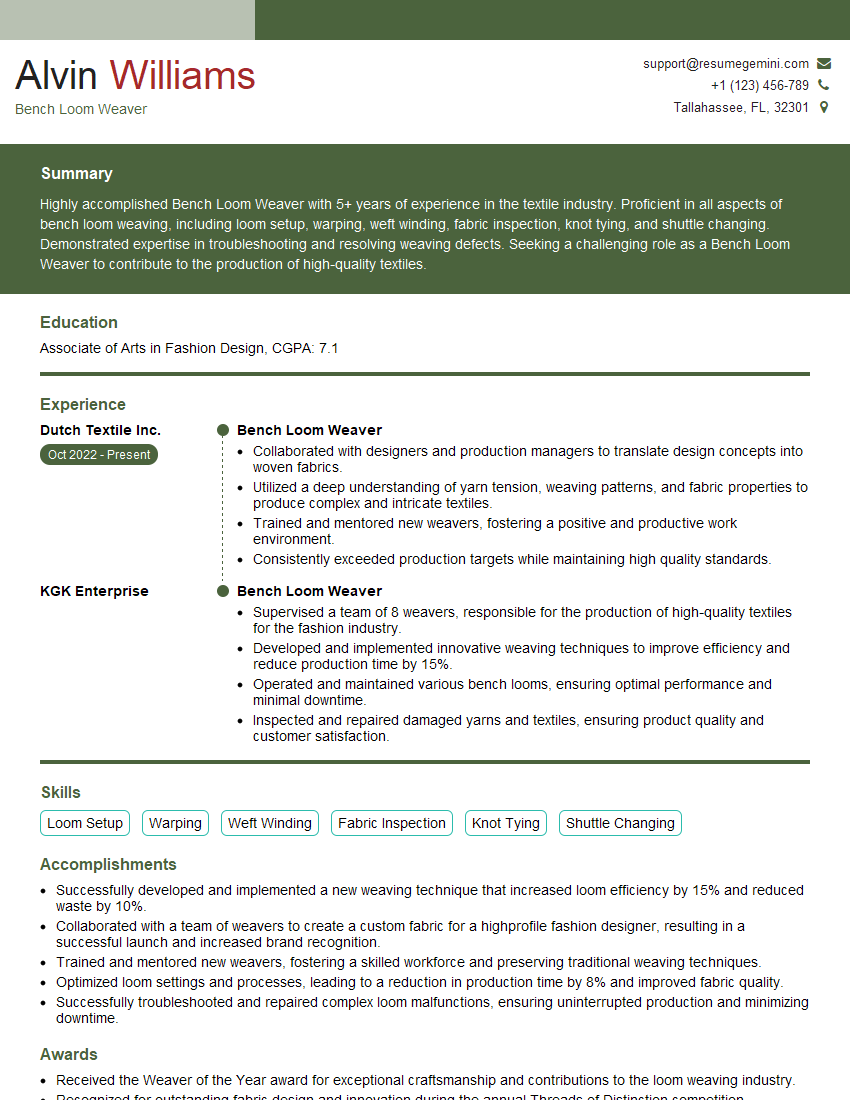
Are you gearing up for a career in Bench Loom Weaver? Feeling nervous about the interview questions that might come your way? Don’t worry, you’re in the right place. In this blog post, we’ll dive deep into the most common interview questions for Bench Loom Weaver and provide you with expert-backed answers. We’ll also explore the key responsibilities of this role so you can tailor your responses to showcase your perfect fit.
Acing the interview is crucial, but landing one requires a compelling resume that gets you noticed. Crafting a professional document that highlights your skills and experience is the first step toward interview success. ResumeGemini can help you build a standout resume that gets you called in for that dream job.






Essential Interview Questions For Bench Loom Weaver
1. Explain the process of setting up a bench loom for weaving?
To set up a bench loom for weaving, I follow these steps:
- Assemble the frame and tension the warp threads.
- Wind the weft yarn onto shuttles.
- Thread the shuttles through the warp threads.
- Adjust the beater to the correct position.
- Tie on the weft yarn and start weaving.
2. Describe the different types of weaves that can be created on a bench loom?
There are many different types of weaves that can be created on a bench loom, including:
Plain weave
- This is the simplest weave, where each weft thread passes over one warp thread and under the next.
Twill weave
- This weave creates a diagonal pattern by offsetting the weft threads by one warp thread on each row.
Satin weave
- This weave creates a smooth, shiny surface by floating the weft threads over several warp threads at a time.
3. What are the key factors to consider when selecting yarn for bench loom weaving?
When selecting yarn for bench loom weaving, I consider the following factors:
- Fiber content: Different fibers have different properties, such as strength, drape, and texture.
- Yarn weight: The thickness of the yarn will affect the appearance and drape of the fabric.
- Color: The color of the yarn will determine the color of the fabric.
- Texture: The texture of the yarn will affect the handfeel of the fabric.
4. How do you troubleshoot common problems that occur during bench loom weaving?
Common problems that occur during bench loom weaving include:
- Broken warp threads: These can be repaired by tying on a new thread.
- Dropped weft threads: These can be repaired by re-threading the shuttle and weaving in the loose end.
- Uneven tension: This can be corrected by adjusting the tension on the warp threads.
- Fabric defects: These can be caused by a variety of factors, such as incorrect threading or improper tension.
5. What are the safety precautions that should be taken when working with a bench loom?
When working with a bench loom, it is important to take the following safety precautions:
- Wear appropriate clothing and safety gear, such as safety glasses and gloves.
- Keep the work area clean and free of tripping hazards.
- Be aware of the location of the shuttle and other moving parts.
- Never reach into the loom while it is in operation.
- Unplug the loom before making any adjustments or repairs.
6. How do you maintain and care for a bench loom?
To care for a bench loom, I perform the following maintenance tasks:
- Clean the loom regularly with a soft brush or cloth.
- Oil the moving parts regularly to prevent wear and tear.
- Check the tension on the warp threads regularly and adjust as needed.
- Store the loom in a dry, cool place when not in use.
7. What are the advantages and disadvantages of using a bench loom for weaving?
Advantages:
- Bench looms are relatively portable and easy to set up.
- They are relatively inexpensive.
- They can be used to weave a wide variety of fabrics.
Disadvantages:
- Bench looms are not as fast as industrial looms.
- They require more skill to operate than industrial looms.
- They can only be used to weave small pieces of fabric.
8. What are your strengths and weaknesses as a bench loom weaver?
My strengths as a bench loom weaver include:
- I have a strong understanding of the principles of weaving.
- I am skilled at setting up and operating a bench loom.
- I am creative and have a good eye for design.
My weaknesses as a bench loom weaver include:
- I am not as fast as some other weavers.
- I am still learning some of the more advanced weaving techniques.
9. What are your career goals as a bench loom weaver?
My career goals as a bench loom weaver are to:
- Become a master weaver.
- Develop my own line of handwoven fabrics.
- Teach others how to weave.
10. What questions do you have for me about the position?
I am interested in learning more about the following:
- The company’s history and mission.
- The specific responsibilities of the position.
- The company’s expectations for the successful candidate.
- The company’s benefits package.
Interviewers often ask about specific skills and experiences. With ResumeGemini‘s customizable templates, you can tailor your resume to showcase the skills most relevant to the position, making a powerful first impression. Also check out Resume Template specially tailored for Bench Loom Weaver.
Career Expert Tips:
- Ace those interviews! Prepare effectively by reviewing the Top 50 Most Common Interview Questions on ResumeGemini.
- Navigate your job search with confidence! Explore a wide range of Career Tips on ResumeGemini. Learn about common challenges and recommendations to overcome them.
- Craft the perfect resume! Master the Art of Resume Writing with ResumeGemini’s guide. Showcase your unique qualifications and achievements effectively.
- Great Savings With New Year Deals and Discounts! In 2025, boost your job search and build your dream resume with ResumeGemini’s ATS optimized templates.
Researching the company and tailoring your answers is essential. Once you have a clear understanding of the Bench Loom Weaver‘s requirements, you can use ResumeGemini to adjust your resume to perfectly match the job description.
Key Job Responsibilities
Bench Loom Weavers are responsible for operating bench looms to create woven fabrics. They work with a variety of materials, including cotton, wool, silk, and linen, to produce a range of fabrics for use in clothing, upholstery, and other applications.
1. Set up and operate bench looms
Bench Loom Weavers are responsible for setting up and operating bench looms. This includes adjusting the loom’s tension, speed, and other settings to ensure that the fabric is woven correctly.
2. Thread the loom
Bench Loom Weavers must thread the loom with the appropriate yarn or thread. This is a delicate process that requires precision to ensure that the fabric is woven correctly.
3. Weave the fabric
Bench Loom Weavers use a variety of techniques to weave the fabric. They can use plain, twill, or satin weaves, and they can also use a variety of yarns to create different textures and colors.
4. Inspect the fabric
Bench Loom Weavers are responsible for inspecting the fabric to ensure that it meets quality standards. They look for defects such as holes, tears, and uneven weaving.
Interview Tips
Preparing thoroughly for a Bench Loom Weaver interview can significantly increase your chances of success. Below are some tips to help you ace the interview:
1. Research the company and position
Before the interview, take some time to research the company and the position to understand the company’s culture, values, and the specific requirements of the role.
2. Understand the key job responsibilities
Make sure you have a clear understanding of the key job responsibilities of a Bench Loom Weaver, as outlined in the job description. This will help you to tailor your answers to the interviewer’s questions and demonstrate your knowledge of the role.
3. Practice your answers
Take some time to practice answering common interview questions. This will help you to feel more confident and prepared during the interview.
4. Showcase your skills and experience
Highlight your skills and experience that are relevant to the position. For example, if you have experience with a specific type of loom or weaving technique, be sure to mention this in the interview.
5. Be enthusiastic and positive
Be enthusiastic and positive during the interview, and be sure to show your interest in the position. Your enthusiasm will help the interviewer to see that you are passionate about the work.
Next Step:
Armed with this knowledge, you’re now well-equipped to tackle the Bench Loom Weaver interview with confidence. Remember, preparation is key. So, start crafting your resume, highlighting your relevant skills and experiences. Don’t be afraid to tailor your application to each specific job posting. With the right approach and a bit of practice, you’ll be well on your way to landing your dream job. Build your resume now from scratch or optimize your existing resume with ResumeGemini. Wish you luck in your career journey!