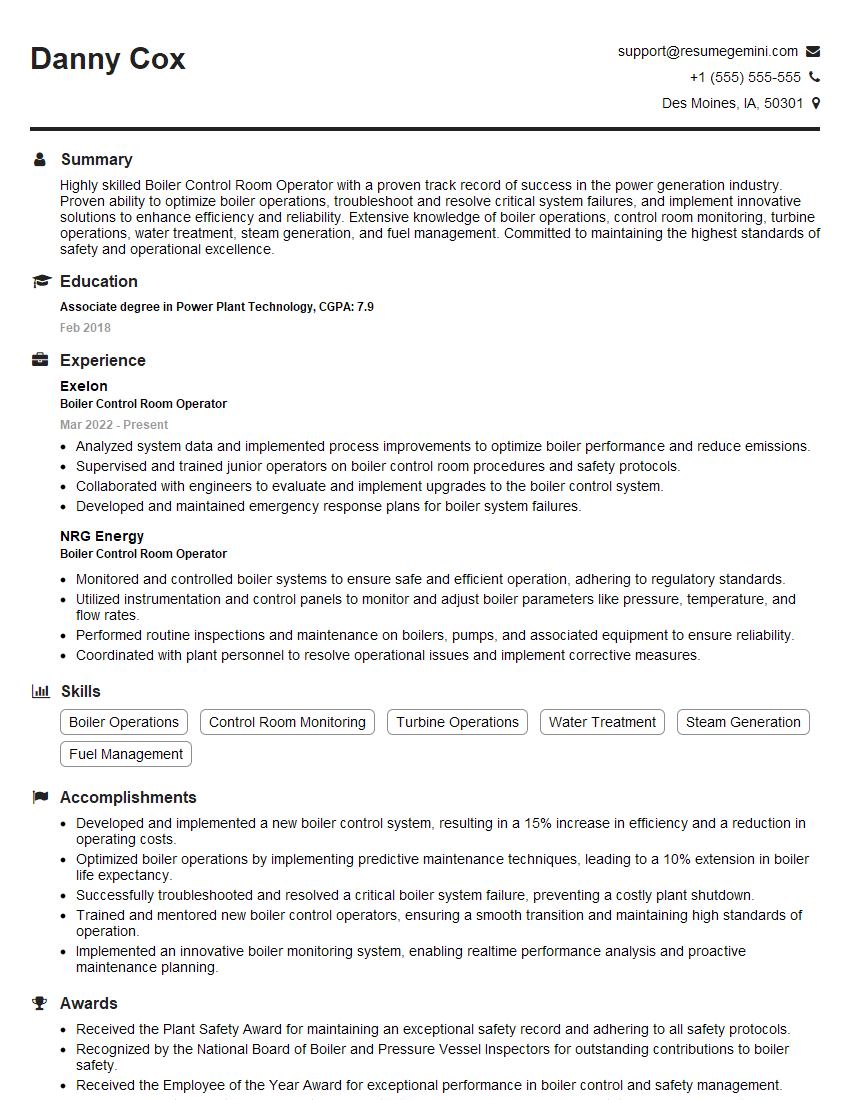
Are you gearing up for a career shift or aiming to ace your next interview? Look no further! We’ve curated a comprehensive guide to help you crack the interview for the coveted Boiler Control Room Operator position. From understanding the key responsibilities to mastering the most commonly asked questions, this blog has you covered. So, buckle up and let’s embark on this journey together
Acing the interview is crucial, but landing one requires a compelling resume that gets you noticed. Crafting a professional document that highlights your skills and experience is the first step toward interview success. ResumeGemini can help you build a standout resume that gets you called in for that dream job.






Essential Interview Questions For Boiler Control Room Operator
1. Explain the working principle of a boiler control system?
- A boiler control system maintains the desired steam pressure and temperature by regulating the fuel supply, airflow, and water level.
- It comprises sensors, controllers, and actuators that monitor and adjust system parameters.
- The system ensures efficient and safe boiler operation, preventing overheating or underheating.
2. Describe the different types of sensors used in boiler control systems?
Temperature sensors: Measure boiler temperature at various points (e.g., steam, water, flue gas).
Pressure sensors: Monitor steam pressure, water pressure, and flue gas pressure.
Flow sensors: Measure fuel flow, water flow, and air flow.
Level sensors: Determine water level in the boiler drum.
3. Explain the role of a programmable logic controller (PLC) in a boiler control system?
- A PLC is a computer-based controller that executes user-defined logic programs.
- In a boiler control system, the PLC receives inputs from sensors and controls outputs to actuators.
- It performs complex calculations, including PID control algorithms, to maintain desired system parameters.
4. Describe the process of tuning a PID controller for a boiler control system?
Proportional gain (Kp): Adjusts the control output proportionally to the error.
Integral gain (Ki): Eliminates steady-state error by accumulating the integral of the error.
Derivative gain (Kd): Anticipates future errors based on the rate of change of the error.
Tuning involves adjusting these gains to optimize system stability and response time.
5. Explain the importance of regular maintenance for boiler control systems?
- Ensures system reliability and prevents unexpected failures.
- Maintains optimal performance by calibrating sensors and cleaning actuators.
- Early detection of issues allows for proactive repairs, reducing downtime and costs.
6. Describe the safety features incorporated into boiler control systems?
- Low water cutoff: Shuts off the fuel supply if the water level falls below a critical point.
- High pressure cutoff: Trips the boiler if steam pressure exceeds safe limits.
- Flame failure protection: Monitors the presence of a flame and shuts off the fuel if it goes out.
7. Explain the environmental impact of boiler control systems?
- Optimize fuel efficiency, reducing CO2 emissions.
- Control flue gas emissions by adjusting air-to-fuel ratio, reducing NOx and SOx.
- Monitor and maintain boiler efficiency, minimizing energy consumption.
8. Describe the different types of fuel used in boilers and their impact on control strategies?
- Natural gas: Clean-burning fuel with low emissions, requires precise air-to-fuel ratio control.
- Coal: High-carbon fuel that produces ash and particulate matter, requires complex control strategies for combustion efficiency and emissions reduction.
- Biofuels: Renewable fuels that reduce carbon footprint, require adjustments to fuel handling and combustion control.
9. Explain the use of artificial intelligence (AI) in modern boiler control systems?
- Predictive maintenance: AI algorithms analyze sensor data to predict potential issues, enabling proactive maintenance.
- Adaptive control: AI-based controllers automatically adjust control parameters based on changing operating conditions, improving system efficiency.
- Fault detection and diagnostics: AI can detect and diagnose faults more accurately and quickly than traditional methods.
10. Describe your experience in troubleshooting and resolving common issues in boiler control systems?
- Sensor malfunctions: Diagnosed and replaced faulty sensors to restore accurate system monitoring.
- Controller failures: Troubleshooted and repaired controller issues, ensuring proper signal processing and output control.
- Actuator problems: Identified and replaced faulty actuators to maintain the desired boiler parameters.
Interviewers often ask about specific skills and experiences. With ResumeGemini‘s customizable templates, you can tailor your resume to showcase the skills most relevant to the position, making a powerful first impression. Also check out Resume Template specially tailored for Boiler Control Room Operator.
Career Expert Tips:
- Ace those interviews! Prepare effectively by reviewing the Top 50 Most Common Interview Questions on ResumeGemini.
- Navigate your job search with confidence! Explore a wide range of Career Tips on ResumeGemini. Learn about common challenges and recommendations to overcome them.
- Craft the perfect resume! Master the Art of Resume Writing with ResumeGemini’s guide. Showcase your unique qualifications and achievements effectively.
- Great Savings With New Year Deals and Discounts! In 2025, boost your job search and build your dream resume with ResumeGemini’s ATS optimized templates.
Researching the company and tailoring your answers is essential. Once you have a clear understanding of the Boiler Control Room Operator‘s requirements, you can use ResumeGemini to adjust your resume to perfectly match the job description.
Key Job Responsibilities
Boiler Control Room Operators are responsible for the safe and efficient operation of boilers and associated equipment in power plants, industrial facilities, and other settings. Some of the key responsibilities of a Boiler Control Room Operator include:
1. Monitoring and controlling boiler operations
Monitor boiler performance and make necessary adjustments to maintain optimal operating conditions. Control boiler fuel flow, air flow, and other parameters to ensure efficient combustion and steam generation.
- Maintain proper boiler water level, pressure, and temperature.
- Monitor and adjust boiler feedwater chemistry to prevent corrosion and scale formation.
2. Troubleshooting and resolving boiler issues
Identify and resolve boiler problems quickly and efficiently. Troubleshoot boiler malfunctions, such as leaks, equipment failures, and process upsets.
- Perform maintenance and repairs on boiler equipment, including pumps, valves, and controls.
- Coordinate with maintenance personnel to resolve more complex boiler issues.
3. Maintaining a safe work environment
Follow established safety procedures and protocols to ensure a safe work environment in the boiler control room and surrounding areas.
- Monitor and respond to boiler alarms, including high-pressure, low-water, and fire alarms.
- Train and supervise other boiler operators on safety procedures.
4. Maintaining records and documentation
Maintain accurate records of boiler operations, including data on fuel consumption, steam generation, and maintenance activities.
- Prepare reports and logs on boiler performance and maintenance.
- Participate in regular inspections and audits to ensure compliance with safety and environmental regulations.
Interview Tips
Preparing for an interview for a Boiler Control Room Operator position can increase your chances of success. Here are some tips on how to ace the interview:
1. Research the company and position
Gain insights into the company’s culture, values, and operations. Research the specific job responsibilities and requirements, and tailor your answers to demonstrate how your skills and experience align with the position.
- Visit the company’s website and LinkedIn page to learn about their mission, vision, and recent projects.
- Identify keywords in the job description and highlight your relevant skills and experience in your resume and during the interview.
2. Practice answering common interview questions
Practice answering common interview questions related to boiler operations, troubleshooting, and safety. Prepare examples from your previous experience that showcase your abilities and problem-solving skills.
- Describe a situation where you successfully resolved a boiler malfunction.
- Explain how you would respond to a boiler alarm indicating high-pressure.
3. Emphasize safety and attention to detail
Boiler Control Room Operators are responsible for ensuring the safe and efficient operation of boilers, so it’s crucial to emphasize your commitment to safety and attention to detail during the interview.
- Provide examples of how you maintained a safe work environment and followed safety protocols.
- Explain how you ensure accuracy in monitoring and controlling boiler operations.
4. Show enthusiasm and willingness to learn
Express your enthusiasm for the role and the industry. Demonstrate your willingness to learn and adapt to new technologies and operating procedures.
- Inquire about the company’s investment in training and development for boiler operators.
- Share your passion for problem-solving and continuous improvement in boiler operations.
Next Step:
Now that you’re armed with the knowledge of Boiler Control Room Operator interview questions and responsibilities, it’s time to take the next step. Build or refine your resume to highlight your skills and experiences that align with this role. Don’t be afraid to tailor your resume to each specific job application. Finally, start applying for Boiler Control Room Operator positions with confidence. Remember, preparation is key, and with the right approach, you’ll be well on your way to landing your dream job. Build an amazing resume with ResumeGemini