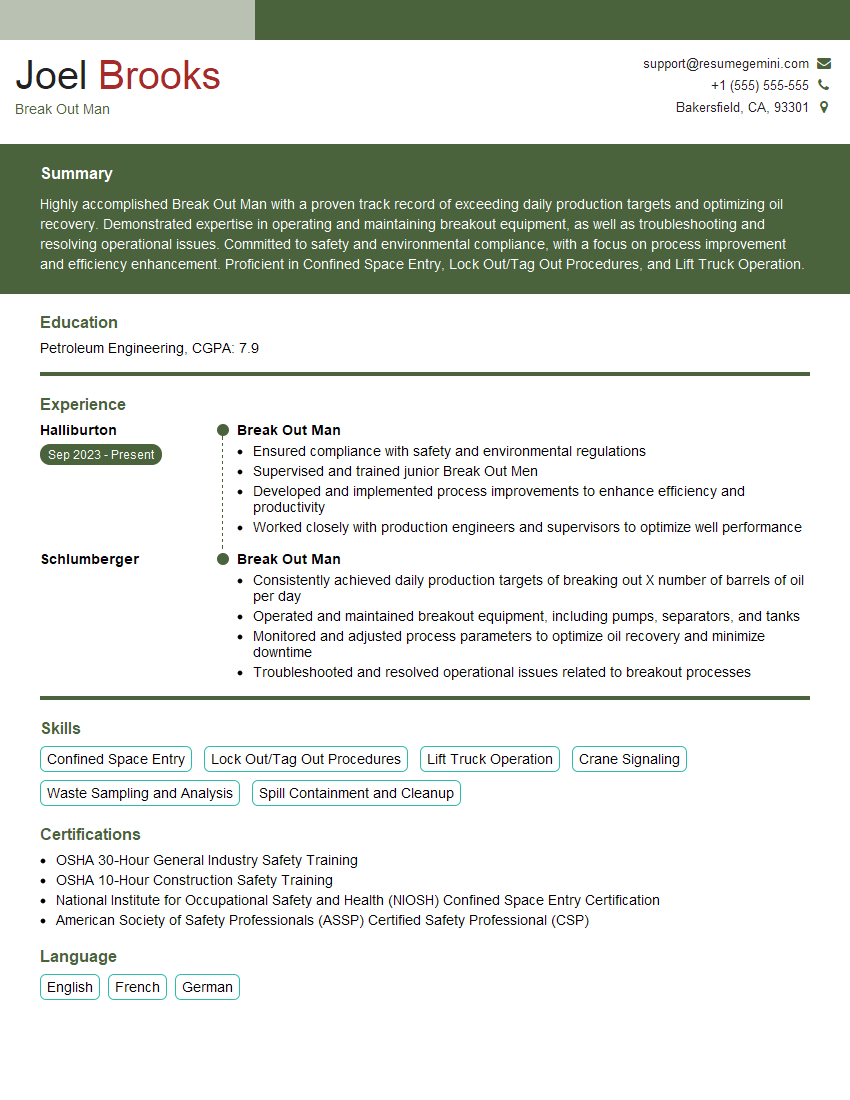
Are you gearing up for an interview for a Break Out Man position? Whether you’re a seasoned professional or just stepping into the role, understanding what’s expected can make all the difference. In this blog, we dive deep into the essential interview questions for Break Out Man and break down the key responsibilities of the role. By exploring these insights, you’ll gain a clearer picture of what employers are looking for and how you can stand out. Read on to equip yourself with the knowledge and confidence needed to ace your next interview and land your dream job!
Acing the interview is crucial, but landing one requires a compelling resume that gets you noticed. Crafting a professional document that highlights your skills and experience is the first step toward interview success. ResumeGemini can help you build a standout resume that gets you called in for that dream job.






Essential Interview Questions For Break Out Man
1. Explain the concept of breakpoint and how it is used to control the layout of a web page.
- A breakpoint is a specific screen width at which the layout of a web page changes.
- Breakpoints are used to create responsive web designs that adjust to different screen sizes, such as desktop, tablet, and mobile.
- By defining breakpoints, developers can control how the page elements are positioned, sized, and displayed at different screen widths.
2. Describe the role of CSS media queries in implementing responsive layouts.
Media Queries
- CSS media queries allow developers to define styles that apply only when certain conditions are met, such as the screen width being within a specific range.
- Using media queries, developers can create custom styles for different screen sizes and device types.
Implementing Responsive Layouts
- Media queries are essential for implementing responsive layouts because they enable developers to tailor the page’s appearance and behavior based on the device’s screen size.
- By defining media queries for different breakpoints, developers can ensure that the page is optimized for the user’s device.
3. Explain the difference between flexbox and grid for creating layouts.
- Flexbox (Flexible Box Layout) is a one-dimensional layout system that allows for flexible distribution of space among items.
- Grid is a two-dimensional layout system that provides more control over the placement and alignment of items.
- Flexbox is suitable for creating simple layouts with one-dimensional alignment, while Grid is more appropriate for complex layouts that require precise control over both horizontal and vertical axes.
4. Describe the use of CSS variables for managing design tokens.
- CSS variables allow developers to define custom properties that can be used throughout the stylesheet.
- Design tokens are reusable design elements, such as colors, fonts, and spacing, that are used to maintain consistency across a project.
- By storing design tokens as CSS variables, developers can easily update and maintain them in a centralized location, ensuring consistency across the entire project.
5. Explain the concept of performance optimization and describe some techniques used to improve website performance.
- Performance optimization is the process of improving the speed and responsiveness of a website.
- Techniques for performance optimization include:
- Optimizing images
- Minifying code
- Using caching
- Reducing HTTP requests
- Implementing lazy loading
6. Describe the principles of accessibility and how they can be implemented in web development.
- Accessibility ensures that websites are accessible and usable by individuals with disabilities.
- Principles of accessibility include:
- Providing alternative text for images
- Using semantic HTML elements
- Ensuring keyboard accessibility
- Providing closed captions for videos
7. Explain the importance of version control systems (VCS) and describe the benefits of using them in web development.
- VCSs (e.g., Git, SVN) allow developers to track and manage changes to code over time.
- Benefits of using VCSs include:
- Collaboration: Multiple developers can work on the same codebase simultaneously.
- Version control: Changes to the code are tracked, allowing developers to revert to previous versions if needed.
- Code history: VCSs provide a detailed history of all changes made to the code, which can be useful for debugging and maintenance.
8. Describe the concept of progressive enhancement and explain how it can be applied in web development.
- Progressive enhancement is a development approach that prioritizes providing a basic user experience on all browsers and devices, while gradually enhancing the experience for browsers that support more advanced features.
- Benefits of progressive enhancement:
- Increased accessibility: Ensures that all users have a usable experience regardless of their browser or device.
- Improved performance: Focuses on delivering essential content and functionality first, which can improve page load times.
- Future-proofing: Accommodates future browser advancements without breaking the experience for older browsers.
9. Explain the concept of cross-browser compatibility and describe techniques for ensuring that websites work consistently across different browsers.
- Cross-browser compatibility ensures that a website functions as intended across a variety of browsers.
- Techniques for cross-browser compatibility:
- Testing on multiple browsers
- Using cross-browser testing tools
- Adopting browser-specific prefixes for CSS properties
- Polyfilling missing features in older browsers
10. Describe the importance of continuous integration (CI) and continuous delivery (CD) in web development.
Continuous Integration (CI)
- CI automates the process of building, testing, and merging code changes into a central repository.
- CI tools run tests on every code change, ensuring that the codebase is always in a buildable and testable state.
Continuous Delivery (CD)
- CD automates the process of deploying code changes to production.
- CD tools can be configured to automatically deploy code changes to the production environment after passing all necessary tests.
Benefits of CI/CD
- Improved code quality
- Faster and more reliable deployments
- Reduced risk of production issues
Interviewers often ask about specific skills and experiences. With ResumeGemini‘s customizable templates, you can tailor your resume to showcase the skills most relevant to the position, making a powerful first impression. Also check out Resume Template specially tailored for Break Out Man.
Career Expert Tips:
- Ace those interviews! Prepare effectively by reviewing the Top 50 Most Common Interview Questions on ResumeGemini.
- Navigate your job search with confidence! Explore a wide range of Career Tips on ResumeGemini. Learn about common challenges and recommendations to overcome them.
- Craft the perfect resume! Master the Art of Resume Writing with ResumeGemini’s guide. Showcase your unique qualifications and achievements effectively.
- Great Savings With New Year Deals and Discounts! In 2025, boost your job search and build your dream resume with ResumeGemini’s ATS optimized templates.
Researching the company and tailoring your answers is essential. Once you have a clear understanding of the Break Out Man‘s requirements, you can use ResumeGemini to adjust your resume to perfectly match the job description.
Key Job Responsibilities
Break Out Men are responsible for carrying out a variety of tasks related to the production process in a manufacturing or industrial setting. They may work in a variety of industries, including automotive, aerospace, electronics, and food processing.
1. Material Handling
Break Out Men are responsible for moving and handling materials throughout the production process. This may involve loading and unloading trucks, moving materials between workstations, and feeding materials into production machines.
- Loading and unloading trucks
- Moving materials between workstations
- Feeding materials into production machines
2. Machine Operation
Break Out Men may also be responsible for operating production machines. This may involve setting up machines, monitoring their operation, and troubleshooting any problems that may occur.
- Setting up machines
- Monitoring machine operation
- Troubleshooting problems
3. Inspection and Quality Control
Break Out Men may also be responsible for inspecting and checking the quality of products. This may involve visually inspecting products, checking dimensions and tolerances, and testing products for functionality.
- Visually inspecting products
- Checking dimensions and tolerances
- Testing products for functionality
4. Maintenance and Repair
Break Out Men may also be responsible for performing basic maintenance and repairs on production equipment. This may involve cleaning and lubricating machines, replacing parts, and making minor adjustments.
- Cleaning and lubricating machines
- Replacing parts
- Making minor adjustments
Interview Tips
To help you prepare for your interview for a Break Out Man position, here are a few tips:
1. Research the company and the position
Take some time to learn about the company you’re applying to and the specific position you’re interested in. This will help you understand the company’s culture and values, as well as the specific skills and experience they’re looking for in a Break Out Man.
- Visit the company’s website
- Read articles about the company
- Talk to people who work for the company
2. Practice answering common interview questions
There are a number of common interview questions that you’re likely to be asked, such as “Tell me about yourself” and “Why are you interested in this position?” It’s a good idea to practice answering these questions in advance so that you can deliver your answers confidently and concisely.
- Use the STAR method to answer behavioral questions
- Be specific and provide examples
- Tailor your answers to the job description
3. Be prepared to talk about your experience and skills
The interviewer will want to know about your experience and skills as a Break Out Man. Be sure to highlight your experience in material handling, machine operation, inspection and quality control, and maintenance and repair.
- Quantify your experience whenever possible
- Use action verbs to describe your skills
- Be enthusiastic and passionate about your work
4. Be prepared to ask questions
Asking questions at the end of an interview shows that you’re interested in the position and the company. It also gives you an opportunity to learn more about the company and the position.
- Ask about the company’s culture
- Ask about the company’s growth plans
- Ask about the specific challenges of the position
Next Step:
Now that you’re armed with a solid understanding of what it takes to succeed as a Break Out Man, it’s time to turn that knowledge into action. Take a moment to revisit your resume, ensuring it highlights your relevant skills and experiences. Tailor it to reflect the insights you’ve gained from this blog and make it shine with your unique qualifications. Don’t wait for opportunities to come to you—start applying for Break Out Man positions today and take the first step towards your next career milestone. Your dream job is within reach, and with a polished resume and targeted applications, you’ll be well on your way to achieving your career goals! Build your resume now with ResumeGemini.