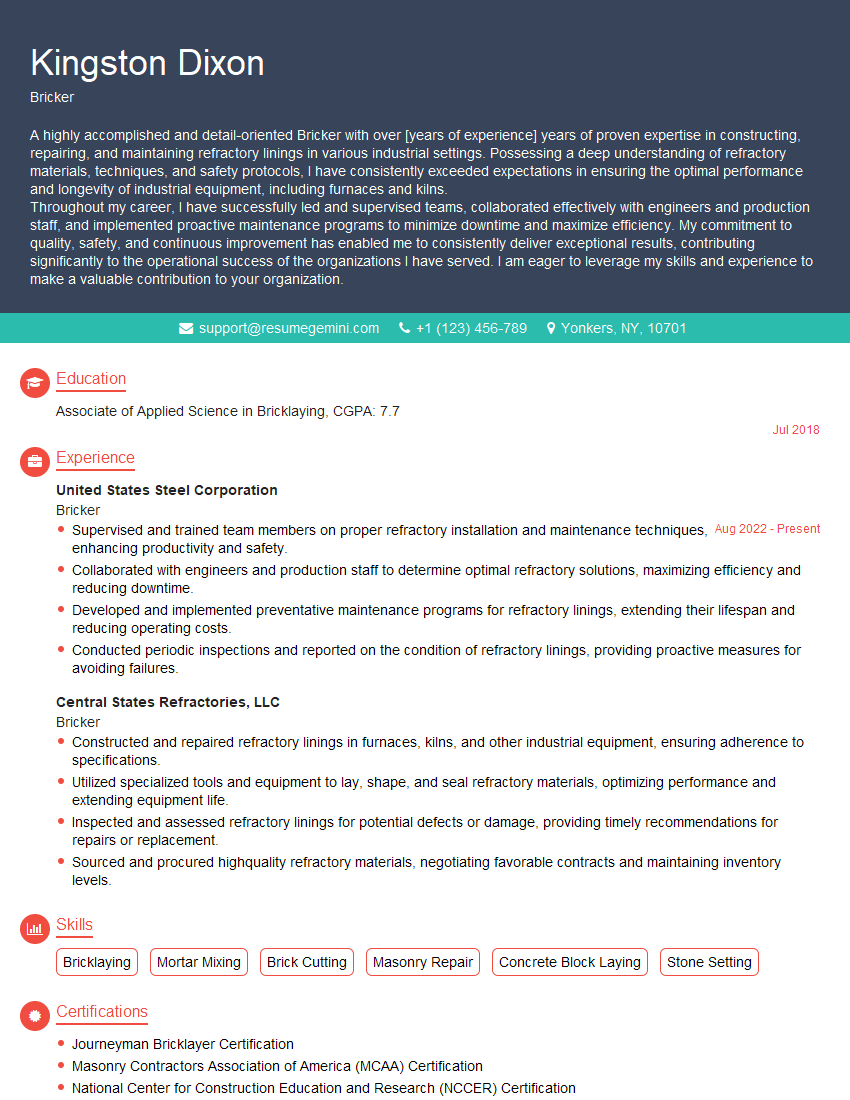
Are you gearing up for a career in Bricker? Feeling nervous about the interview questions that might come your way? Don’t worry, you’re in the right place. In this blog post, we’ll dive deep into the most common interview questions for Bricker and provide you with expert-backed answers. We’ll also explore the key responsibilities of this role so you can tailor your responses to showcase your perfect fit.
Acing the interview is crucial, but landing one requires a compelling resume that gets you noticed. Crafting a professional document that highlights your skills and experience is the first step toward interview success. ResumeGemini can help you build a standout resume that gets you called in for that dream job.






Essential Interview Questions For Bricker
1. Tell me about your experience with data mining and machine learning techniques?
answer the questiom here in detail and mention points using ul tag as done below
- I have experience with a variety of data mining and machine learning techniques, including supervised and unsupervised learning, feature engineering, and model evaluation.
- I have used these techniques to develop models for a variety of tasks, including fraud detection, customer churn prediction, and anomaly detection.
2. How would you approach a problem of high dimensionality where the number of features is much larger than the number of samples?
Feature Selection
- I would use feature selection techniques to reduce the number of features and select the most informative ones.
- I would use techniques such as filter methods (e.g., correlation analysis, information gain), wrapper methods (e.g., forward/backward selection), and embedded methods (e.g., L1/L2 regularization).
Dimensionality Reduction
- I would use dimensionality reduction techniques to reduce the number of features and create a new set of features that are more suitable for the task.
- I would use techniques such as principal component analysis (PCA), singular value decomposition (SVD), and t-distributed stochastic neighbor embedding (t-SNE).
3. How do you handle missing data in your machine learning models?
- I use a variety of techniques to handle missing data in my machine learning models, depending on the nature of the data and the task at hand.
- If the missing data is a small percentage of the overall data, I may simply remove the missing values.
- If the missing data is a larger percentage of the overall data, I may use imputation techniques to estimate the missing values.
- I may also use machine learning algorithms that are designed to handle missing data, such as missing value imputation models or multiple imputation.
4. Can you tell me how would you evaluate the performance of a machine learning model?
- I use a variety of metrics to evaluate the performance of my machine learning models, depending on the task at hand.
- For classification tasks, I may use metrics such as accuracy, precision, recall, and F1-score.
- For regression tasks, I may use metrics such as mean squared error, root mean squared error, and mean absolute error.
- I may also use other metrics, such as the area under the receiver operating characteristic curve (AUC-ROC) or the area under the precision-recall curve (AUC-PR), to evaluate the performance of my models.
5. Can you describe the strengths and weaknesses of the following machine learning algorithms: decision trees, random forests, and support vector machines?
Decision Trees
Strengths:
- Easy to interpret and understand.
- Can handle both categorical and numerical data.
Weaknesses:
- Can be unstable and sensitive to changes in the data.
- Can overfit the data.
Random Forests
Strengths:
- More stable and less prone to overfitting than decision trees.
- Can handle both categorical and numerical data.
Weaknesses:
- Can be more computationally expensive than decision trees.
- Can be difficult to interpret and understand.
Support Vector Machines
Strengths:
- Powerful and effective for classification and regression tasks.
- Can handle both categorical and numerical data.
Weaknesses:
- Can be computationally expensive for large datasets.
- Can be difficult to interpret and understand.
6. What is your favorite machine learning algorithm and why?
- My favorite machine learning algorithm is the random forest algorithm.
- I like the random forest algorithm because it is a powerful and versatile algorithm that can be used for a variety of tasks, including classification, regression, and unsupervised learning.
- I also like the random forest algorithm because it is relatively easy to understand and implement.
7. What are some of the challenges you have faced in your machine learning projects?
- One of the biggest challenges I have faced in my machine learning projects is dealing with missing data.
- Missing data can be a problem for machine learning algorithms because it can make it difficult to learn the underlying patterns in the data.
- Another challenge I have faced is dealing with high-dimensional data.
- High-dimensional data can be a problem for machine learning algorithms because it can make it difficult to find the most informative features and build accurate models.
8. What are some of the latest trends in machine learning?
- One of the latest trends in machine learning is the use of deep learning.
- Deep learning algorithms are powerful and can be used to solve a variety of problems, including image recognition, natural language processing, and speech recognition.
- Another trend in machine learning is the use of reinforcement learning.
- Reinforcement learning algorithms are able to learn from their mistakes and improve their performance over time.
9. What are your career goals?
- My career goal is to become a machine learning engineer.
- I want to use my skills to develop machine learning solutions that can solve real-world problems.
- I am particularly interested in using machine learning to improve the healthcare and education sectors.
10. Why do you want to work for our company?
- I am excited about the opportunity to work for your company because of your commitment to innovation and your focus on using machine learning to solve real-world problems.
- I believe that my skills and experience would be a valuable asset to your team, and I am eager to contribute to your company’s success.
Interviewers often ask about specific skills and experiences. With ResumeGemini‘s customizable templates, you can tailor your resume to showcase the skills most relevant to the position, making a powerful first impression. Also check out Resume Template specially tailored for Bricker.
Career Expert Tips:
- Ace those interviews! Prepare effectively by reviewing the Top 50 Most Common Interview Questions on ResumeGemini.
- Navigate your job search with confidence! Explore a wide range of Career Tips on ResumeGemini. Learn about common challenges and recommendations to overcome them.
- Craft the perfect resume! Master the Art of Resume Writing with ResumeGemini’s guide. Showcase your unique qualifications and achievements effectively.
- Great Savings With New Year Deals and Discounts! In 2025, boost your job search and build your dream resume with ResumeGemini’s ATS optimized templates.
Researching the company and tailoring your answers is essential. Once you have a clear understanding of the Bricker‘s requirements, you can use ResumeGemini to adjust your resume to perfectly match the job description.
Key Job Responsibilities
As a Bricker, you will be involved in the construction of various structures using bricks and other materials.
1. Bricklaying
You will be responsible for laying bricks in walls, columns, arches, and other structures according to blueprints and specifications.
- Setting up scaffolding and laying out bricks according to plans
- Mixing and applying mortar between bricks to create a strong bond
- Ensuring that bricks are laid level, plumb, and in a uniform pattern
2. Masonry Repair
You may also be tasked with repairing existing brick structures, such as repairing cracks, replacing damaged bricks, and repointing mortar joints.
- Inspecting brickwork for damage and determining the cause
- Removing damaged or loose bricks and replacing them with new ones
- Applying new mortar to repoint joints and seal cracks
3. Concrete Work
In addition to bricklaying, you may also be involved in pouring and finishing concrete, such as for foundations, slabs, and curbs.
- Preparing concrete mix and pouring it into forms
- Smoothing and finishing concrete surfaces to create a level and durable finish
- Stripping forms once the concrete has set
4. Other Related Tasks
Other duties may include:
- Cleaning and maintaining equipment
- Assisting with other construction tasks as needed
- Ensuring a safe and clean worksite
Interview Tips
To ace your interview for a Bricker position, it is crucial to demonstrate your skills and experience, as well as your passion for the trade.
1. Highlight Your Expertise
Make sure your resume and cover letter clearly showcase your bricklaying and masonry skills. Quantify your experience by providing specific examples of projects you have worked on and the techniques you used.
- Example: “I have 5 years of experience in bricklaying, including working on high-rise buildings, residential homes, and commercial properties. I am proficient in various bricklaying techniques, such as running bond, Flemish bond, and herringbone patterns.”
2. Research the Company and Industry
Take the time to learn about the company you are applying to and the construction industry as a whole. This will help you understand their needs and the current trends in the field.
- Example: If the company specializes in historical restoration, you might mention your interest in preserving architectural heritage and your knowledge of traditional bricklaying methods.
3. Practice Common Interview Questions
Prepare for common interview questions by practicing your answers beforehand. This will help you articulate your skills and experience confidently.
- Example: “Tell me about a time when you faced a challenge on a construction site and how you overcame it.”
- Answer: “On a recent project, we encountered a problem with the supply of bricks. I proactively contacted our suppliers and coordinated with our team to source alternative materials without delaying the project timeline.”
4. Ask Insightful Questions
Showing interest in the company and the position is essential. Prepare thoughtful questions to ask the interviewer during the interview.
- Example: “What are the company’s plans for future projects, and how can I contribute to them?”
5. Emphasize Safety and Quality
In the construction industry, safety and quality are paramount. Stress your commitment to maintaining a safe work environment and delivering high-quality workmanship.
- Example: “I strictly adhere to all safety regulations and take pride in delivering exceptional brickwork that meets or exceeds industry standards.”
Next Step:
Now that you’re armed with interview-winning answers and a deeper understanding of the Bricker role, it’s time to take action! Does your resume accurately reflect your skills and experience for this position? If not, head over to ResumeGemini. Here, you’ll find all the tools and tips to craft a resume that gets noticed. Don’t let a weak resume hold you back from landing your dream job. Polish your resume, hit the “Build Your Resume” button, and watch your career take off! Remember, preparation is key, and ResumeGemini is your partner in interview success.