Are you gearing up for a career in Buoy Tender? Feeling nervous about the interview questions that might come your way? Don’t worry, you’re in the right place. In this blog post, we’ll dive deep into the most common interview questions for Buoy Tender and provide you with expert-backed answers. We’ll also explore the key responsibilities of this role so you can tailor your responses to showcase your perfect fit.
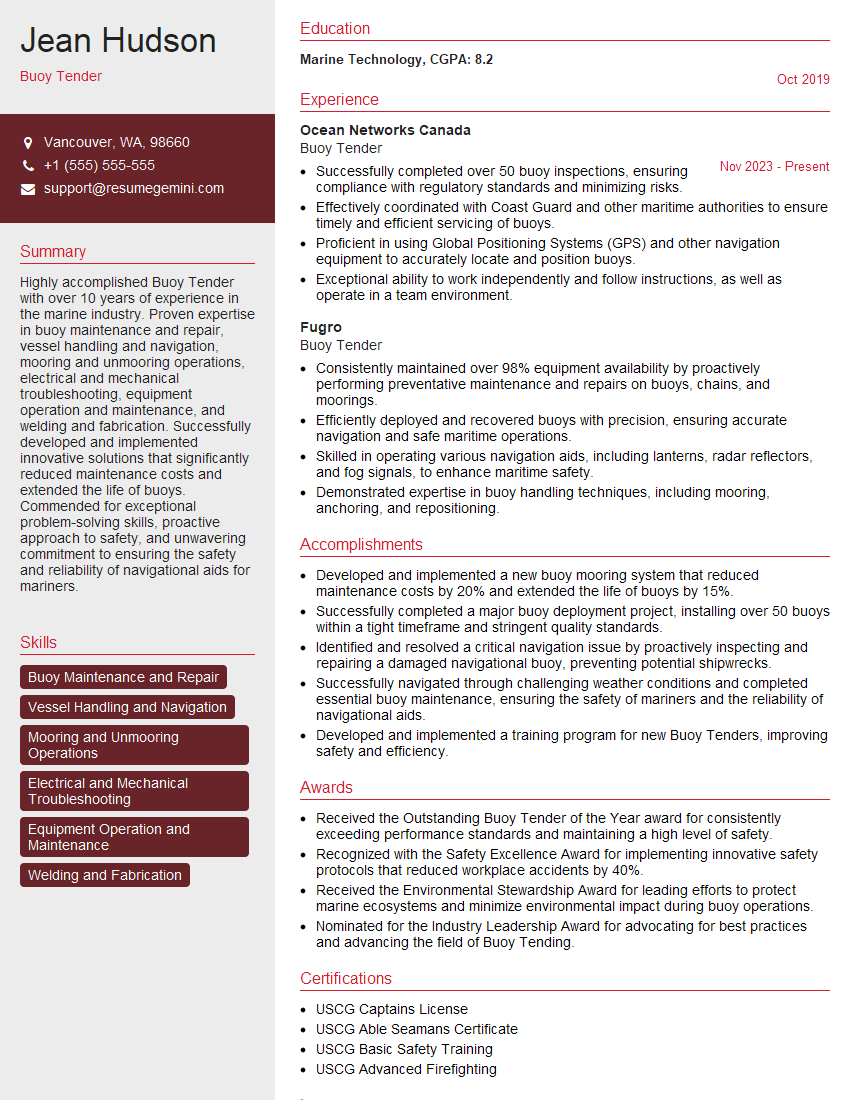
Acing the interview is crucial, but landing one requires a compelling resume that gets you noticed. Crafting a professional document that highlights your skills and experience is the first step toward interview success. ResumeGemini can help you build a standout resume that gets you called in for that dream job.






Essential Interview Questions For Buoy Tender
1. What is the role of a Buoy Tender, and what are some of the key responsibilities?
A Buoy Tender is responsible for maintaining navigational aids, such as buoys, lights, and beacons, to ensure the safe navigation of vessels in waterways. Key responsibilities include:
- Inspecting, repairing, and replacing buoys, lights, and beacons
- Setting and retrieving buoys and moorings
- Conducting surveys of waterways to identify navigational hazards
- Providing assistance to vessels in distress
- Enforcing navigation regulations
2. What are the different types of buoys used for navigational purposes?
Types of buoys
- Lateral buoys: Mark the sides of a channel or fairway
- Cardinal buoys: Indicate the safe side of an obstruction
- Isolated danger buoys: Mark isolated hazards, such as rocks or shoals
- Special purpose buoys: Used for various purposes, such as marking anchorages or restricted areas
3. What are the different types of lights used for navigational purposes?
Types of lights used for navigational purposes include:
- Leading lights: Aligned lights that guide vessels along a specific course
- Range lights: Paired lights used to determine a vessel’s distance from shore
- Sector lights: Lights that emit beams in specific sectors to mark hazards or indicate safe channels
- Flashing lights: Lights that emit a series of flashes to aid in identification and localization
4. What are the different types of beacons used for navigational purposes?
Types of beacons used for navigational purposes include:
- Radar beacons: Transmit radar signals to assist vessels in navigation
- Radio beacons: Transmit radio signals to aid in navigation and emergency communication
- Differential GPS beacons: Transmit corrections to improve the accuracy of GPS signals
- Automatic identification system (AIS) beacons: Transmit vessel information, including position, speed, and course
5. What are the different types of surveys conducted by Buoy Tenders?
Types of surveys conducted by Buoy Tenders include:
- Hydrographic surveys: Measure the depth and shape of the seabed
- Topographic surveys: Map the elevation and contours of land or seabed
- Geophysical surveys: Use geophysical methods to study the structure and properties of the seabed
- Biological surveys: Collect data on marine life and habitats
6. What are the different types of assistance provided by Buoy Tenders to vessels in distress?
Types of assistance provided by Buoy Tenders to vessels in distress include:
- Towing and salvage
- Search and rescue
- Medical assistance
- Communication and coordination with other emergency responders
7. What are the different types of navigation regulations enforced by Buoy Tenders?
Types of navigation regulations enforced by Buoy Tenders include:
- Speed limits
- Traffic separation schemes
- Anchorage regulations
- Environmental protection regulations
8. What are the different types of equipment used by Buoy Tenders to perform their duties?
Types of equipment used by Buoy Tenders to perform their duties include:
- Navigation systems
- Buoy handling equipment
- Hydrographic survey equipment
- Communication systems
- Emergency response equipment
9. What are the different types of safety procedures that must be followed by Buoy Tenders?
Types of safety procedures that must be followed by Buoy Tenders include:
- Workboat safety procedures
- Buoy handling safety procedures
- Hydrographic survey safety procedures
- Emergency response safety procedures
- Environmental protection safety procedures
10. What are the different types of training that Buoy Tenders must receive?
Types of training that Buoy Tenders must receive include:
- Navigation training
- Buoy handling training
- Hydrographic survey training
- Emergency response training
- Environmental protection training
Interviewers often ask about specific skills and experiences. With ResumeGemini‘s customizable templates, you can tailor your resume to showcase the skills most relevant to the position, making a powerful first impression. Also check out Resume Template specially tailored for Buoy Tender.
Career Expert Tips:
- Ace those interviews! Prepare effectively by reviewing the Top 50 Most Common Interview Questions on ResumeGemini.
- Navigate your job search with confidence! Explore a wide range of Career Tips on ResumeGemini. Learn about common challenges and recommendations to overcome them.
- Craft the perfect resume! Master the Art of Resume Writing with ResumeGemini’s guide. Showcase your unique qualifications and achievements effectively.
- Great Savings With New Year Deals and Discounts! In 2025, boost your job search and build your dream resume with ResumeGemini’s ATS optimized templates.
Researching the company and tailoring your answers is essential. Once you have a clear understanding of the Buoy Tender‘s requirements, you can use ResumeGemini to adjust your resume to perfectly match the job description.
Key Job Responsibilities
Buoy Tenders play a crucial role in ensuring the safe operation of waterways and navigation systems. Their primary responsibilities include maintaining, servicing, and repairing navigational buoys and other aids to navigation.
1. Buoy Maintenance and Repair
Conduct routine inspections and maintenance on buoys, including checking their lights, batteries, and moorings.
- Replace or repair damaged buoy components, such as lights, reflectors, and mooring chains.
- Clean and paint buoys to maintain their visibility and longevity.
2. Buoy Deployment and Recovery
Deploy new buoys or replace existing ones based on navigation charts and directives.
- Retrieve buoys that have drifted off their designated positions or need servicing.
- Ensure proper placement and mooring of buoys to provide accurate navigation information.
3. Aids to Navigation Maintenance
Inspect and maintain other aids to navigation, such as lighthouses, beacons, and fog signals.
- Replace bulbs, batteries, and other components as needed.
- Ensure the proper operation and synchronization of navigation aids.
4. Data Collection and Reporting
Document observations, maintenance, and repair activities on buoys and aids to navigation.
- Report any hazards or navigational issues to the appropriate authorities.
- Maintain accurate records for tracking maintenance schedules and buoy locations.
Interview Tips
To ace the interview for a Buoy Tender position, it’s essential to prepare thoroughly and showcase your qualifications and enthusiasm for the role.
1. Research the Company and Industry
Learn about the company’s mission, values, and specific responsibilities for the Buoy Tender position.
- Familiarize yourself with the company’s website and any relevant industry publications.
- Demonstrate your understanding of the importance of maintaining navigational aids for marine safety.
2. Highlight Your Technical Skills
Emphasize your proficiency in electrical, mechanical, and navigation systems related to buoys and aids to navigation.
- Provide examples of your experience in troubleshooting and repairing electrical and mechanical components.
- Share your knowledge of navigation charts, buoys, and other navigational aids.
3. Showcase Your Problem-Solving Abilities
Interviewers will be interested in your ability to solve problems and make decisions in challenging situations.
- Describe instances where you identified and resolved issues related to buoys or navigational aids.
- Emphasize your ability to work independently and make informed decisions when necessary.
4. Emphasize Your Physical Fitness and Endurance
The job of a Buoy Tender requires physical stamina and the ability to work in various weather conditions.
- Discuss your experience working on boats or in marine environments.
- Highlight your ability to perform physical tasks, such as lifting buoys and working in cramped spaces.
Next Step:
Now that you’re armed with a solid understanding of what it takes to succeed as a Buoy Tender, it’s time to turn that knowledge into action. Take a moment to revisit your resume, ensuring it highlights your relevant skills and experiences. Tailor it to reflect the insights you’ve gained from this blog and make it shine with your unique qualifications. Don’t wait for opportunities to come to you—start applying for Buoy Tender positions today and take the first step towards your next career milestone. Your dream job is within reach, and with a polished resume and targeted applications, you’ll be well on your way to achieving your career goals! Build your resume now with ResumeGemini.