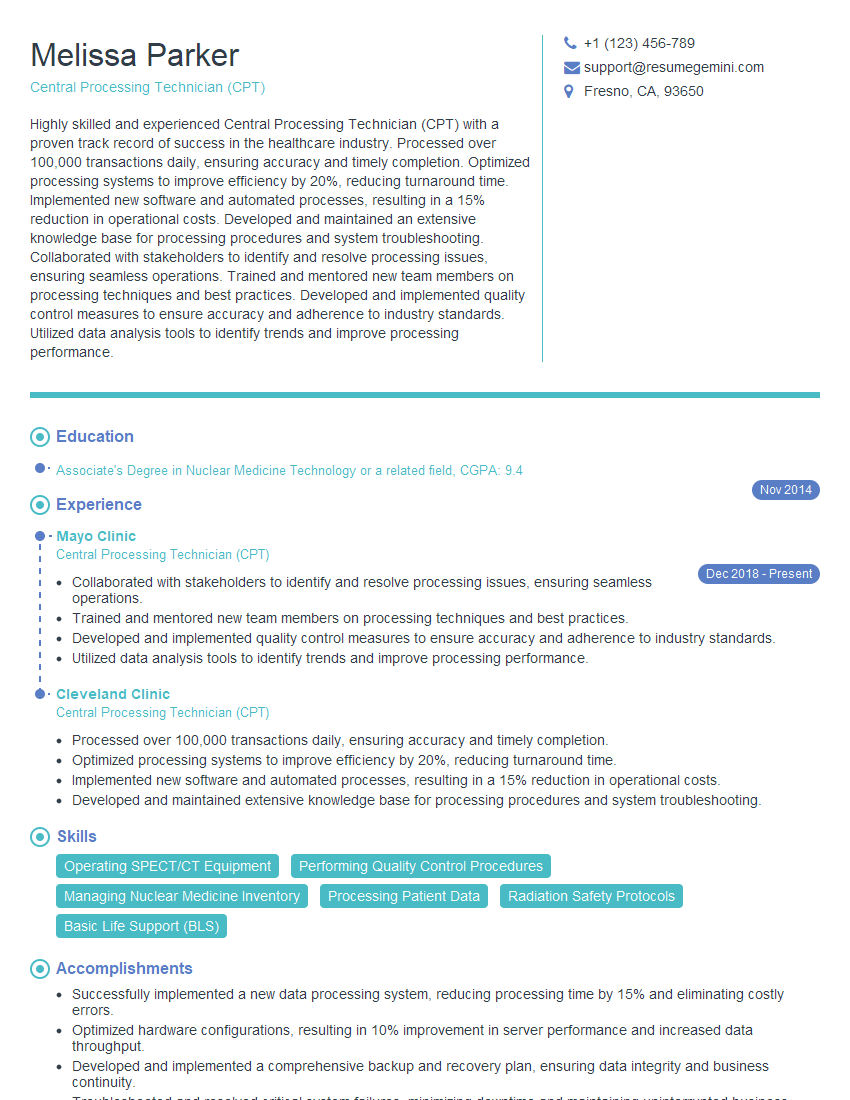
Ever felt underprepared for that crucial job interview? Or perhaps you’ve landed the interview but struggled to articulate your skills and experiences effectively? Fear not! We’ve got you covered. In this blog post, we’re diving deep into the Central Processing Technician (CPT) interview questions that you’re most likely to encounter. But that’s not all. We’ll also provide expert insights into the key responsibilities of a Central Processing Technician (CPT) so you can tailor your answers to impress potential employers.
Acing the interview is crucial, but landing one requires a compelling resume that gets you noticed. Crafting a professional document that highlights your skills and experience is the first step toward interview success. ResumeGemini can help you build a standout resume that gets you called in for that dream job.






Essential Interview Questions For Central Processing Technician (CPT)
1. Describe the troubleshooting process you follow when encountering a hardware issue?
- Identify the symptoms of the issue and gather information about the system.
- Inspect the hardware components visually for any loose connections or damage.
- Run diagnostic tests to pinpoint the faulty component.
- Replace or repair the faulty component and test the system to verify functionality.
- Document the steps taken and any relevant observations.
2. Explain the role of a central processing unit (CPU) in a computer system?
subheading of the answer
- Fetches and executes instructions from the memory.
- Performs arithmetic and logical operations.
- Controls the flow of data and instructions.
subheading of the answer
- Manages input and output devices.
- Acts as the central control unit of the system.
- Coordinates the activities of other components.
3. What are the different types of operating systems used in central processing systems and their key features?
- Windows: Widely used, user-friendly GUI, extensive software support.
- Linux: Open-source, highly customizable, suitable for servers and embedded systems.
- macOS: Proprietary OS for Apple devices, known for its stability and user experience.
- Unix: Multi-user, multitasking OS, used in high-performance computing and enterprise environments.
- Real-time operating systems (RTOS): Designed for systems requiring precise timing and deterministic behavior.
4. Describe the importance of data backup and recovery procedures for central processing systems?
- Protects data from loss due to hardware failures, software errors, or human mistakes.
- Ensures business continuity by restoring data in case of a disaster.
- Complies with data protection regulations and industry standards.
- Reduces downtime and minimizes financial losses associated with data loss.
- Provides peace of mind and confidence in the integrity of data.
5. What are the key performance indicators (KPIs) for measuring the efficiency of a central processing system?
- CPU utilization
- Memory usage
- Network bandwidth
- Disk I/O
- Response time
- Uptime
- Throughput
6. How do you monitor and maintain the health of a central processing system?
- Regularly check system logs and event viewers.
- Monitor performance metrics using performance monitoring tools.
- Perform proactive maintenance tasks, such as cleaning fans and updating firmware.
- Implement redundancy measures to minimize downtime.
- Follow best practices for data security and disaster recovery.
7. What are the emerging trends and advancements in central processing technology?
- Multi-core processors
- Cloud computing
- Virtualization
- Edge computing
- AI and machine learning
- Quantum computing
8. How do you stay updated on the latest technologies and best practices in central processing?
- Attend industry conferences and webinars.
- Read technical journals and online resources.
- Network with other professionals in the field.
- Pursue professional development opportunities.
- Stay informed about vendor announcements and product updates.
9. What is your experience in working with different types of central processing systems?
- Experience with various hardware architectures (x86, ARM, PowerPC)
- Experience with different operating systems (Windows, Linux, Unix)
- Experience with virtualization technologies (VMware, Hyper-V)
- Experience with cloud computing platforms (AWS, Azure, GCP)
- Experience with high-performance computing (HPC) systems
10. Describe a challenging situation you faced while working on a central processing system and how you resolved it?
- Identified a faulty memory module causing system crashes.
- Diagnosed a network bottleneck affecting application performance.
- Implemented a virtualization solution to improve resource utilization.
- Troubleshooted a software conflict causing system instability.
- Upgraded a system to a newer version of the operating system.
Interviewers often ask about specific skills and experiences. With ResumeGemini‘s customizable templates, you can tailor your resume to showcase the skills most relevant to the position, making a powerful first impression. Also check out Resume Template specially tailored for Central Processing Technician (CPT).
Career Expert Tips:
- Ace those interviews! Prepare effectively by reviewing the Top 50 Most Common Interview Questions on ResumeGemini.
- Navigate your job search with confidence! Explore a wide range of Career Tips on ResumeGemini. Learn about common challenges and recommendations to overcome them.
- Craft the perfect resume! Master the Art of Resume Writing with ResumeGemini’s guide. Showcase your unique qualifications and achievements effectively.
- Great Savings With New Year Deals and Discounts! In 2025, boost your job search and build your dream resume with ResumeGemini’s ATS optimized templates.
Researching the company and tailoring your answers is essential. Once you have a clear understanding of the Central Processing Technician (CPT)‘s requirements, you can use ResumeGemini to adjust your resume to perfectly match the job description.
Key Job Responsibilities
A Central Processing Technician (CPT) is responsible for processing, analyzing, and maintaining data for various business purposes. Their key responsibilities may include:
1. Data Processing and Management
Collecting, organizing, and validating data from multiple sources, including manual entry, automated systems, and electronic files.
- Ensuring data accuracy and completeness using data verification techniques.
- Maintaining and managing data storage systems, databases, and data warehouses.
2. Data Analysis and Reporting
Analyzing data using statistical and analytical tools to identify trends, patterns, and insights.
- Preparing reports, dashboards, and presentations to convey analysis results to stakeholders.
- Interpreting data and providing insights to inform decision-making processes.
3. Data Security and Compliance
Implementing and maintaining data security measures to protect sensitive information.
- Adhering to industry standards and regulations for data protection and privacy.
- Monitoring data access and usage to prevent unauthorized breaches or misuse.
4. Collaboration and Stakeholder Management
Interacting with various stakeholders, including business analysts, data scientists, and end-users, to gather requirements and provide support.
- Communicating technical concepts and analysis results to non-technical audiences.
- Providing training and support on data processing and analysis tools.
Interview Tips
To ace an interview for a Central Processing Technician position, consider the following tips:
1. Research the Company and Position
Thoroughly research the company’s industry, mission, and values. Understand the specific requirements and responsibilities of the CPT position.
- Review the job description and identify key skills and qualifications.
- Visit the company’s website and social media pages to learn more about their culture and recent initiatives.
2. Highlight Relevant Skills and Experience
Tailor your resume and cover letter to showcase your relevant skills and experience. Quantify your accomplishments using specific metrics whenever possible.
- Emphasize your proficiency in data processing tools and technologies.
- Highlight your ability to perform data analysis and draw meaningful insights.
3. Practice Answering Common Interview Questions
Prepare for common interview questions, such as:
- Tell me about your experience in data processing and analysis.
- How do you ensure data accuracy and integrity?
- How do you collaborate with stakeholders and translate technical concepts?
4. Prepare Questions for the Interviewer
Asking thoughtful questions demonstrates your interest in the position and the company. Consider asking about:
- The company’s data management strategy and goals.
- The specific data processing and analysis challenges the team faces.
- Opportunities for professional development and growth within the organization.
5. Dress Professionally and Arrive on Time
First impressions matter. Dress appropriately and arrive for your interview on time. Maintain a positive and enthusiastic attitude throughout the interview process.
Next Step:
Armed with this knowledge, you’re now well-equipped to tackle the Central Processing Technician (CPT) interview with confidence. Remember, a well-crafted resume is your first impression. Take the time to tailor your resume to highlight your relevant skills and experiences. And don’t forget to practice your answers to common interview questions. With a little preparation, you’ll be on your way to landing your dream job. So what are you waiting for? Start building your resume and start applying! Build an amazing resume with ResumeGemini.