Are you gearing up for a career in Cheese Grader? Feeling nervous about the interview questions that might come your way? Don’t worry, you’re in the right place. In this blog post, we’ll dive deep into the most common interview questions for Cheese Grader and provide you with expert-backed answers. We’ll also explore the key responsibilities of this role so you can tailor your responses to showcase your perfect fit.
Acing the interview is crucial, but landing one requires a compelling resume that gets you noticed. Crafting a professional document that highlights your skills and experience is the first step toward interview success. ResumeGemini can help you build a standout resume that gets you called in for that dream job.






Essential Interview Questions For Cheese Grader
1. What are the key factors to consider when selecting the right cheese grater?
- Type of cheese: Different cheeses have different textures and hardness, so the type of grater you choose will depend on the cheese you’re using.
- Size: Grater size is important to consider, especially if you’re working with large quantities of cheese.
- Material: Graters are typically made of stainless steel, plastic, or ceramic. Each material has its own advantages and disadvantages, so it’s important to choose the one that best suits your needs.
- Design: Some graters have multiple grating surfaces, while others have a more specialized design. Consider the types of grating you’ll be doing most often to choose the grater that’s right for you.
- Price: Graters range in price from a few dollars to several hundred dollars. Consider your budget and the features you need when making your purchase.
2. What are the different types of cheese graters?
Rotary graters
- Rotary graters are the most common type of grater. They consist of a cylindrical drum with sharp blades that rotate.
- Rotary graters are easy to use and can grate cheese quickly and efficiently.
- However, rotary graters can be difficult to clean, and they can’t be used to grate hard cheeses.
Box graters
- Box graters are a versatile type of grater that can be used to grate a variety of cheeses.
- Box graters have a flat surface with sharp blades that are arranged in different sizes.
- Box graters are easy to use and clean, and they can be used to grate both hard and soft cheeses.
Microplane graters
- Microplane graters are a type of zester that can be used to grate hard cheeses.
- Microplane graters have very sharp blades that are arranged in a fine mesh.
- Microplane graters are ideal for grating Parmesan cheese or other hard cheeses that need to be finely grated.
3. What are the benefits of using a cheese grater?
- Grated cheese melts more evenly than shredded cheese, which can improve the texture of your dishes.
- Grated cheese can be used to add flavor and texture to a variety of dishes, including pasta, pizza, and salads.
- Grated cheese can be used to make a variety of sauces and dips.
- Grating cheese yourself is often more economical than buying pre-shredded cheese.
4. What are the safety precautions to take when using a cheese grater?
- Always use a sharp grater. A dull grater will be more difficult to use and could cause you to injure yourself.
- Hold the cheese firmly against the grater. This will help to prevent the cheese from slipping and causing you to injure yourself.
- Be careful not to grate your fingers. Use the guard that is provided with the grater, or hold the cheese with a kitchen towel.
- Clean the grater thoroughly after each use. This will help to prevent the growth of bacteria.
5. What are the different ways to grate cheese?
- You can grate cheese using a rotary grater, a box grater, or a Microplane grater.
- The type of grater you use will depend on the type of cheese you’re grating and the desired results.
- To grate cheese using a rotary grater, simply insert the cheese into the feeding tube and turn the handle.
- To grate cheese using a box grater, hold the cheese against the grater and rub it back and forth.
- To grate cheese using a Microplane grater, hold the cheese against the grater and gently move it back and forth.
6. What are some tips for grating cheese?
- Use cold cheese. Cold cheese is easier to grate and will produce finer shreds.
- Grate cheese in a circular motion. This will help to prevent the cheese from sticking to the grater.
- Don’t over-grate the cheese. Over-grating the cheese will produce a mushy texture.
- Grate cheese over a plate or bowl. This will help to catch the grated cheese and prevent it from falling on the floor.
7. What are some common mistakes to avoid when grating cheese?
- Don’t use a dull grater. A dull grater will be more difficult to use and could cause you to injure yourself.
- Don’t hold the cheese too tightly against the grater. This can cause the cheese to stick to the grater and make it difficult to grate.
- Don’t over-grate the cheese. Over-grating the cheese will produce a mushy texture.
- Don’t grate cheese over a hot surface. This can cause the cheese to melt and make it difficult to grate.
8. What are some creative ways to use grated cheese?
- Use grated cheese to make a cheese sauce.
- Use grated cheese to make a cheese dip.
- Use grated cheese to make a cheese ball.
- Use grated cheese to make a cheese crust for a casserole.
- Use grated cheese to make a cheese filling for a sandwich or wrap.
9. What are some of the challenges of grating cheese?
- Grating cheese can be time-consuming, especially if you’re grating a large amount of cheese.
- Grated cheese can be messy, especially if you’re not careful.
- Grated cheese can be difficult to clean up, especially if it’s melted.
- Grated cheese can be dangerous, especially if you’re not careful and you cut yourself on the grater.
10. What are some of the benefits of grating cheese?
- Grated cheese melts more evenly than shredded cheese, which can improve the texture of your dishes.
- Grated cheese can be used to add flavor and texture to a variety of dishes, including pasta, pizza, and salads.
- Grated cheese can be used to make a variety of sauces and dips.
- Grating cheese yourself is often more economical than buying pre-shredded cheese.
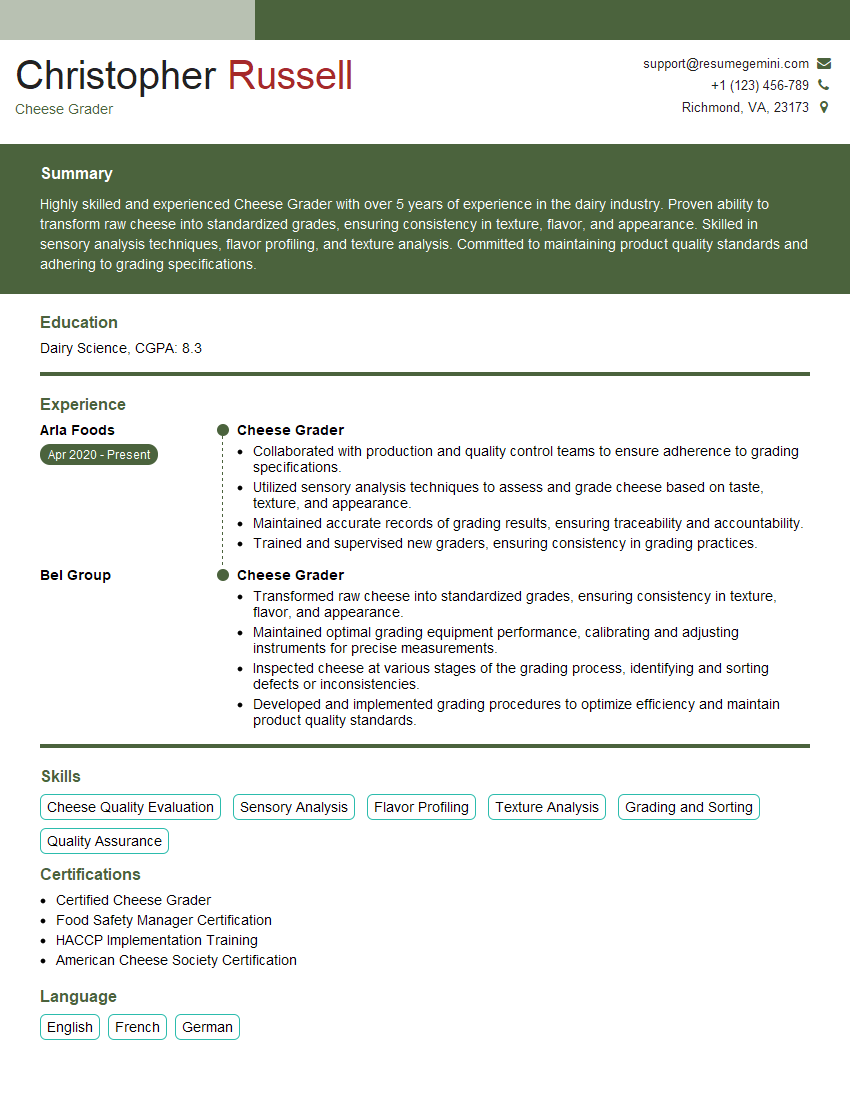
Interviewers often ask about specific skills and experiences. With ResumeGemini‘s customizable templates, you can tailor your resume to showcase the skills most relevant to the position, making a powerful first impression. Also check out Resume Template specially tailored for Cheese Grader.
Career Expert Tips:
- Ace those interviews! Prepare effectively by reviewing the Top 50 Most Common Interview Questions on ResumeGemini.
- Navigate your job search with confidence! Explore a wide range of Career Tips on ResumeGemini. Learn about common challenges and recommendations to overcome them.
- Craft the perfect resume! Master the Art of Resume Writing with ResumeGemini’s guide. Showcase your unique qualifications and achievements effectively.
- Great Savings With New Year Deals and Discounts! In 2025, boost your job search and build your dream resume with ResumeGemini’s ATS optimized templates.
Researching the company and tailoring your answers is essential. Once you have a clear understanding of the Cheese Grader‘s requirements, you can use ResumeGemini to adjust your resume to perfectly match the job description.
Key Job Responsibilities
Assessment of Cheese Quality
The Cheese Grader’s primary responsibility is to evaluate various types of cheese based on established quality standards. This involves carefully examining the cheese for visual characteristics, aroma, texture, and flavor. Their expertise enables them to identify defects and categorise cheese products accordingly.
- Inspect cheese for visual appearance, texture, aroma, and flavor
- Determine if the cheese meets or exceeds quality standards
- Grade cheese using standardized scales and criteria
- Provide detailed feedback on cheese quality to producers and buyers
Sampling and Testing
Cheese Graders also play a crucial role in sampling and testing cheese to ensure its safety and compliance with regulations. They collect samples, conduct sensory evaluations, and utilize scientific methods to assess the cheese’s composition and characteristics.
- Collect samples for sensory evaluation and laboratory testing
- Conduct sensory evaluations to assess cheese flavor, texture, and aroma
- Perform laboratory tests to determine cheese composition, moisture content, and pH levels
- Compile and interpret test results to ensure cheese meets safety and quality standards
Production Monitoring and Improvement
In addition to cheese grading and testing, Cheese Graders may also be involved in monitoring production processes and identifying areas for improvement. Their understanding of cheese quality and industry best practices makes them valuable contributors to enhancing cheese production efficiency and quality.
- Monitor cheese production processes to identify potential quality issues
- Provide feedback and recommendations to optimize cheese production techniques
- Collaborate with cheesemakers to develop and implement quality improvement programs
- Maintain up-to-date knowledge of industry regulations and best practices
Interview Tips
Research the Cheese Industry
Before attending an interview for a Cheese Grader position, it is essential to familiarize yourself with the cheese industry, including production methods, types of cheese, and cheese grading systems. Researching online, reading industry publications, and visiting cheese-making facilities can provide you with valuable insights.
- Read articles and books about cheese production and grading
- Attend industry events and conferences to connect with experts
- Visit cheese factories to observe cheese-making processes firsthand
Highlight Relevant Skills and Experience
In your resume and during the interview, emphasize your skills and experience that are relevant to cheese grading. These may include sensory evaluation abilities, knowledge of cheese quality standards, and experience in food science or related fields.
- Use specific examples to demonstrate your sensory evaluation skills
- Describe your understanding of cheese grading systems and standards
- Highlight any experience you have in cheese production or quality control
Emphasize Attention to Detail
Cheese grading requires meticulous attention to detail. In the interview, highlight your ability to carefully observe and evaluate cheese characteristics. Provide examples of situations where you demonstrated your precision and thoroughness in other roles.
- Explain how you ensure accuracy in your work
- Share examples of how you identified and addressed quality issues
- Describe your approach to maintaining objectivity and consistency in your evaluations
Be Prepared for Sensory Evaluation Tests
Many cheese grader interviews include a sensory evaluation test. Practice identifying different cheese flavors, textures, and aromas beforehand. Bring a pen and paper or a notepad to the interview to record your observations and impressions.
- Practice tasting and smelling different types of cheese
- Develop a vocabulary to describe cheese characteristics
- Bring a notepad to the interview for sensory evaluation notes
Next Step:
Now that you’re armed with interview-winning answers and a deeper understanding of the Cheese Grader role, it’s time to take action! Does your resume accurately reflect your skills and experience for this position? If not, head over to ResumeGemini. Here, you’ll find all the tools and tips to craft a resume that gets noticed. Don’t let a weak resume hold you back from landing your dream job. Polish your resume, hit the “Build Your Resume” button, and watch your career take off! Remember, preparation is key, and ResumeGemini is your partner in interview success.