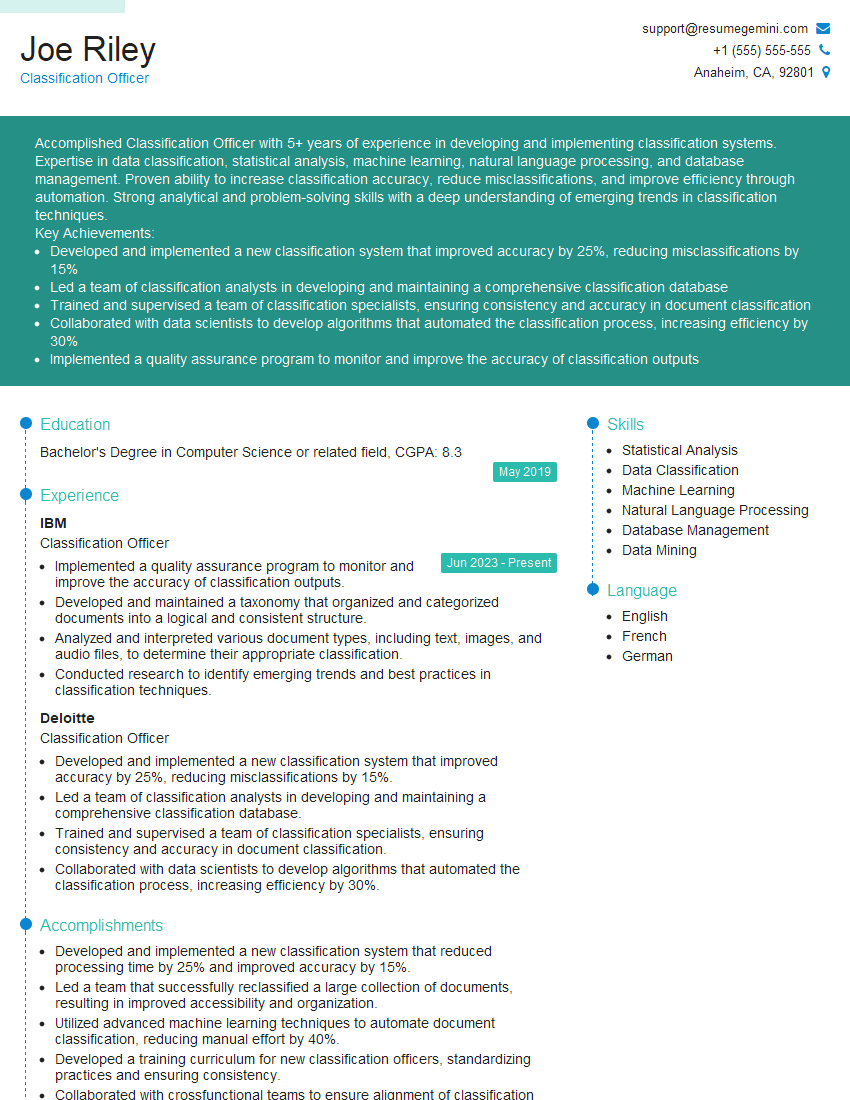
Are you gearing up for a career shift or aiming to ace your next interview? Look no further! We’ve curated a comprehensive guide to help you crack the interview for the coveted Classification Officer position. From understanding the key responsibilities to mastering the most commonly asked questions, this blog has you covered. So, buckle up and let’s embark on this journey together
Acing the interview is crucial, but landing one requires a compelling resume that gets you noticed. Crafting a professional document that highlights your skills and experience is the first step toward interview success. ResumeGemini can help you build a standout resume that gets you called in for that dream job.






Essential Interview Questions For Classification Officer
1. How do you stay updated with the latest classification techniques and best practices?
- Attend industry conferences and workshops to learn about new developments and trends.
- Read research papers and articles to stay abreast of the latest advances in machine learning and classification algorithms.
- Collaborate with other classification professionals to share knowledge and best practices.
- Take online courses or certification programs to enhance my skills and stay up-to-date with the latest technologies.
2. How do you approach a new classification project?
Understanding the Business Goals
- Identify the specific business objectives of the project.
- Gather requirements from stakeholders to understand the desired outcomes and performance metrics.
Data Collection and Exploration
- Determine the relevant data sources and collect the necessary data.
- Explore the data to identify patterns, trends, and potential features for classification.
Feature Engineering
- Extract and transform the data to create meaningful features for classification.
- Apply dimensionality reduction techniques to enhance model performance.
Model Selection and Evaluation
- Select appropriate classification algorithms based on the data and business requirements.
- Train and evaluate multiple models using cross-validation to ensure robustness.
Model Deployment and Monitoring
- Deploy the best-performing model into production.
- Monitor the model’s performance over time and make adjustments as needed.
3. What are the different types of classification errors and how can they be mitigated?
- False positive: Occurs when a sample is classified as positive when it is actually negative. Can be mitigated by adjusting the classification threshold or using more specific features.
- False negative: Occurs when a sample is classified as negative when it is actually positive. Can be mitigated by reducing the classification threshold or using more sensitive features.
- Precision: Measures the proportion of positive predictions that are correct. Can be improved by focusing on extracting more relevant features and using algorithms that minimize false positives.
- Recall: Measures the proportion of actual positives that are correctly predicted. Can be improved by using algorithms that minimize false negatives and by ensuring that the features are comprehensive.
4. How do you handle imbalanced datasets where one class is significantly underrepresented?
- Resampling: Oversample the minority class or undersample the majority class to balance the dataset.
- Cost-sensitive learning: Assign different costs to different classes during training to penalize the model for misclassifying the minority class.
- Ensemble methods: Combine multiple models trained on different subsets of the data or using different features to improve overall performance.
5. Explain the concept of ROC curves and AUC and how they are used to evaluate classification models.
- ROC curve: Plots the true positive rate (TPR) against the false positive rate (FPR) at different classification thresholds.
- AUC: Area under the ROC curve, which measures the overall performance of the model in classifying positive and negative samples.
- A higher AUC indicates better model performance, as it represents the probability that the model will correctly classify a randomly selected positive sample over a randomly selected negative sample.
6. What techniques can be used to improve the interpretability of classification models?
- Feature importance analysis: Identifies the features that contribute most to the model’s predictions.
- Decision trees: Provide a hierarchical representation of the decision-making process, making it easier to understand how the model makes predictions.
- Linear models: Have simple and interpretable coefficients that can be analyzed to understand the relationship between features and predictions.
7. How do you validate the performance of a classification model on unseen data?
- Holdout validation: Split the dataset into training and validation sets and evaluate the model on the validation set to avoid overfitting.
- Cross-validation: Iteratively train and evaluate the model on different subsets of the data to obtain a more robust estimate of performance.
- Bootstrapping: Resample the data multiple times with replacement to generate multiple datasets and train and evaluate the model on each dataset.
8. What are the advantages and disadvantages of deep learning for classification tasks?
Advantages:
- Can automatically learn complex features from raw data.
- Can handle large and unstructured datasets.
- Can improve performance on tasks that require high-level reasoning.
Disadvantages:
- Can be computationally expensive to train.
- Can be difficult to interpret and explain the model’s predictions.
- Requires large amounts of labeled data for training.
9. How can you address the issue of overfitting in classification models?
- Regularization: Penalize the model for having large weights or complex structures.
- Early stopping: Stop training the model when the validation error starts to increase.
- Dropout: Randomly drop out neurons or features during training to prevent co-adaptation.
- Bagging and boosting: Train multiple models on different subsets of the data or using different features and combine their predictions.
10. Can you provide an example of a classification project you worked on and describe your role and contributions to its success?
- Project Description: Developed a customer churn prediction model to identify customers at risk of leaving the company.
- Role: Led the data analysis, model development, and model implementation phases.
- Contributions: Collected and preprocessed the customer data, identified relevant features, trained and evaluated multiple classification models, and implemented the best-performing model in production, resulting in a significant reduction in customer churn rate.
Interviewers often ask about specific skills and experiences. With ResumeGemini‘s customizable templates, you can tailor your resume to showcase the skills most relevant to the position, making a powerful first impression. Also check out Resume Template specially tailored for Classification Officer.
Career Expert Tips:
- Ace those interviews! Prepare effectively by reviewing the Top 50 Most Common Interview Questions on ResumeGemini.
- Navigate your job search with confidence! Explore a wide range of Career Tips on ResumeGemini. Learn about common challenges and recommendations to overcome them.
- Craft the perfect resume! Master the Art of Resume Writing with ResumeGemini’s guide. Showcase your unique qualifications and achievements effectively.
- Great Savings With New Year Deals and Discounts! In 2025, boost your job search and build your dream resume with ResumeGemini’s ATS optimized templates.
Researching the company and tailoring your answers is essential. Once you have a clear understanding of the Classification Officer‘s requirements, you can use ResumeGemini to adjust your resume to perfectly match the job description.
Key Job Responsibilities
A Classification Officer plays a pivotal role in analyzing, classifying, and interpreting sensitive government documents to safeguard national security. Their key job responsibilities include:
1. Document Analysis and Classification
Thoroughly examining documents, identifying their contents, and assigning appropriate classification levels (e.g., Confidential, Secret, Top Secret) based on established security guidelines and policies.
- Determining the potential impact of unauthorized disclosure on national security
- Consistently applying classification principles to ensure uniformity and consistency
2. Declassification and Redaction
Reviewing older classified documents to determine their continued relevance and if they can be declassified. Redacting sensitive information before releasing documents to protect national security interests.
- Evaluating documents for historical or public interest value
- Balancing the need for transparency with the protection of sensitive information
3. Policy Development and Implementation
Collaborating with relevant stakeholders to develop and implement policies and procedures related to document classification and management. Providing guidance to other government agencies on classification practices.
- Staying abreast of evolving security threats and adjusting policies accordingly
- Ensuring that classification practices align with legal and ethical principles
4. Training and Education
Conducting training programs and workshops to educate government employees and contractors on proper document classification and handling procedures. Maintaining a high level of knowledge and expertise in classification matters.
- Developing tailored training materials for different stakeholder groups
- Keeping up-to-date on the latest classification techniques and technologies
Interview Tips
To ace a Classification Officer interview, it is crucial to prepare thoroughly and demonstrate a deep understanding of the job responsibilities and the security domain:
1. Research the Organization and Role
Become familiar with the specific government agency you’re applying to and the role’s responsibilities. Review their mission, values, and any relevant news or publications.
- Example: “I have researched your agency’s mission to protect national security and am particularly interested in the Classification Officer’s role in safeguarding sensitive information.”
2. Highlight Relevant Experience and Skills
Emphasize your experience in document analysis, classification, or related fields. Showcase your ability to handle sensitive information and adhere to security protocols.
- Example: “In my previous role, I developed and implemented classification policies for a defense contractor, ensuring compliance with government regulations.”
3. Demonstrate Knowledge of Classification Principles
Be prepared to discuss the fundamentals of document classification, including the different levels of sensitivity and the factors considered when assigning them.
- Example: “I have a thorough understanding of the National Security Classification System, including the criteria for determining Confidential, Secret, and Top Secret classifications.”
4. Articulate Your Understanding of National Security
Explain your understanding of national security threats and the role of classification in protecting sensitive information. Articulate your commitment to maintaining confidentiality and upholding ethical standards.
- Example: “I recognize the gravity of national security threats and am committed to safeguarding classified information to protect our nation’s interests.”
5. Prepare for Behavioral Questions
Behavioral questions focus on your past performance and how you’ve handled specific situations. Be prepared to provide examples that demonstrate your attention to detail, analytical skills, and ability to work in a team.
- Example: “Describe a time when you had to handle a highly sensitive document and how you ensured its confidentiality.”
Next Step:
Armed with this knowledge, you’re now well-equipped to tackle the Classification Officer interview with confidence. Remember, preparation is key. So, start crafting your resume, highlighting your relevant skills and experiences. Don’t be afraid to tailor your application to each specific job posting. With the right approach and a bit of practice, you’ll be well on your way to landing your dream job. Build your resume now from scratch or optimize your existing resume with ResumeGemini. Wish you luck in your career journey!