Feeling lost in a sea of interview questions? Landed that dream interview for Clinical Pharmacologist but worried you might not have the answers? You’re not alone! This blog is your guide for interview success. We’ll break down the most common Clinical Pharmacologist interview questions, providing insightful answers and tips to leave a lasting impression. Plus, we’ll delve into the key responsibilities of this exciting role, so you can walk into your interview feeling confident and prepared.
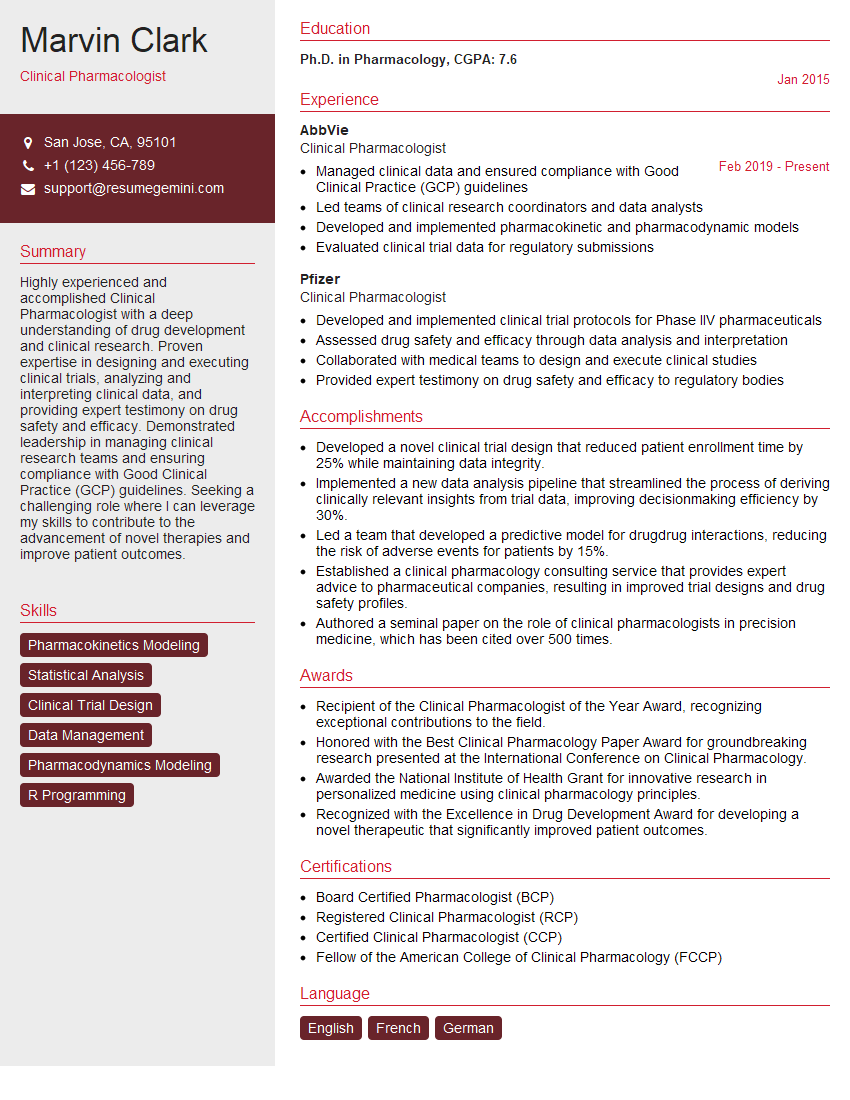
Acing the interview is crucial, but landing one requires a compelling resume that gets you noticed. Crafting a professional document that highlights your skills and experience is the first step toward interview success. ResumeGemini can help you build a standout resume that gets you called in for that dream job.






Essential Interview Questions For Clinical Pharmacologist
1. What is the role of a clinical pharmacologist in drug development?
- Responsible for designing and conducting clinical trials to evaluate the safety and efficacy of new drugs.
- Interpreting clinical data and making recommendations regarding drug dosing, administration, and potential adverse effects.
2. Describe the different phases of clinical trials and the key objectives of each phase.
Phase I
- Evaluate safety and tolerability in a small number of healthy volunteers.
- Determine the maximum tolerated dose and identify common adverse effects.
Phase II
- Assess efficacy in a larger group of patients with the target disease.
- Establish the recommended dose range and gather more safety data.
Phase III
- Confirm efficacy and safety in a large-scale trial.
- Compare the new drug to existing treatments or placebo.
3. What are the ethical considerations involved in conducting clinical trials?
- Ensure informed consent from all participants.
- Minimize risks to participants and protect their privacy.
- Conduct trials in accordance with Good Clinical Practice (GCP) guidelines.
4. Describe the process of pharmacokinetic (PK) modeling and its applications in drug development.
- Develop mathematical models to describe drug absorption, distribution, metabolism, and excretion (ADME).
- Predict drug concentrations in the body and optimize dosing regimens.
- Identify factors that may affect drug PK, such as age, weight, and disease state.
5. What are the challenges in translating preclinical findings to clinical outcomes?
- Animal models may not accurately predict human responses.
- Differences in drug metabolism and clearance between species.
- Variability in patient characteristics and disease severity.
6. Describe the role of biomarkers in clinical pharmacology.
- Identify individuals who are more likely to respond to a particular treatment.
- Monitor disease progression and evaluate treatment efficacy.
- Predict adverse drug effects and optimize dosing.
7. What are the regulatory requirements for clinical pharmacology studies?
- Adherence to Good Clinical Practice guidelines.
- Submission of Investigational New Drug (IND) applications.
- Approval from Institutional Review Boards and ethics committees.
8. Describe the challenges of working in a multidisciplinary drug development team.
- Effective communication among team members from different backgrounds (medical, scientific, regulatory).
- Managing diverse opinions and perspectives.
- Meeting deadlines and achieving consensus on critical decisions.
9. What are the emerging trends in clinical pharmacology?
- Use of advanced statistical methods and machine learning.
- Integration of real-world data into clinical trials.
- Development of personalized medicine approaches based on genetic and phenotypic data.
10. How do you stay up-to-date with the latest advancements in clinical pharmacology?
- Attend scientific conferences and workshops.
- Read peer-reviewed journals and research articles.
- Collaborate with experts in the field.
11. Describe a challenging clinical pharmacology project you have worked on and how you overcame the obstacles.
Give a specific example of a project where you faced obstacles and explain how you used your technical skills and problem-solving abilities to overcome them, highlighting any innovative approaches or techniques you employed.
12. How would you approach a situation where you need to communicate complex clinical pharmacology concepts to non-technical stakeholders?
Explain your strategy for simplifying and conveying technical information to individuals with diverse backgrounds while ensuring understanding and informed decision-making. Provide examples of effective communication techniques or tools you have used in similar situations.
13. What are your strengths and weaknesses as a clinical pharmacologist?
- Highlight your technical expertise, analytical skills, and experience with clinical trial design and execution.
- Acknowledge areas where you are actively seeking to improve or gain additional knowledge.
14. What is your understanding of ethical considerations in clinical pharmacology and how do you ensure compliance with ethical guidelines?
Explain your knowledge of ethical principles, such as informed consent, privacy, and minimizing risks to participants. Describe how you integrate ethical considerations into your work, including any specific protocols or best practices you follow.
15. How do you stay informed about the latest advancements and research in the field of clinical pharmacology?
- Describe your strategies for keeping up with scientific literature, attending conferences, and engaging in professional development opportunities.
- Discuss how you incorporate new knowledge and techniques into your work.
Interviewers often ask about specific skills and experiences. With ResumeGemini‘s customizable templates, you can tailor your resume to showcase the skills most relevant to the position, making a powerful first impression. Also check out Resume Template specially tailored for Clinical Pharmacologist.
Career Expert Tips:
- Ace those interviews! Prepare effectively by reviewing the Top 50 Most Common Interview Questions on ResumeGemini.
- Navigate your job search with confidence! Explore a wide range of Career Tips on ResumeGemini. Learn about common challenges and recommendations to overcome them.
- Craft the perfect resume! Master the Art of Resume Writing with ResumeGemini’s guide. Showcase your unique qualifications and achievements effectively.
- Great Savings With New Year Deals and Discounts! In 2025, boost your job search and build your dream resume with ResumeGemini’s ATS optimized templates.
Researching the company and tailoring your answers is essential. Once you have a clear understanding of the Clinical Pharmacologist‘s requirements, you can use ResumeGemini to adjust your resume to perfectly match the job description.
Key Job Responsibilities
Clinical Pharmacologists play a vital role in the development and evaluation of new drugs and therapies. Their key job responsibilities include:
1. Drug Discovery and Development
Involved in the early stages of drug discovery by identifying potential new drug targets and evaluating the safety and efficacy of new drug candidates.
- Conducting preclinical studies to assess drug metabolism, pharmacokinetics, and toxicity.
- Designing and conducting clinical trials to evaluate the safety and efficacy of new drugs in humans.
2. Drug Safety and Efficacy Monitoring
Monitoring the safety and efficacy of drugs after they have been approved for use.
- Reviewing clinical trial data and adverse event reports to identify any potential safety concerns.
- Conducting post-marketing studies to further evaluate the safety and efficacy of drugs.
3. Data Analysis and Interpretation
Analyzing and interpreting clinical trial data to assess the safety and efficacy of new drugs.
- Using statistical methods to analyze clinical trial data and identify trends and patterns.
- Writing scientific reports and presentations to communicate the results of clinical trials.
4. Regulatory Affairs
Ensuring that drugs are developed and marketed in compliance with regulatory requirements.
- Interacting with regulatory agencies such as the FDA to obtain approval for new drugs.
- Preparing and submitting regulatory documents such as Investigational New Drug (IND) applications and New Drug Applications (NDAs).
Interview Tips
To ace an interview for a Clinical Pharmacologist position, it is important to prepare thoroughly and demonstrate your knowledge and skills. Here are some interview tips and hacks:
1. Research the Company and Position
Familiarize yourself with the company’s mission and values, as well as the specific requirements of the Clinical Pharmacologist position. This will help you answer questions intelligently and show that you are genuinely interested in the opportunity.
- Visit the company’s website and read its annual report.
- Review the job description and identify the key qualifications and skills required.
2. Prepare for Behavioral Interview Questions
Behavioral interview questions are designed to assess your past performance and how you would behave in specific situations. Prepare for common behavioral interview questions by recalling specific examples from your experience that demonstrate your relevant skills.
- Use the STAR method (Situation, Task, Action, Result) to structure your answers.
- Focus on highlighting your accomplishments and how you added value to your previous roles.
3. Practice Your Technical Skills
Clinical Pharmacologists are expected to have a strong understanding of pharmacology, statistics, and clinical trial design. Be prepared to answer questions that test your knowledge in these areas.
- Review your notes from your pharmacology, statistics, and clinical trial design courses.
- Practice solving problems related to drug metabolism, pharmacokinetics, and statistical analysis.
4. Be Enthusiastic and Confident
Enthusiasm and confidence are essential for success in any interview. Show the interviewer that you are passionate about clinical pharmacology and that you are confident in your abilities. Maintain eye contact, speak clearly, and be positive.
- Dress professionally and arrive on time for your interview.
- Be prepared to talk about your accomplishments and how you can contribute to the company.
5. Ask Thoughtful Questions
Asking thoughtful questions at the end of the interview shows that you are engaged and interested in the opportunity. Prepare a few questions that are specific to the company and the position.
- Ask about the company’s culture and values.
- Ask about the specific projects that you would be working on.
Next Step:
Armed with this knowledge, you’re now well-equipped to tackle the Clinical Pharmacologist interview with confidence. Remember, a well-crafted resume is your first impression. Take the time to tailor your resume to highlight your relevant skills and experiences. And don’t forget to practice your answers to common interview questions. With a little preparation, you’ll be on your way to landing your dream job. So what are you waiting for? Start building your resume and start applying! Build an amazing resume with ResumeGemini.