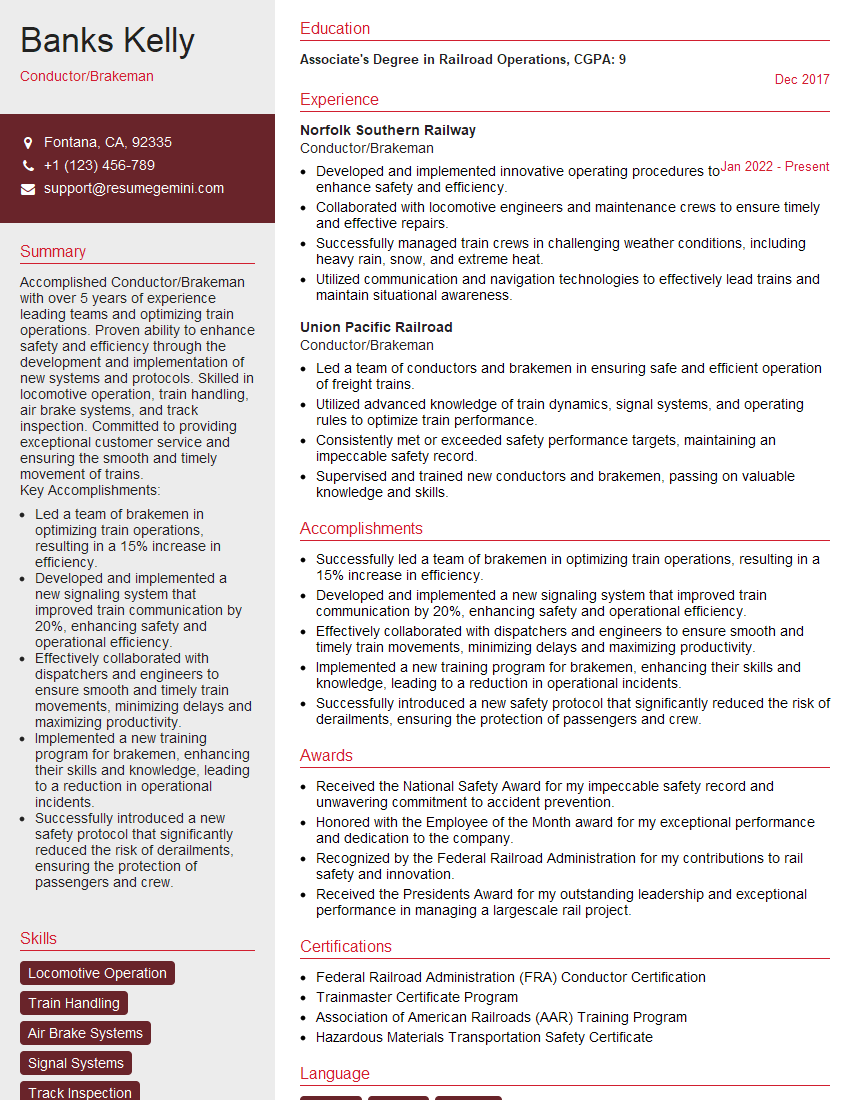
Are you gearing up for a career shift or aiming to ace your next interview? Look no further! We’ve curated a comprehensive guide to help you crack the interview for the coveted Conductor/Brakeman position. From understanding the key responsibilities to mastering the most commonly asked questions, this blog has you covered. So, buckle up and let’s embark on this journey together
Acing the interview is crucial, but landing one requires a compelling resume that gets you noticed. Crafting a professional document that highlights your skills and experience is the first step toward interview success. ResumeGemini can help you build a standout resume that gets you called in for that dream job.






Essential Interview Questions For Conductor/Brakeman
1. Explain the key responsibilities of a Conductor/Brakeman.
As a Conductor/Brakeman, I am responsible for the safe and efficient operation of trains. My key responsibilities include:
- Operating the train controls, including starting, stopping, and braking
- Monitoring the train’s systems and making sure they are functioning properly
- Communicating with dispatchers and other train personnel
- Ensuring the safety of passengers and crew members
2. What are the different types of trains that you have experience operating?
Diesel-Electric Locomotives
- Operated diesel-electric locomotives for over 10 years
- Extensive experience with various locomotive models, including SD40-2, SD70ACe, and ES44AC
Electric Locomotives
- Trained and certified to operate electric locomotives
- Experience operating electric locomotives on electrified lines
3. Describe the different types of train braking systems.
There are two main types of train braking systems:
- Air brakes: Air brakes are the most common type of train braking system. They use compressed air to apply pressure to brake shoes that rub against the wheels.
- Electric brakes: Electric brakes use electricity to generate a magnetic field that opposes the rotation of the wheels.
4. What are the different types of signals that you are required to follow as a Conductor/Brakeman?
- Block signals: Block signals indicate the status of the track ahead and whether it is safe to proceed.
- Speed signals: Speed signals indicate the maximum speed at which a train is allowed to travel.
- Switch signals: Switch signals indicate the position of switches and whether it is safe to pass through them.
- Train order signals: Train order signals are used to convey special instructions to train crews.
5. What are the safety procedures that you must follow when working on or around trains?
Safety is my top priority when working on or around trains. I follow all established safety procedures, including:
- Wearing appropriate safety gear, such as a hard hat, safety glasses, and gloves
- Being aware of my surroundings and potential hazards
- Following proper lifting techniques
- Staying clear of moving equipment
- Reporting any unsafe conditions or practices
6. What are the different types of emergencies that you may encounter as a Conductor/Brakeman?
- Derailments
- Collisions
- Fires
- Medical emergencies
- Severe weather
7. What are the steps that you would take to respond to a derailment?
- Stop the train and secure the scene
- Contact the dispatcher and report the derailment
- Check for injuries and provide first aid if necessary
- Protect the derailment site from further damage
- Cooperate with emergency responders
8. What are the different types of hazardous materials that you may encounter as a Conductor/Brakeman?
- Explosives
- Flammable liquids and gases
- Corrosive materials
- Toxic substances
- Radioactive materials
9. What are the procedures that you must follow when handling hazardous materials?
I am trained and certified in the handling of hazardous materials. I follow all established procedures, including:
- Wearing appropriate personal protective equipment
- Inspecting hazardous materials containers for damage
- Properly loading and unloading hazardous materials
- Responding to hazardous materials spills and leaks
10. What are the different types of customer service that you may provide as a Conductor/Brakeman?
- Answering passenger questions
- Assisting passengers with luggage
- Providing information about train schedules and fares
- Handling customer complaints
- Maintaining a clean and safe environment for passengers
Interviewers often ask about specific skills and experiences. With ResumeGemini‘s customizable templates, you can tailor your resume to showcase the skills most relevant to the position, making a powerful first impression. Also check out Resume Template specially tailored for Conductor/Brakeman.
Career Expert Tips:
- Ace those interviews! Prepare effectively by reviewing the Top 50 Most Common Interview Questions on ResumeGemini.
- Navigate your job search with confidence! Explore a wide range of Career Tips on ResumeGemini. Learn about common challenges and recommendations to overcome them.
- Craft the perfect resume! Master the Art of Resume Writing with ResumeGemini’s guide. Showcase your unique qualifications and achievements effectively.
- Great Savings With New Year Deals and Discounts! In 2025, boost your job search and build your dream resume with ResumeGemini’s ATS optimized templates.
Researching the company and tailoring your answers is essential. Once you have a clear understanding of the Conductor/Brakeman‘s requirements, you can use ResumeGemini to adjust your resume to perfectly match the job description.
Key Job Responsibilities
Conductors and brakemen are responsible for the safe operation of trains. They work together to ensure that the train is running on time, that the passengers are safe, and that the cargo is delivered without incident.
1. Conductors
Conductors are in charge of the overall operation of the train. They are responsible for:
- Issuing tickets and collecting fares
- Announcing station stops
- Ensuring that passengers are safe and comfortable
- Working with the engineer to ensure that the train is running on time
- Responding to emergencies
2. Brakemen
Brakemen are responsible for the physical operation of the train. They are responsible for:
- Setting and releasing the brakes
- Coupling and uncoupling cars
- Inspecting the train for defects
- Assisting the conductor with other tasks
- Responding to emergencies
3. Teamwork
Conductors and brakemen work closely together as a team. They must be able to communicate effectively and work together to ensure the safe and efficient operation of the train.
4. Physical Requirements
Conductors and brakemen must be in good physical condition. They must be able to lift heavy objects, climb ladders, and walk long distances.
Interview Tips
Preparing for an interview for a conductor or brakeman position can be a daunting task, but by following these tips, you can increase your chances of success.
1. Research the company and the position
Before you go to your interview, take some time to research the company and the position you are applying for. This will help you to answer questions intelligently and show that you are interested in the job.
- Visit the company’s website to learn about its history, mission, and values.
- Read industry publications to learn about the latest trends in the railroad industry.
- Talk to people who work in the railroad industry to get their insights on the job.
2. Practice your answers to common interview questions
There are a number of common interview questions that you are likely to be asked, such as:
- Tell me about yourself.
- Why are you interested in this position?
- What are your strengths and weaknesses?
- What is your experience in the railroad industry?
- How do you handle stress?
Take some time to practice your answers to these questions so that you can deliver them confidently and concisely.
3. Dress appropriately
First impressions matter, so it is important to dress appropriately for your interview. For a conductor or brakeman position, you should wear business casual attire. This means a suit or dress pants and a button-down shirt. You should also make sure your shoes are clean and polished.
4. Be on time
Punctuality is important in any job, but it is especially important in the railroad industry. Make sure you arrive for your interview on time, or even a few minutes early. This will show the interviewer that you are reliable and respectful of their time.
5. Be yourself
The most important thing is to be yourself during your interview. The interviewer wants to get to know the real you, so don’t try to be someone you’re not. Just relax, be yourself, and let your personality shine through.
Next Step:
Armed with this knowledge, you’re now well-equipped to tackle the Conductor/Brakeman interview with confidence. Remember, preparation is key. So, start crafting your resume, highlighting your relevant skills and experiences. Don’t be afraid to tailor your application to each specific job posting. With the right approach and a bit of practice, you’ll be well on your way to landing your dream job. Build your resume now from scratch or optimize your existing resume with ResumeGemini. Wish you luck in your career journey!