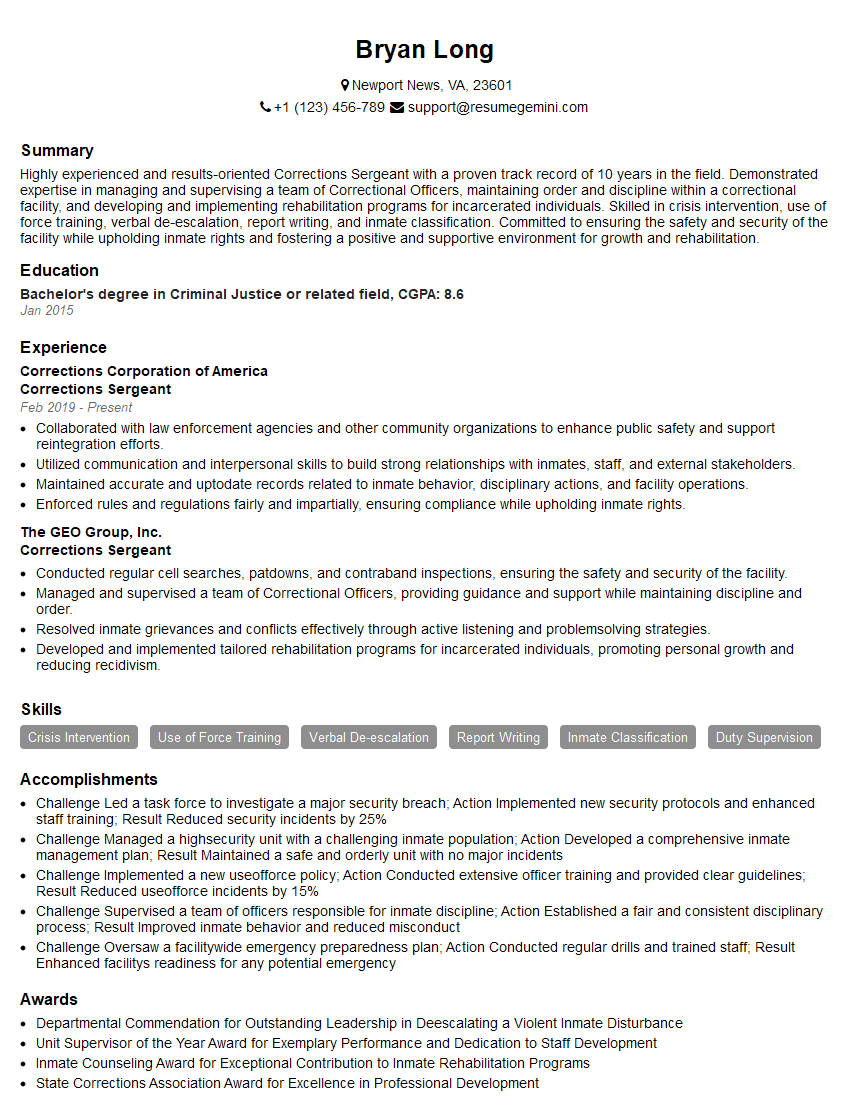
Are you gearing up for a career in Corrections Sergeant? Feeling nervous about the interview questions that might come your way? Don’t worry, you’re in the right place. In this blog post, we’ll dive deep into the most common interview questions for Corrections Sergeant and provide you with expert-backed answers. We’ll also explore the key responsibilities of this role so you can tailor your responses to showcase your perfect fit.
Acing the interview is crucial, but landing one requires a compelling resume that gets you noticed. Crafting a professional document that highlights your skills and experience is the first step toward interview success. ResumeGemini can help you build a standout resume that gets you called in for that dream job.






Essential Interview Questions For Corrections Sergeant
1. Describe the key performance indicators (KPIs) you would track and monitor as a Corrections Sergeant?
The KPIs I would track and monitor as a Corrections Sergeant include:
- Inmate discipline and conduct
- Security and safety of the facility
- Staff morale and performance
- Cost-effectiveness of the operation
- Compliance with all applicable laws and regulations
2. How would you ensure that your staff is properly trained and equipped to handle the challenges of working in a correctional facility?
Staff Training
- Conduct regular training sessions on topics such as safety procedures, inmate management, and de-escalation techniques.
- Provide opportunities for staff to participate in specialized training programs, such as firearms training or crisis intervention.
- Establish a system for tracking and documenting staff training.
Staff Equipment
- Ensure that staff have access to the necessary equipment, such as protective gear, communication devices, and restraint devices.
- Inspect and maintain equipment regularly to ensure that it is in good working order.
- Provide training on the proper use of equipment.
3. What is your approach to maintaining order and discipline within a correctional facility?
My approach to maintaining order and discipline within a correctional facility includes:
- Establishing clear and concise rules and regulations.
- Enforcing rules and regulations consistently and fairly.
- Providing inmates with opportunities to earn privileges and rewards for good behavior.
- Utilizing a graduated system of sanctions for rule violations.
- Working closely with inmates to resolve issues and address concerns.
4. How would you handle a situation where an inmate is being disruptive or aggressive?
If an inmate is being disruptive or aggressive, I would:
- Remain calm and assess the situation.
- Attempt to de-escalate the situation by talking to the inmate and trying to understand their concerns.
- If de-escalation is not possible, I would use force only as a last resort and in accordance with established policies and procedures.
- After the situation has been resolved, I would document the incident and follow up with the inmate to address any underlying issues.
5. How would you work with other members of the corrections team to ensure the smooth and efficient operation of the facility?
To ensure the smooth and efficient operation of the facility, I would:
- Establish clear lines of communication and collaborate with other members of the corrections team.
- Share information and resources with other units and departments.
- Provide support and assistance to other staff members when needed.
- Participate in team meetings and workgroups to discuss and resolve issues.
6. Describe your experience in supervising and evaluating staff members.
In my previous role as a Corrections Sergeant, I was responsible for supervising and evaluating a team of 10 correctional officers. My responsibilities included:
- Providing staff with clear instructions and expectations.
- Monitoring staff performance and providing feedback.
- Conducting regular performance evaluations.
- Recognizing and rewarding staff for their accomplishments.
- Addressing and disciplining staff members for performance issues.
7. How would you stay up-to-date on changes in laws and regulations governing correctional facilities?
To stay up-to-date on changes in laws and regulations governing correctional facilities, I would:
- Attend training seminars and workshops.
- Read industry publications and articles.
- Network with other professionals in the field.
- Review legal updates provided by the department or agency.
8. What is your understanding of the Americans with Disabilities Act (ADA) and how does it apply to correctional facilities?
The Americans with Disabilities Act (ADA) is a federal law that prohibits discrimination against individuals with disabilities in employment, public accommodations, transportation, and telecommunications. In correctional facilities, the ADA applies to all aspects of operations, including inmate housing, programming, and medical care. I would ensure that all staff are trained on the ADA and that all inmates are treated fairly and with respect, regardless of their disability status.
9. How would you handle a situation where an inmate has a grievance?
If an inmate has a grievance, I would:
- Listen to the inmate’s complaint and try to understand their concerns.
- Investigate the grievance thoroughly and gather all relevant information.
- Make a decision on the grievance and provide the inmate with a written response.
- Follow up with the inmate to ensure that their grievance has been resolved.
10. What are your thoughts on the use of technology in correctional facilities?
I believe that technology can be a valuable tool in correctional facilities. It can be used to improve safety and security, streamline operations, and provide inmates with access to education and rehabilitation programs. However, it is important to use technology in a responsible and ethical way. I would work with staff and inmates to develop clear policies and procedures for the use of technology.
For example, I would consider implementing the following technologies in a correctional facility:
- Body-worn cameras for staff
- Electronic monitoring systems for inmates
- Distance learning programs for inmates
- Electronic health records systems
- Automated gate systems
Interviewers often ask about specific skills and experiences. With ResumeGemini‘s customizable templates, you can tailor your resume to showcase the skills most relevant to the position, making a powerful first impression. Also check out Resume Template specially tailored for Corrections Sergeant.
Career Expert Tips:
- Ace those interviews! Prepare effectively by reviewing the Top 50 Most Common Interview Questions on ResumeGemini.
- Navigate your job search with confidence! Explore a wide range of Career Tips on ResumeGemini. Learn about common challenges and recommendations to overcome them.
- Craft the perfect resume! Master the Art of Resume Writing with ResumeGemini’s guide. Showcase your unique qualifications and achievements effectively.
- Great Savings With New Year Deals and Discounts! In 2025, boost your job search and build your dream resume with ResumeGemini’s ATS optimized templates.
Researching the company and tailoring your answers is essential. Once you have a clear understanding of the Corrections Sergeant‘s requirements, you can use ResumeGemini to adjust your resume to perfectly match the job description.
Key Job Responsibilities
As a Corrections Sergeant, your primary responsibilities encompass a diverse range of duties within a correctional facility.
1. Supervising Inmates and Staff
You will be tasked with maintaining order and discipline among inmates, ensuring their safety and well-being while also supervising and guiding correctional officers.
- Conduct regular cell inspections and inmate counts to ensure security.
- Coordinate and oversee inmate work assignments and educational programs.
2. Enforcing Policies and Procedures
You will be responsible for enforcing all applicable laws, regulations, and policies within the facility, ensuring compliance and adherence to established standards.
- Investigate incidents and write reports to document any violations or misconduct.
- Conduct searches and security screenings to prevent the introduction of contraband.
3. Maintaining Security and Control
You will play a vital role in maintaining the security and control of the facility, ensuring the safety of inmates, staff, and visitors.
- Monitor security cameras and respond to any alarms or incidents.
- Coordinate lockdown procedures in the event of emergencies or disturbances.
4. Managing Inmate Records and Programs
You will be responsible for maintaining accurate inmate records, monitoring their progress, and coordinating various programs such as rehabilitation and release planning.
- Review and update inmate files, including disciplinary records and classification information.
- Facilitate and oversee inmate grievance procedures to resolve any issues or concerns.
Interview Tips
Preparing for a Corrections Sergeant interview requires a combination of research, practice, and professional conduct.
1. Research the Facility and the Position
Thoroughly research the correctional facility where you are applying, its mission, policies, and security protocols. Familiarize yourself with the specific responsibilities and expectations of the Corrections Sergeant position.
- Visit the facility’s website and read any available reports or publications.
- Network with individuals who have worked or are currently employed at the facility.
2. Be Clear and Concise in Your Responses
When answering interview questions, provide clear, concise, and relevant responses. Avoid using vague or general statements. Focus on demonstrating your specific skills, experience, and knowledge related to the job.
- Use the STAR method (Situation, Task, Action, Result) to structure your answers and provide specific examples.
- Quantify your accomplishments whenever possible to demonstrate the impact of your work.
3. Dress Professionally and Maintain a Respectful Demeanor
First impressions matter. Dress appropriately for the interview, maintaining a professional and respectful demeanor throughout the interaction. Be polite and courteous to all staff and interviewers.
- Wear a suit or business attire in neutral colors such as black, navy, or gray.
- Arrive on time and greet interviewers with a firm handshake and eye contact.
4. Prepare Questions to Ask the Interviewers
Preparing thoughtful questions to ask the interviewers demonstrates your interest in the position and the facility. It also provides you with an opportunity to gather additional information to make an informed decision.
- Ask about the facility’s current challenges and priorities.
- Inquire about opportunities for professional development and advancement.
Next Step:
Armed with this knowledge, you’re now well-equipped to tackle the Corrections Sergeant interview with confidence. Remember, a well-crafted resume is your first impression. Take the time to tailor your resume to highlight your relevant skills and experiences. And don’t forget to practice your answers to common interview questions. With a little preparation, you’ll be on your way to landing your dream job. So what are you waiting for? Start building your resume and start applying! Build an amazing resume with ResumeGemini.